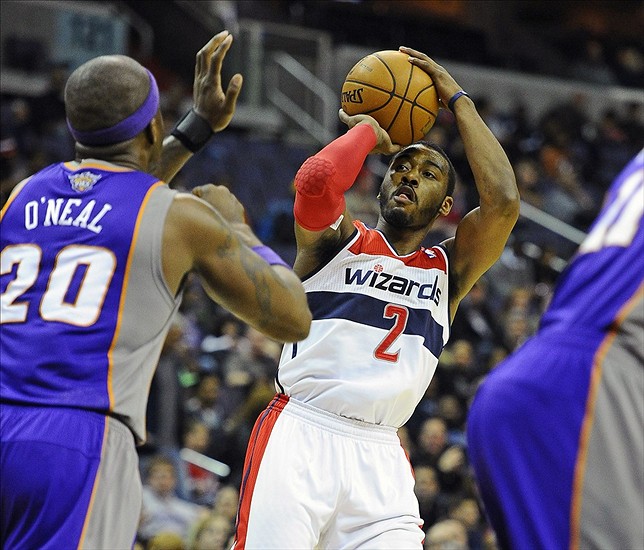
Projection: Wizards Will Win 43 and Make Playoffs This Season

Will John Wall make The Leap to All-Star status this season?

NBA preseason doesn’t mean an awful lot. It’s perhaps a bit more important for a team like the Wizards — a bad team trying to get into the playoffs for the first time in awhile. But even then the information it provides isn’t all that…informative.

The regular season Wizards will get a significant boost from the preseason Wizards because of their move last Friday to acquire center Marcin Gortat. The veteran takes the spot vacated by the injured Emeka Okafor, who was sent to Phoenix (along with a first round pick).

I’ll get to my projection/prediction for the season in a moment, but first, a look at the preseason numbers. I’m not wasting time with the team-level stuff. The Wizards were terrible on offense and excellent on defense during the exhibition games. That’s theoretically a way to win games — a 68-65 win counts as much in the standings as one that’s 114-111. Still, being good on both ends would be preferable. If there’s any takeaway from the team-level preseason numbers it’s that the team was similar to the one they had last year (not surprising considering their few personnel changes), which was characterized by terrible offense and excellent defense.

Looking at the individuals, I’d conclude that most of the roster underwhelmed. Bradley Beal and Trevor Booker played well; Nene was okay, but not performing at the level he’s maintained throughout his career; and the rest…pretty bad. John Wall, the guy they’re building around, was awful. He shot badly from everywhere (.415 from two-point range; .118 from three-point range; just .727 from the free throw line), and committing 4.4 turnovers per 36 minutes.

Below is a table showing an “estimated” Player Production Average (PPA) for each player. I say “estimated” because PPA is based on league average season by season. That average is fairly consistent year to year, but there are fluctuations. Since it’s preseason, there isn’t enough data to calculate a true league “average” so I use an approximation of league average. Also, full PPA adjusts for pace, accounts for individual defense and includes a “degree of difficulty” factor — none of which I’m including in looking at the preseason numbers. In PPA, average is 100, higher is better, and replacement level is 45.

Player G MPG ePPA PPA
Bradley Beal 7 30.3 146 92
Trevor Booker 6 20.5 144 96
Nene 5 22.2 118 119
Glen Rice 6 14.0 70
Jan Vesely 7 20.3 67 19
Trevor Ariza 7 23.4 52 108
Martell Webster 6 23.5 49 114
Al Harrington 5 16.6 43  81
Eric Maynor 6 21.0 38 32
Kevin Seraphin 7 25.9 27 22
Garrett Temple 5 15.6 25 60
John Wall 7 28.1 12 139

That last column is the player’s PPA in 2012-13. Except for Al Harrington, who missed most of last season with a staph infection.

Again, don’t read too much into the preseason numbers. The play of Beal and Booker are hopeful signs. Also good to see Jan Vesely doing something positive on the floor — he actually led the team in rebounding in preseason.

I’m not overly worried about Wall’s poor play, although it would have been nice to see him pick up where he left off at the end of last season.

If you’re thinking you’ll see better play from Eric Maynor once the season begins, stop it. At best the Wizards are likely get replacement level production from him.

Other potential cautions: Martell Webster and Kevin Seraphin were bad. Webster’s play is potentially worrisome because he hasn’t established himself to the point where his production level is a given. Last year, he had a terrific preseason, and it translated into a solid regular season. This year? Hard to say.

Seraphin’s preseason performance, is unfortunately matches up with most of the data on him. He was inefficient, turnover prone and rebounded like a SF.

Ariza’s preseason stats don’t mean a whole lot. He’s well-established and fairly consistent. He’ll provide the team with another season of stellar defense and meh offense, which will grade out to about average.

2013-14 Projection

Given the team’s offseason moves, it was clear that the team’s fortunes this season rested on the health of three players: Wall, Nene and Okafor. Now that they’ve traded for Gortat, their fortunes rest on the health of three players: Wall, Nene and Gortat. They don’t have quality depth behind any of these three.

While my projection relies on statistical data, there’s a fair amount of guesswork in divvying up minutes. The table below shows my estimates of games played, minutes played, and PPA. The estimates for games and minutes are a combination of player history, analysis of similar players in the NBA record, and logic. PPA estimates incorporate each player’s individual performance history, analysis of historical similars, and aging effects.

POS  Player  G MPG LS 2013-14
PG John Wall 66 35.8 139 160
PG Eric Maynor 75 13.0 32 34
G Garrett Temple 60 10.9 60 45
SG Glen Rice 42 11.4 75
SG Bradley Beal 68 34.0 92 108
SF Otto Porter 41 20.0 75
SF Trevor Ariza 61 29.6 108 105
SF Martell Webster 60 24.6 114 97
PF Nene 62 29.1 119 146
PF Chris Singleton 34 10.0 24 43
PF Jan Veseley 60 10.0 19 51
PF Al Harrington 66 18.0 81 78
PF Trevor Booker 58 19.7 96 106
C Marcin Gortat 74 29.0 125 146
C Kevin Seraphin 69 18.2 22 46

LS = last season, except for Harrington.

My approach projects Wall making The Leap to All-Star level production, whether he makes the team or not. It also projects significant improvement from Beal, although it suggests he’s another year from making The Leap himself. I’m also expecting bounce-back years in per minute production from Nene and Gortat.

I’m expecting regression from Webster both in terms of overall production and in health.

I crunched the numbers on several different scenarios. In a best-case situation that assumes near perfect health, the Wizards could win 48 games. My worst case projection has them at 34 wins.

Final prediction: 43-39, and the Wizards get the 7th seed in the playoffs.

For those who are curious, here’s how the projections looked with the various possibilities between Okafor, Gortat and neither.

  • Current roster (with Gortat): 43-39
  • With healthy Okafor: 42-40
  • Without Gortat or Okafor (no trade): 38-44

How Can the Wizards Improve? Shoot Better

wall jumper

Writing at Grantland, Kirk Goldsberry introduced a new metric he dubbed “ShotScore.” Basically, the idea is to compare a player’s shooting from various locations on the floor to the league average from that spot. Effectively, it adds a degree of difficulty component to NBA shooting stats.

I could do without his strawman stuff about field goal percentage — the problems with FG% are why stat goobers switched to effective field goal percentage, which accounts for the effect of the 3pt shot — but Goldsberry’s work is both good and flawed. Want a more in-depth look at what’s wrong with it, check out Tom Ziller’s piece. To summarize: ShotScore is way complex, and it rewards players for shooting better than average from anywhere on the floor — even if it’s just a low-percentage shot, period. Also, it doesn’t account for a valuable way players produce points: shooting free throws.

Let me illustrate. Let’s say that the league average on long two-point attempts is 40%. If a player came along and shot nothing but long twos (and lots of them), and shot 45%, ShotScore would say that player was a good shooter — +100 points compared to the league average taking those same shots.

Except, that player would actually be taking a low value shot. The league’s eFG (which accounts for the 3pt shot) was .496 last season, which means that given 1,000 FGA, we’d expect the league to produce (on average) 992 points — 92 more than the “good” shooter.

To further illustrate, let’s say Mr. Long Two has a teammate who by some weird design shoots only three-pointers (and lots of them), but shoots just league average. Archaic FG% would say Long Two is the better shooter, .450 to .359. ShotScore would agree. Long Two produced 100 points more than the league average shooter would have produced on the same number of long two-point attempts.

Both would be wrong. Because that average three-point shooter would have produced 992 points on his 1,000 FGA — 92 points more than the “better” shooter taking long two-point attempts. Any coach with a bit of sense would want an average 3pt shooter over a “better than average” shooter on long twos.

In his article, Ziller introduces some simpler metrics that actually do a better job of determining which players shoot the best. His “simpler” approach uses a bit of logic and stats that are already publicly available. I’m not going to waste time explaining — if you’re interested in the details, click over to Ziller’s article.

Using my spreadsheets, I pointed Ziller’s formulas at the Wizards last season. And, it’s not a pretty sight. Using Ziller’s “Extra Field Points” metric, only three Wizards last season were a net positive: Martell Webster, Trevor Ariza and Jan Vesely.

Now, before you throw out the stat because of Vesely, keep in mind that he had an efg of .500 last season — league average was .496. Given Vesely’s number of shot attempts, the league would have scored 113 points — Vesely generated 114 points off his field goal attempts, a net of +1.

Here’s a quick table from last season:

PLAYER Extra Field Points
Martell Webster 70
Trevor Ariza 4
Jan Vesely 1
Cartier Martin 0
Trevor Booker -2
Shelvin Mack -4
Jason Collins -4
Earl Barron -11
Jannero Pargo -13
Shaun Livingston -18
A.J. Price -18
Nene Hilario -20
Garrett Temple -20
Jordan Crawford -23
Emeka Okafor -26
Bradley Beal -27
Chris Singleton -48
Kevin Seraphin -51
John Wall -70

This table tells us why the Wizards lost so many games last season. Given the same number of field goal attempts, the league would have produced 6,645 points from the field. The Wizards produced 6,365 — a deficit of 280 points. The team’s overall scoring deficit last season: 208. At the bottom of the list is a stark reminder of what John Wall’s poor shooting AND poor shot selection costs the team.

Washington was better from the free throw line, but still below the league standard. For the season, the team’s free throw shooting cost them 36 points. That works out to about 0.4 points per game — one extra loss over an 82-game schedule.

Here’s a look at the team’s free throw shooting:

PLAYER Extra FT Points
Martell Webster 19
John Wall 16
Jordan Crawford 7
Trevor Ariza 6
Bradley Beal 5
Shaun Livingston 4
A.J. Price 2
Jason Collins 0
Jannero Pargo 0
Shelvin Mack -1
Cartier Martin -1
Earl Barron -2
Garrett Temple -2
Kevin Seraphin -5
Nene Hilario -7
Chris Singleton -13
Trevor Booker -14
Jan Vesely -17
Emeka Okafor -35

This table shows Wall regaining some ground from the FT line that he gives up with his bad shooting from the floor. Some, but not all.

One last table looking strictly at shooting — this one combining extra field goal points (EFPT) with extra free throw points (EFTP) into a unified Extra Points (EPTS). Hmm, I guess if we’re talking Wizards, it could “in-EPTS” couldn’t it?

PLAYER EFGP EFTP EPTS
Martell Webster 70 19 88
Trevor Ariza 4 6 11
Cartier Martin 0 -1 -1
Jason Collins -4 0 -3
Shelvin Mack -4 -1 -4
Jannero Pargo -13 0 -12
Earl Barron -11 -2 -12
Shaun Livingston -18 4 -14
A.J. Price -18 2 -16
Jordan Crawford -23 7 -16
Jan Vesely 1 -17 -17
Trevor Booker -2 -14 -17
Bradley Beal -27 5 -22
Garrett Temple -20 -2 -22
Nene Hilario -20 -7 -26
John Wall -70 16 -54
Kevin Seraphin -51 -5 -56
Emeka Okafor -26 -35 -61
Chris Singleton -48 -13 -61

The numbers may not add exactly because of rounding, but it’s good enough for my purposes today. Note that only two players were net positives when they shot the ball: Webster and Ariza — both of whom shot less than their inaccurate teammates.

Wall, for example, led the team in per minute true shooting attempts, but was the team’s fourth worst shooter overall. Seraphin was third in usage (behind Wall and Jordan Crawford), and third worst shooting the ball. The team needs to either redistribute its shot attempts or get significant improvement from the guys pulling the trigger.

So, while all this is good, it’s still focused only on shooting. Players contribute in other ways offensively that show up in the box score — getting offensive boards, assisting, avoiding turnovers.

Using Ziller’s principle and my own revised version of Dean Oliver’s individual offensive rating formula (expressed as points produced per 100 individual possessions), I calculated an expected points produced based on the number of possessions a player used. So, finding Additional Points Produced (APTS) is EPP – PROD (that’s expected points produced minus points produced).

Let’s take Webster as our example. Last year, through FGA, FTA, turnovers, offensive rebounds and assists, Webster used 681 possessions. The league’s offensive rating was 105.8 points per 100 possessions, so the “expected points produced” for those 681 possessions was 721. Webster produced 797, meaning that (with rounding) Webster produced 77 Additional Points.

Note: points produced is NOT the same thing as points scored. Points produced includes non-scoring contributions to the offense (offensive rebounds, assists, turnovers) and shares credit with teammates.

PLAYER APTS
Martell Webster 77
Trevor Booker 11
A.J. Price 1
John Wall 0
Jason Collins -3
Shelvin Mack -4
Shaun Livingston -11
Jannero Pargo -13
Earl Barron -14
Jan Vesely -14
Trevor Ariza -14
Nene Hilario -17
Cartier Martin -25
Bradley Beal -28
Garrett Temple -30
Jordan Crawford -36
Emeka Okafor -39
Chris Singleton -54
Kevin Seraphin -127

Unsurprisingly, Webster is still at the top. He shot the ball extremely well last season and committed few turnovers. But check out number four on the list — Wall. It’s a net zero, which means that the PG produced an average number of points given the possessions he used. What impresses me, however, is the value of his non-shooting contributions. Remember, Wall’s shooting from the floor was a net -70 points. His overall shooting (free throws and field goals combined) was a net -54. Even so, his overall impact was average. If he ever really learns how to shoot…

At the bottom of the list we see the heavy cost of Kevin Seraphin’s terrible shooting, few offensive boards, no assists, and abundant turnovers. Chris Singleton’s -54 is bizarrely impressive given the forward’s low usage and fairly low minutes.

Assuming they’re able to maintain the defense, the team must get better on offense to reach the playoffs. Some of that is possible (likely even) by individual improvement. Bradley Beal had a rough start to his rookie year, but was significantly more efficient as the season wore on. And he’s looked good in preseason.

Nene has long been one of the league’s more efficient offensive players, but hampered by injuries, he had his least efficient full season since he was a rookie — in 2002-03. Will Nene be able to get back to his career norms (offensive rating of about 112 vs. 103 last season), or was last year a sign of the inevitable age-related decline?

No matter how they do it, the Wizards must get better on offense if they hope to make the playoffs — especially with the possibility of an extended absence from defensive stalwart Emeka Okafor.