Projection: Wizards to Win 42

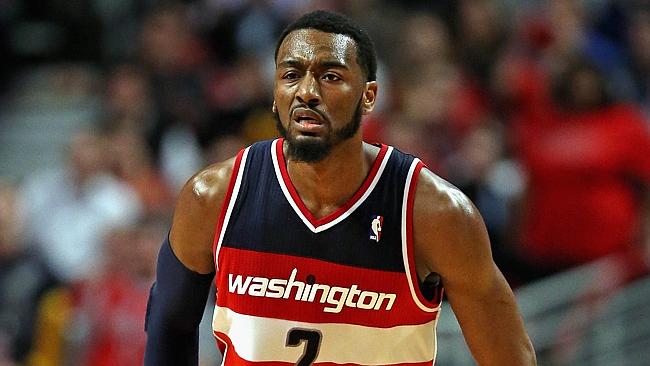
wall 02My 2015-16 Wizards preview is up at Vice Sports. I won’t steal my own thunder much, except to say that my projection approach says the Wizards will win 41-42 games this season. Not as encouraging as I’d hoped, and I had some mild surprises in the numbers — younger players not being predicted to improve as much as I’d have intuitively expected.

At any rate, please click over and give it a read at Vice.

The 2015 NBA Draft According to YODA

yoda2A few years back, I embarked on an effort to develop a statistically-based, objective method of evaluating prospects for the NBA draft. I make no claims that it’s perfect, but I’ve found the results decent enough, albeit not yet subjected to rigorous analysis. That’s coming.

When I get time.

Someday.

On the Wizards message board at RealGM, I referred to the effort a few times as “Ye Olde Draft Analyzer,” someone called it YODA, and the name stuck. YODA isn’t complex — at least not yet. It’s built on the Player Production Average metric I devised that credits players for things they do to help their teams win, and debits them for things they do that hurt the cause — each in proper proportion. YODA takes each player’s production (box score stats) then applies adjustments for position, age, team strength/level of competition, and objective measures of physical attributes (combine measurements and times).

In general, YODA likes efficient players who shoot well, rebound well, assist without committing turnovers, and generate blocks and steals without fouling too much. Being on a good team that plays a challenging schedule is also helpful, but not determinant — players like Kenneth Faried, Paul Millsap and Danny Granger had excellent ratings despite not playing for traditional powers.

YODA’s biggest limitation is international players. I haven’t had the time to research the numbers posted by prospects overseas, or to objectively assess the quality of the competition they face. Rather than guessing, I’ve chosen to leave them out of the process for now. Given the global nature of the draft, that’s a significant limitation, and it’s one I hope to fix for next year.

My belief on draft strategy is that the smart move is to pick the best player available, even if he doesn’t fit an immediate need. My approach is to first rate players in absolute terms, then group them into tiers of “about the same.” The idea is that when several players of “about the same” quality are available when your team’s pick comes, the team can pick the player they think best fits current needs. But, don’t reach into a lower tier for a perceived need. Just pick the better player and make another move down the road, if necessary.

Here’s this year’s draft in order of both absolute value according to YODA, and divided by tier.

TIER ONE

  • Karl-Anthony Towns, PF, Kentucky
  • Jahlil Okafor, C, Duke

TIER TWO

  • D’Angelo Russell, PG, Ohio State
  • Frank Kaminsky, C, Wisconsin

TIER THREE

  • Rondae Hollis-Jefferson, SF, Arizona
  • Kelly Oubre, SF, Kansas (EDITED position due to corrected measurements)
  • Delon Wright, PG, Utah
  • Cameron Payne, PG, Murray State
  • Bobby Portis, PF, Arkansas

TIER FOUR

  • Justise Winslow, SF, Duke
  • Myles Turner, C, Texas

TIER FIVE

  • Jerian Grant, PG, Notre Dame
  • Robert Upshaw, C, Washington
  • Willie Cauley-Stein, C, Kentucky
  • Sam Dekker, SF, Wisconsin
  • Devin Booker, SG, Kentucky

TIER SIX

  • Kevon Looney, PF, UCLA
  • Tyus Jones, PG, Duke
  • Cliff Alexander, PF/C, Kansas
  • Terry Rozier, G, Louisville
  • Justin Anderson, SF, Virginia
  • Stanley Johnson, SF, Arizona

TIER SEVEN

  • Briante Weber, PG, VCU
  • Bryce Jones, SG, Iowa State
  • Aaron White, PF, Iowa
  • Trey Lyles, PF, Kentucky
  • Montrezl Harrell, PF, Louisville

TIER EIGHT

  • Richaun Holmes, PF, Bowling Green
  • Pat Connaughton, SG, Notre Dame
  • R.J. Hunter, SG, Georgia State

In simple terms, the first round grades end with Tier Six. If things go more or less the way the mock drafts predict, the Wizards may be able to select a PG from Tier Three (Delon Wright), or perhaps a PF with potential like Looney.

While I fully expect the Wizards to sell or give away their second round pick, I think there may be some opportunities to get potentially useful players on inexpensive contracts with additional second rounders. I’d be interested in taking a guy like Cliff Alexander, or even Robert Upshaw (assuming he’s medically cleared to play despite a heart condition).

The consensus view on this year’s draft seems to be that it’s top heavy with a steep drop-off in talent after the lottery. I don’t really see that in the numbers. Towns and Okafor are a relatively weak top two, and the drop in ratings isn’t any greater than it is in most years. In other words, it looks like a draft.

Feel free to tweet me if you have questions about specific players. I’ve analyzed most seniors, and virtually all of the early entrants (except for the international players).

EDITED on June 30 when I was able to confirm that Kelly Oubre’s standing reach, as measured at the scouting combine, was incorrect. When the measurement was corrected, Oubre moved from Tier Four to Tier Three.

NBA Playoffs: PPA Update

Just numbers because…no time. This is through games played on May 10, 2015.

Player Production Average (PPA) is an overall rating stat I developed that credits players for things they do that help a team win and debits them for things that hurt the cause. PPA is pace neutral, accounts for defense, and includes a “degree of difficulty” factor based on the level of competition a player faces while on the floor. In PPA, 100 = average, higher is better and replacement level is 45.

Player POS Tm G MPG PPA
DeMarre Carroll SF ATL 9 35.2 212
Al Horford C ATL 9 32.2 182
Paul Millsap PF ATL 9 35.7 174
Kyle Korver SG ATL 9 38.2 147
Jeff Teague PG ATL 9 32.1 108
Shelvin Mack PG ATL 7 4.9 96
Mike Scott PF ATL 8 11.1 83
Mike Muscala PF ATL 3 8.0 66
Dennis Schroder PG ATL 9 17.9 63
Pero Antic PF ATL 9 16.7 34
Kent Bazemore SG ATL 9 17.7 32
John Jenkins SG ATL 2 2.5 -85
Elton Brand PF ATL 2 2.0 -212
Jae Crowder SF BOS 4 25.0 126
Jared Sullinger PF BOS 4 20.0 110
Tyler Zeller C BOS 4 22.5 85
Isaiah Thomas PG BOS 4 29.8 67
Marcus Smart PG BOS 4 22.5 57
Evan Turner SG BOS 4 29.5 50
Brandon Bass PF BOS 4 21.5 49
Avery Bradley SG BOS 4 33.3 23
Kelly Olynyk C BOS 4 13.3 20
Jonas Jerebko PF BOS 4 17.0 -13
Gerald Wallace SF BOS 1 4.0 -68
Luigi Datome SF BOS 3 4.7 -87
Phil Pressey PG BOS 2 2.5 -158
Brook Lopez C BRK 6 39.0 166
Alan Anderson SG BRK 6 23.7 122
Joe Johnson SG BRK 6 41.5 103
Jarrett Jack PG BRK 6 25.5 94
Deron Williams PG BRK 6 32.0 87
Markel Brown SG BRK 2 5.0 68
Thaddeus Young PF BRK 6 31.7 55
Bojan Bogdanovic SF BRK 6 34.3 48
Mason Plumlee C BRK 6 8.2 30
Earl Clark PF BRK 2 6.5 -47
Darius Morris PG BRK 1 5.0 -84
Mirza Teletovic PF BRK 3 5.3 -115
Jerome Jordan C BRK 1 5.0 -168
Jimmy Butler SG CHI 10 42.2 195
Pau Gasol PF CHI 9 32.6 191
Nazr Mohammed C CHI 2 5.5 155
Mike Dunleavy SF CHI 10 32.1 137
Derrick Rose PG CHI 10 37.6 123
Joakim Noah C CHI 10 31.9 120
Doug McDermott SF CHI 2 3.5 119
Taj Gibson PF CHI 10 23.5 117
Kirk Hinrich SG CHI 8 10.4 89
Nikola Mirotic PF CHI 9 14.7 10
Tony Snell SF CHI 9 14.4 7
E’Twaun Moore SG CHI 2 3.0 -5
Aaron Brooks PG CHI 10 11.5 -14
Kevin Love PF CLE 4 26.8 165
Timofey Mozgov C CLE 8 25.5 152
Kyrie Irving PG CLE 8 40.0 143
Tristan Thompson PF CLE 8 30.6 141
LeBron James SF CLE 8 41.9 120
Iman Shumpert SG CLE 8 31.9 113
J.R. Smith SG CLE 6 26.7 107
Mike Miller SF CLE 2 14.5 84
Shawn Marion SF CLE 3 4.0 48
James Jones SF CLE 8 12.6 28
Matthew Dellavedova SG CLE 8 16.3 20
Kendrick Perkins C CLE 4 5.0 -4
Joe Harris SG CLE 1 2.0 -217
Al-Farouq Aminu SF DAL 5 30.0 177
Tyson Chandler C DAL 5 32.0 161
Charlie Villanueva PF DAL 5 8.6 135
Monta Ellis SG DAL 5 39.4 111
Dirk Nowitzki PF DAL 5 36.2 109
Jose Barea PG DAL 5 30.8 68
Raymond Felton PG DAL 3 12.0 18
Rajon Rondo PG DAL 2 18.5 15
Bernard James C DAL 1 2.0 0
Greg Smith PF DAL 1 1.0 0
Amar’e Stoudemire PF DAL 5 15.0 -3
Devin Harris PG DAL 4 18.5 -14
Richard Jefferson SF DAL 4 12.8 -30
Chandler Parsons SF DAL 1 37.0 -33
Dwight Powell PF DAL 2 1.5 -81
Stephen Curry PG GSW 7 39.6 179
Andrew Bogut C GSW 7 25.9 159
Harrison Barnes SF GSW 7 32.3 151
Draymond Green SF GSW 7 38.7 149
Klay Thompson SG GSW 7 37.1 130
Festus Ezeli C GSW 7 6.3 55
Andre Iguodala SG GSW 7 28.0 53
Shaun Livingston PG GSW 7 14.4 49
Leandro Barbosa SG GSW 7 12.6 35
Marreese Speights PF GSW 7 7.3 21
Justin Holiday SG GSW 1 1.0 0
David Lee PF GSW 2 4.5 -106
James Michael McAdoo PF GSW 1 1.0 -285
James Harden SG HOU 9 35.7 190
Dwight Howard C HOU 9 32.7 167
Jason Terry SG HOU 9 26.8 95
Clint Capela C HOU 9 7.8 82
Terrence Jones PF HOU 9 24.4 78
Trevor Ariza SF HOU 9 37.4 64
Josh Smith PF HOU 9 22.2 61
Pablo Prigioni PG HOU 9 20.7 34
Corey Brewer SF HOU 9 26.0 15
Nick Johnson SG HOU 5 5.6 -7
Joey Dorsey PF HOU 5 2.4 -36
Kostas Papanikolaou SF HOU 5 3.0 -199
Chris Paul PG LAC 9 36.0 230
DeAndre Jordan C LAC 11 34.3 193
Blake Griffin PF LAC 11 39.4 193
Spencer Hawes PF LAC 5 6.2 102
Austin Rivers PG LAC 11 18.3 90
Matt Barnes SF LAC 11 30.3 90
Dahntay Jones SF LAC 9 1.7 87
J.J. Redick SG LAC 11 38.7 81
Jamal Crawford SG LAC 11 27.5 41
Lester Hudson SG LAC 5 6.8 31
Glen Davis PF LAC 11 11.5 1
Hedo Turkoglu SF LAC 10 5.1 -23
Ekpe Udoh PF LAC 4 3.0 -57
Jordan Adams SG MEM 2 1.0 853
Russ Smith PG MEM 1 1.0 284
Mike Conley PG MEM 5 27.8 192
Marc Gasol C MEM 8 37.1 172
Courtney Lee SG MEM 8 33.5 161
Tony Allen SG MEM 8 32.1 151
Kosta Koufos C MEM 8 11.8 141
Beno Udrih PG MEM 7 19.6 92
Vince Carter SG MEM 8 15.8 73
JaMychal Green PF MEM 2 1.0 69
Zach Randolph PF MEM 8 35.5 66
Nick Calathes SG MEM 6 17.3 18
Jeff Green SF MEM 8 25.6 7
Jon Leuer PF MEM 2 2.0 -37
Zaza Pachulia C MIL 6 21.5 140
Jared Dudley SG MIL 6 18.3 122
John Henson C MIL 6 25.5 118
Khris Middleton PF MIL 6 38.7 88
Jerryd Bayless PG MIL 6 20.0 53
Tyler Ennis PG MIL 1 16.0 47
Giannis Antetokounmpo SG MIL 6 33.5 47
Michael Carter-Williams PG MIL 6 31.8 43
O.J. Mayo SG MIL 6 26.0 41
Jorge Gutierrez PG MIL 1 12.0 24
Ersan Ilyasova PF MIL 6 23.7 21
Johnny O’Bryant PF MIL 1 12.0 -3
Miles Plumlee C MIL 1 16.0 -66
Alexis Ajinca C NOP 3 3.3 244
Anthony Davis PF NOP 4 43.0 198
Dante Cunningham PF NOP 4 18.8 143
Quincy Pondexter SF NOP 4 31.0 95
Omer Asik C NOP 4 19.8 91
Eric Gordon SG NOP 4 35.8 85
Ryan Anderson PF NOP 4 23.8 81
Jrue Holiday PG NOP 3 18.3 58
Tyreke Evans SF NOP 4 31.3 49
Norris Cole PG NOP 4 26.5 -39
Allen Crabbe SG POR 2 19.5 150
Meyers Leonard C POR 5 21.2 144
Alonzo Gee SF POR 1 3.0 133
Joel Freeland C POR 2 3.5 96
C.J. McCollum SG POR 5 33.2 93
Robin Lopez C POR 5 23.4 89
LaMarcus Aldridge PF POR 5 41.6 79
Nicolas Batum SF POR 5 41.8 66
Chris Kaman C POR 3 12.3 56
Damian Lillard PG POR 5 40.2 54
Steve Blake PG POR 5 8.6 -26
Arron Afflalo SG POR 3 20.0 -130
Tim Frazier PG POR 2 1.5 -312
Tim Duncan PF SAS 7 35.7 213
Kawhi Leonard SF SAS 7 35.7 154
Patrick Mills PG SAS 7 16.0 154
Marco Belinelli SG SAS 7 16.6 136
Boris Diaw PF SAS 7 28.3 96
Danny Green SG SAS 7 29.1 86
Manu Ginobili SG SAS 7 18.7 80
Cory Joseph PG SAS 4 5.5 77
Jeff Ayres PF SAS 3 4.0 43
Tiago Splitter C SAS 7 17.6 23
Tony Parker PG SAS 7 30.0 -18
Aron Baynes C SAS 4 10.0 -52
Matt Bonner PF SAS 7 5.1 -70
Greg Stiemsma C TOR 1 2.0 530
Jonas Valanciunas C TOR 4 26.5 141
Patrick Patterson PF TOR 4 26.5 121
Amir Johnson PF TOR 4 28.0 90
DeMar DeRozan SG TOR 4 39.8 74
Terrence Ross SF TOR 4 26.8 38
Lou Williams SG TOR 4 25.5 26
Greivis Vasquez PG TOR 4 25.3 14
Kyle Lowry PG TOR 4 32.8 -6
Tyler Hansbrough PF TOR 4 12.0 -13
James Johnson PF TOR 2 6.0 -117
Marcin Gortat C WAS 7 32.6 227
John Wall PG WAS 5 38.2 175
Paul Pierce SF WAS 7 29.4 160
Otto Porter SF WAS 7 33.3 153
Kris Humphries PF WAS 1 5.0 140
Bradley Beal SG WAS 7 41.3 109
Drew Gooden PF WAS 7 18.3 101
Ramon Sessions PG WAS 7 22.6 62
Nene Hilario PF WAS 7 24.6 54
Will Bynum SG WAS 2 8.5 35
Martell Webster SF WAS 1 4.0 34
Kevin Seraphin C WAS 5 8.8 -19
Garrett Temple SG WAS 2 11.0 -46
Rasual Butler SF WAS 2 3.5 -82

NBA Playoffs: What Are The Odds?

steph curry

Okay, I’ve tried several different ways to talk myself into predicting that the Wizards will somehow beat the Toronto Raptors in the first round of the playoffs and meet their doom in a second round matchup with the Atlanta Hawks. Hasn’t worked, though.

I know Toronto struggled over the last couple months of the season. So did the Wizards. I know the Raptors have a not-so-good coach. So do the Wizards. In a way, the two teams are opposing images of the other. Washington has a good defense and a crummy offense; Toronto has a terrific offense and a bad defense. The key difference: Toronto is better.

The gap between the teams isn’t oceanic. Washington’s odds in any one particular contest in the upcoming series aren’t awful. They have basically a 41% chance of winning at Toronto and a slightly better than coin flip odds of winning at home. In terms of probability, it would be something like winning three straight coin flips, and then winning a “loaded” toss where the odds have been lowered from 50-50 to 60-40. It’s possible, but not likely.

The Wizards could be helped a bit by Kyle Lowry’s iffy back, but the numbers accumulated over a six-month season say they’ll be lucky to pull off the upset. On the bright side for fans hoping to at least be entertained, there’s only about a 9% chance the Raptors sweep.

As you can see from the table below, the Wizards are significant underdogs against the Raptors. The only teams with worse odds of winning their first round series are the eight seeds (Brooklyn and New Orleans), and the East’s seven seed (Boston). The best chances for first-round upsets come in the more balanced West. Houston vs. Dallas and the Clippers vs. the Spurs look to tight.

The best chance for a seeding upset is likely to happen in the second round where the Clippers would be favored against either Houston or Dallas.

The numbers suggest that Golden State — the league’s best team all season — has the best chance of winning the championship this season. I actually estimate them with a better than 50% chance of being champions. Despite coasting through the last few weeks of the season, Atlanta finished the regular season as the East’s best team by a significant margin. They’ll be tested in the Eastern Conference Finals against Cleveland and Lebron James.

EAST
1st RND HOME ROAD WINNER ODDS
1 vs 8 ATL BRK ATL 91%
2 vs 7 CLE BOS CLE 79%
3 vs 6 CHI MIL CHI 70%
4 vs 5 TOR WAS TOR 70%
2nd RND HOME ROAD WINNER ODDS
1 vs 4 ATL TOR ATL 69%
2 vs 3 CLE CHI CLE 64%
ECF HOME ROAD WINNER ODDS
1 vs 2 ATL CLE ATL 61%
WEST
1st RND HOME ROAD WINNER ODDS
1 vs 8 GSW NOP GSW 92%
2 vs 7 HOU DAL HOU 58%
3 vs 6 LAC SAS LAC 57%
4 vs 5 POR MEM POR 61%
2nd RND HOME ROAD WINNER ODDS
1 vs 4 GSW POR GSW 83%
2 vs 3 HOU LAC LAC 65%
WCF HOME ROAD WINNER ODDS
1 vs 3 GSW LAC GSW 73%
FINALS HOME ROAD WINNER ODDS
1 vs 1 GSW ATL GSW 98%

Wizards Update: The Home Stretch

sessions ramon

There’s a temptation to note the Wizards have won four in a row and five of their last six and conclude they’re headed for the playoffs in good form. I don’t share that optimism, however. This is a stretch of games where Washington was expected to win with four games against three of the league’s weakest teams — Charlotte (21st in Simple Rating System — a power ranking published by Basketball-Reference.com that combines scoring differential with strength of schedule), New York (30th) and Philadelphia (29th) twice.

Failing to win at least four of the six would have been cause for real concern. Getting an “extra” win against Memphis was encouraging, although it’s worth noting the Grizzlies were coming off a hard-fought win against Oklahoma City the previous night while the Wizards coasted to an easy (and restful — the only starter to play more than 30 minutes was Bradley Beal) over the hapless Knicks.

The Wizards aren’t “fixed,” they’re playing bad opponents. It’s good that they’re beating those teams, but that’s not the same as saying they’re in good shape. Realistically speaking, they continue to look how they’ve looked all season — a slightly better than average team that feasts on the 99-pound weaklings in the East and can sometimes summon the game to challenge (and even beat) a good team if stuff goes right for them and wrong for the other side.

The preceding is talking about the team’s big picture. The overall. They’re excellent on defense, and have been since the end of January. Unfortunately, their offense has been terrible during the same time frame. Since the playoffs are about to start, we’re about to hear a bunch of the old maxim that defense wins in the postseason. Like a lot of truisms, it’s half true. Unless the Wizards are able to operate with some level of offensive efficiency against higher-quality opponents, they’re not going deep in the playoffs.

I’ll get more into postseason matchups when the regular season concludes, but it does help that Washington is in the East. First, because they’ll be in the playoffs at all. Out West, they’d at best be scrapping for the eighth seed. In their actual conference, they’ll have a punchers chance in the first round against Toronto or Chicago.

Player Production Average Update

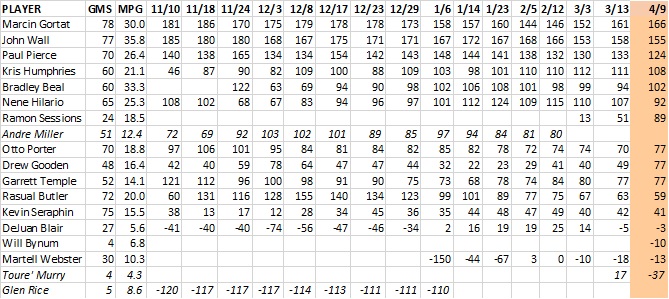
Player Production Average (PPA) is an overall rating stat I developed that credits players for things they do that help a team win and debits them for things that hurt the cause. PPA is pace neutral, accounts for defense, and includes a “degree of difficulty” factor based on the level of competition a player faces while on the floor. In PPA, 100 = average, higher is better and replacement level is 45.

The numbers under each date represent the player’s PPA for the entire season to that date. The number in the far right column (labeled PPA) is the player’s current PPA through games played last night. For a look at how players on other teams rate, visit here.
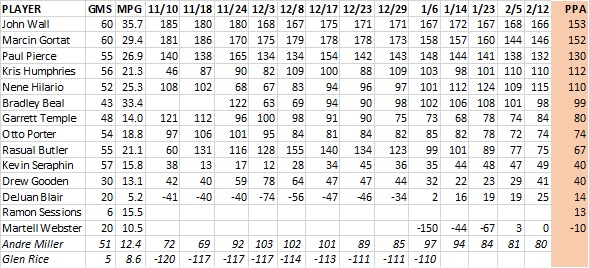
2015-04-09 -- wiz ppaSearching for encouragement as the playoffs approach? Look at Gortat and Wall — both of whom have been consistently good all season. Beal has played better the past few weeks, as have Sessions, Porter and Gooden.

On the other hand, Nenê and Pierce have struggled. The hope is that they’re recharging for the playoffs. But, they’re also the team’s oldest players, and they could be wearing down from the long season.

Wizards Update: Bouncing Back?

sessions

After a lengthy stretch of losing basketball, the Wizards have won four of their last six. Have they shaken off their mid-season swoon? Are they poised to win like it’s November or December?

No, and not likely.

While the Wizards have played better over the past six games, their offense has remained below average, and their defense has been unsustainably fantabulous. During this 4-2 stretch, Washington has allowed its opponents just 96.5 points per 100 possessions. If they managed to do that over a full season, they’d be one of the 15 best defenses since 1973-74 when the league began collecting the stats necessary to calculate defensive rating. For the season, the Wizards are allowing 102.8 points per 100 possessions.

Another factor: they’ve had the good fortune of meeting injury-depleted teams. And even then, the results have been mixed. They lost to Chicago, which was missing Jimmy Butler, Derrick Rose and Taj Gibson. They eked out a two-point victory against Miami, which didn’t have Chris Bosh, Dwyane Wade or Luol Deng. And, they beat the snot out of Memphis, which lacked Mike Conley, Tony Allen, Marc Gasol and Zach Randolph — also known as the Grizzlies’ four best players.

I know Randy Wittman and Ernie Grunfeld have said the Wizards just need to play better on defense and work harder. I respectfully disagree. Their defense — even during the period of sustained losing — wasn’t bad. The decline has been on offense, and it still needs to be fixed.

Player Production Average Update

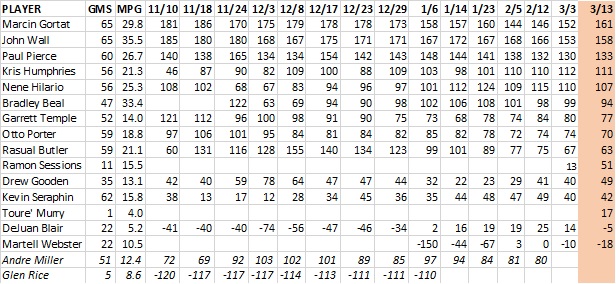
Player Production Average (PPA) is an overall rating stat I developed that credits players for things they do that help a team win and debits them for things that hurt the cause. PPA is pace neutral, accounts for defense, and includes a “degree of difficulty” factor based on the level of competition a player faces while on the floor. In PPA, 100 = average, higher is better and replacement level is 45.

The numbers under each date represent the player’s PPA for the entire season to that date. The number in the far right column (labeled PPA) is the player’s current PPA through games played last night. For a look at how players on other teams rate, visit here.

2015-03-13 -- wiz ppa

My apologies for the format. The spreadsheet has reached a width that WordPress struggles to accommodate.

Good weeks for Gortat, Wall, Pierce and Gooden. Not so good for Beal, Temple, Porter and Butler.

Ramon Sessions provided hope with a couple decent games.

Martell Webster isn’t able to physically compete at an NBA level, presumably because of his back.

I’ve thought all season that DeJuan Blair should have been playing ahead of Kevin Seraphin, but Blair looks unable to compete physically at an NBA level because of too much eating and insufficient exercise.

Wizards to Sign Underwhelming Murry

murry shoots

Media reports say the Washington Wizards are close to signing D-League guard Toure’ Murry to a 10-day contract. While the Wizards could use some backcourt help because of injuries to Bradley Beal, Garrett Temple and Martell Webster, regression from Rasual Butler, and crummy play from newly-acquired Ramon Sessions, it’s unlikely Murry will offer much help.

There are positives in Murry’s game, of course. He has good size and athleticism, and judging by the numbers, he’s active and plays hard. So far this season, he’s averaging 20.2 points, 9.6 rebounds, 9.3 assists and 2.5 assists per 100 possessions with two different D-League teams.

Yet, his Player Production Average (PPA) for the season is just 89. Yes, despite those impressive per 100 possession numbers, he still rates below average in the D-League this year. He’s been a bit better with Rio Grande, but even then he rates right about average (PPA: 98).

(For those who might not be regular readers: Player Production Average (PPA) is an overall rating stat I developed that credits players for things they do that help a team win and debits them for things that hurt the cause. PPA is pace neutral, accounts for defense, and includes a “degree of difficulty” factor based on the level of competition a player faces while on the floor. In PPA, 100 = average and higher is better.)

So what’s the problem? Points, rebounds, assists and steals are all on the “plus” side of the player evaluation ledger. Unfortunately, Murry also has high numbers on the “minus” side. This includes poor shooting and lots of turnovers.

Here’s a comparison of Murry’s shooting to the rest of the D-League this year:

Stat Murry D-League
efg .452 .518
2pt% .475 .512
3pt% .254 .354

If there’s a reason to think he’ll shoot better in the NBA than he has in the D-League, I’d love to see it. In the minors this season, Murry shoots more frequently than average per 100 possessions, but scores less. His assists are nice, but are offset by high turnovers. Overall this season, his offensive rating is 102 points per 100 possessions in a league that has an offensive rating of 110. Even if we ignore his less-good stint with Idaho, his offensive rating is still just 105, which is well below average.

Murry is a good defender, according to the defense part of PPA. He generates steals, which could be good depending on how (meaning: does he steal the ball by being in good position and having great anticipation, or is he disrupting the team concept by gambling in passing lanes?), and he’s aggressive on the defensive glass. Both his teams this season have been terrible defensively — more than five points per 100 possessions worse than average. It’s hard to blame him for that considering he has just 670 total D-League minutes this year. Overall, my approach suggests he’s an above average defender.

This is fine, but…in basketball, situational substitutions are difficult to make. Teams have to take the whole player — good and bad. What matters is a player’s overall impact. And Murry’s is decidedly average. D-League average. Given what’s been ailing the Wizards lately, if they were going to skew toward one end of the court, offense would seem more logical. In my analysis, it’s unlikely Murry will help much. Barring a Butler-like hot streak, Murry will be a deficit on offense who might hold his own defensively.

Could the Wizards have done better? Well, there are several guards in the D-League who have been more productive. This includes the tiny Tim Frazier, who was terrible in six games with Philadelphia last month. Other guys who look more promising in the numbers:

  • David Stockton, Reno — Small (just 5-11), but efficient. His offensive rating is 119 so far this season. Excellent shooter with impressive assist numbers. His team has been terrible defensively, but he rates as having an average defensive impact. Came to training camp with Washington, so maybe they’ve already seen enough to conclude they don’t want him. D-League PPA: 162
  • Seth Curry, Erie — Doesn’t have a well-rounded game, BUT he’s an adequate defender who shoots like a Curry. PPA: 152.
  • Elliott Williams, Santa Cruz — A 6-5 SG type who’s a willing passer and has shot the ball well this season. Decent defender on a good defensive team. PPA: 147.
  • D.J. Seeley, Delaware — A 6-4 SG and willing passer who has shot well this season (.435 on 186 3pt attempts). Too many turnovers for my liking. And he rates a shade below average defensively. PPA: 133.
  • Aaron Craft, Santa Cruz — Small, quick, strong and tough-as-graphene. Craft was one of the best collegiate defenders I ever saw, and that’s showing up in his D-League numbers as well. Still a suspect three-point shooter, but he’s a good passer, doesn’t commit turnovers, and seems to know a thing or two about running a team. PPA: 122.
  • Vander Blue, Los Angeles — A 6-4 SG out of Marquette, which means he plays hard and defends. He’s not really a PG, but he’s a much improved shooter — .421 from 3pt range on 126 attempts. PPA: 119.

None of these guys are guaranteed producers, of course. All have their “warts,” as does Murry. If the Wizards wanted a 3&D type, Williams, Seeley and Blue would seem to be better options. Stockton and Craft are “pure PGs” and the front office may imagine they have that backup role covered with Ramon Sessions.

Signing Murry isn’t a disaster. But, he doesn’t match what the Wizards need, and he isn’t much of a prospect for the future. In that sense, it is something of a missed opportunity.

EDIT — Since publishing, Nick Bilka asked on Twitter about Chris Babb. He looks like a better option as well. Babb is a 6-5 SG who rebounds decently, defends adequately and shoots the three well. PPA: 141.

Wizards Update: Death Spiral

wall wtf

When the NBA entered its annual All-Star break, I started work on a piece intended to look at how teams similar to this year’s Wizards throughout league history fared when they reached the playoffs. At the time, Washington was 33-21, and their Simple Rating System (SRS) — a measure of team strength that combines scoring differential with strength of schedule — was +1.67 per game.

In the six games they’ve played since the break, they faced opponents with a combined scoring differential of -1.15. Even an average team would have been expected to win four of the six. The Wizards went 1-5 and were outscored by a whopping 86 points. That’s 14.3 points per game. Even if I throw out the 38-point loss to Cleveland as an aberration, Washington lost the other five by 9.6 points per game. Their SRS now stands at -0.02.

All season, I’ve been writing variations on the theme of “The Wizards Just Ain’t That Good,” but I’m still surprised by their catastrophic collapse since the All-Star break. What’s scary: their remaining 22 games don’t look as easy as they did just a few weeks ago.

Fourteen of their remaining contests are against likely playoff teams. And, the key statistical indicators of team strength I watch are all dipping. This recent stretch of horrific basketball could merely be a rough patch for an average team, but it could also be a signal of an aging group that’s about to flat line.

When I run the numbers through my “who’s gonna win” machine, the results are…well…bad. In a worst-case scenario, the Wizards would limp into the playoffs with just seven wins over their last 22. I think they’ll be better than that, but it’s hard to find more than 11 wins the rest of the way (which, by the way, would give them a final record of 45-37, which happens to be what I projected for them back in October). Barring a miracle about-face, those dreams of a 50-win season will remain just that.

As long as I’m fretting, here’s another reason for Wizards fans to be concerned: this interview of team president Ernie Grunfeld by radio guy Dave Johnson. Presented with respectful softball questions by Johnson, Grunfeld offered his thoughts on how his team could pull out of its skid — and thoroughly misdiagnosed what’s wrong.

In the interview, Grunfeld suggested the team’s biggest problem has been a decline in their defense. He said their results will improve when they play better defense, get out on the fast break and “compete” on a nightly basis.

Here’s a look at the Wizards pre- and post-All-Star break:

TIME PACE ORTG DRTG
Pre-ASB 93.5 105.4 102.9
Post-ASB 96.7 93.4 108.3
CHANGE 3.2 -11.9 -5.4

What the numbers show is that the Wizards have played faster since the All-Star break, but have been worse. Grunfeld gets partial credit on the “play better defense” portion of his prescription since that would be a good thing to do. However, The drop in offensive efficiency is more than double their change in defensive efficiency. That means the team’s struggles are first and foremost because of its offense.

In case you were wondering, forgetting the debacle against Cleveland doesn’t change the analysis. Their defense the past three games has been excellent and yet they lost two because their offense was a horror show. If the Wizards want to start winning, they do need to get better on both ends, but their most important fix will be on offense.

There’s another issue with Grunfeld’s prescription — the data show the team’s offensive and defensive efficiency are uncorrelated. I’ve been tracking offensive and defensive efficiency by pace for years now, and this season’s result is the same as every other year. Good defense doesn’t cause good offense. Good offense doesn’t cause good defense. It’s almost as if offense and defense occur at different ends of the floor.

This season, if the numbers suggest anything it’s the Wizards show a very slight tendency to play better defense when they’re worse on offense. In terms of pace effects, Washington has a very slight tendency to play worse on offense in faster-paced games. But these “effects” are so small they’re basically meaningless.

Player Production Average Update

Player Production Average (PPA) is an overall rating stat I developed that credits players for things they do that help a team win and debits them for things that hurt the cause. PPA is pace neutral, accounts for defense, and includes a “degree of difficulty” factor based on the level of competition a player faces while on the floor. In PPA, 100 = average, higher is better and replacement level is 45.

The numbers under each date represent the player’s PPA for the entire season to that date. The number in the far right column (labeled PPA) is the player’s current PPA through games played last night. For a look at how players on other teams rate, visit here.

2015-03-03 -- wiz ppa

My apologies for the format. The spreadsheet has reached a width that WordPress struggles to accommodate.

Early returns on the Andre Miller for Ramon Sessions trade aren’t good. As the table above shows, Miller had a PPA of 80 with the Wizards; Sessions has managed a Maynor-esque 13 so far. Meanwhile, Miller’s PPA with the Kings is a robust 90 (good for a backup PG). Sessions in Sacramento posted a 16 PPA.

Unsurprisingly for a team that barely ended a five-game losing streak, production for most guys was down. The biggest decliner was John Wall, but he was hardly alone. The team also saw drop-offs from Nenê, Garrett Temple, Rasual Butler, and Kevin Seraphin.

Perhaps the Wizards can turn things around, but it’s an old team that doesn’t have a ton of upside. Over the season’s final 22 contests, Wall will likely play more like he did earlier in the season, but it’s not realistic to think any of the team’s older players have much room for improvement. Maybe Beal or Porter can play better to close out the season, but neither looks ready to provide a surge in production.

Realistically speaking, if the Wizards can go .500 the rest of the way, I’d call it a success. But, winning just seven or eight of their remaining 22 is a realistic possibility as well. That would leave them with 41 or 42 wins, which would almost certainly relegate them to the sixth seed. Where they’d probably draw Cleveland and get bounced from the playoffs in the first round.

So. Wizards.
Wizards Update: Designed to Piss Off Charles Barkley

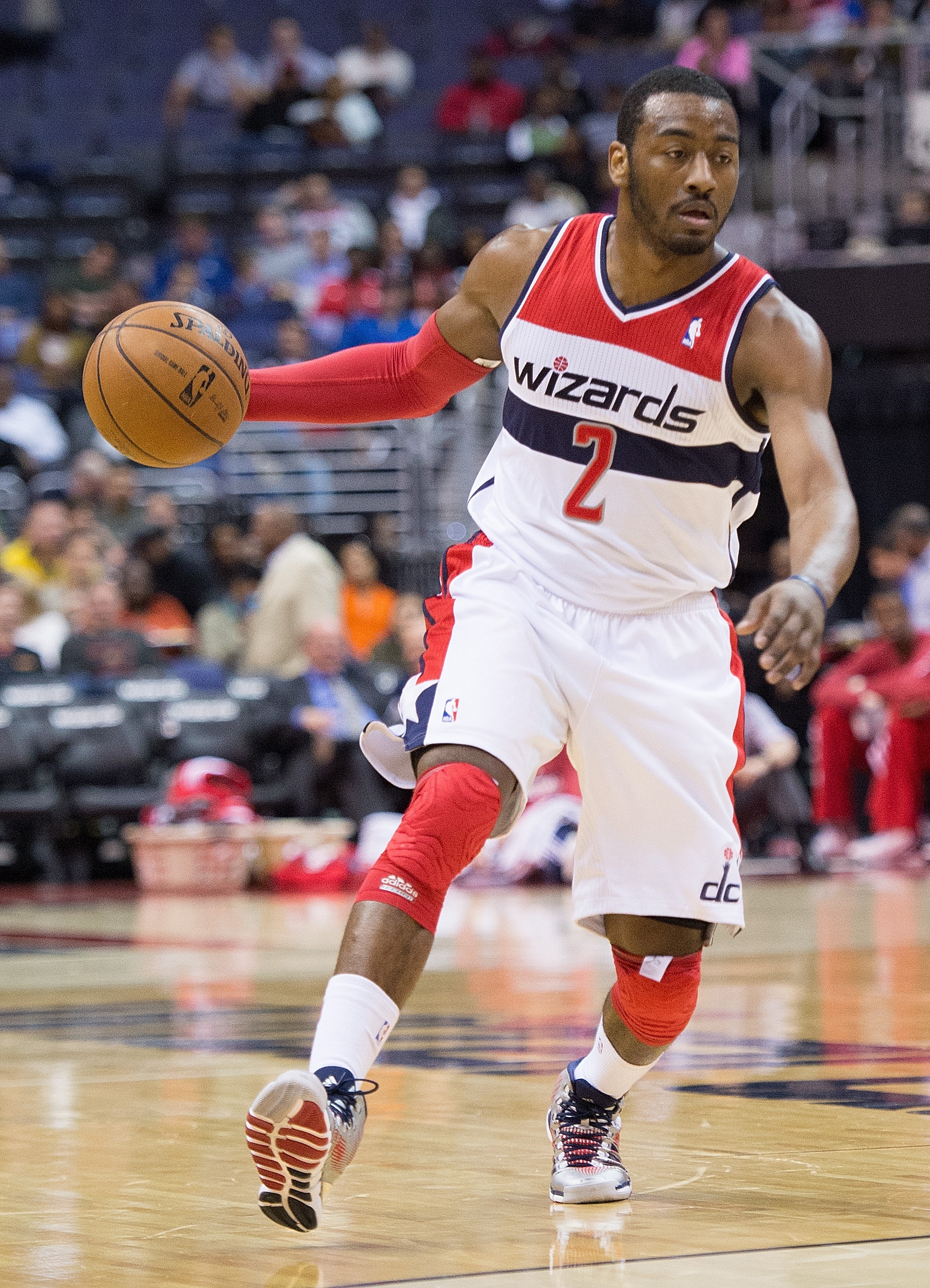
Drew Gooden celebrates being the biggest improver in this week's Player Production Average update.
Drew Gooden celebrates being the biggest improver in this week’s Player Production Average update.

Charles Barkley doesn’t like analytics. His argument works out to this: “I don’t know anything about analytics and I never will. Also, you stat people never played the game and couldn’t get girls in high school.”

Partial credit to the new number one on my list of people I’d like to meet at a poker table — I didn’t “get girls” in high school, perhaps because I was too busy playing basketball.

Of course, if we apply Barkley’s fatuous logic that only people who have played the game are qualified to offer opinions about the game, then only people who have done analytics would be qualified to offer opinions about analytics. Which means, by Barkley’s own Rules of Living, we should all shut the hell up — on a lot of things. Hmm, maybe he’s on to something.

Despite Barkley’s assertion that “analytics don’t work,” the facts are that in recent years, top teams have made extensive use of analytics to improve their teams. Of course, there are crappy teams that use analytics, but the same was true when teams were built by Men Who Stared At Players.

Analytics are not an end to themselves, and they’re not intended to eliminate people from decision-making. They’re tools to help inform decisions — sorta like being able to estimate odds in poker. You’re playing both the cards and the people across the table, but it’s a sucker who wagers without a good sense for their chances of winning. Which reminds me that Barkley really sucks at gambling.

Speaking of analytics, the Wizards could use some help. Despite dominating wins over sad-sack Brooklyn and Orlando, there’s a pervasive sense of gloom about the team lately. Since starting the season 22-8, they’re 11-13. The struggles weren’t a shock — it was the toughest part of the team’s schedule.

Heading into the All-Star break, areas for concern are much the same as they were when I wrote about them more than a month ago:

  • Age — Production has dropped significantly over the past month for the team’s oldest players, Paul Pierce and Andre Miller. Nenê has been doing better, but remains below average for a starter. The team has been terrific with him on the floor, however. And, in the “no shock” category, Rasual Butler’s production has dropped.
  • No Elite Producers — No, not even Wall, at least not on a per minute basis. His PPA (see below) is 166. That would rank fourth on the Atlanta Hawks behind Al Horford (203), Jeff Teague (190), and Paul Millsap (175). Among players with at least 500 minutes this season, Wall ranks 30th in per minute production. He’s 11th in total production, so I’ll take that as an argument in favor of “elite” status, even though he’s played the second most minutes in the league this year, and seven of the 10 ahead of him have played significantly fewer minutes. Wall IS playing well. But, I think there’s still major room for improvement.
  • Kevin Seraphin — He was better in January, but seems to have flattened out in February. Overall, he continues to rate right around replacement level. I think the team can get by with him against bad teams, but will need better play off the bench when they face tougher competition.
  • Lack of Progress From The Youngsters — Bradley Beal’s PPA has been hovering in the average range; Porter’s in the below-average-but-still-useful range. But, neither guy has taken a significant step forward, and now Beal is sidelined for a third time with a “stress reaction” in his leg.
  • Health — Beal with the stress reaction. Webster recovering from back surgery. Wall with the migraines and the (maybe) Achilles soreness, and/or ankle soreness. Humphries with the back. Nothing major yet, but these bumps and bruises can affect productivity, and there are always injury concerns with older players.

Weekly Player Production Average Update

Player Production Average (PPA) is an overall rating stat I developed that credits players for things they do that help a team win and debits them for things that hurt the cause. PPA is pace neutral, accounts for defense, and includes a “degree of difficulty” factor based on the level of competition a player faces while on the floor. In PPA, 100 = average, higher is better and replacement level is 45.

The numbers under each date represent the player’s PPA for the entire season to that date. The number in the far right column (labeled PPA) is the player’s current PPA through games played last night. For a look at how players on other teams rate, visit here.

2015-02-12 -- Wizards PPA update

My apologies on the format, but I was running out of space for the full week-by-week PPA table. By the end of the season, we’ll all need a magnifying glass to read it.

A lot of consistency at this point. Most of the guys seem to have found their levels. My biggest worries are with the old guys, who seem to be wearing down as the season progresses. Hopefully they’ll be rejuvenated by this year’s extra-long All-Star break.

Wizards Update: The Losing Streak

gortat shaved mohawk

So little time today, but I want to get the numbers up and address one topic: the (apparently) Official Wizards Fan Talking Point that the the Wizards are a “good” team going through a tough stretch.

While there’s a certain appeal to that position, and its supporters could point to the team’s record as evidence, the numbers simply don’t agree. The key stat to understand relative team strength is scoring differential — even more than record. The guys at Basketball-Reference created a robust team strength measure they call Simple Rating System (SRS), which combines scoring differential and strength of schedule.

In SRS, the WIzards have bounced around a bit this season, climbing into the top 10 for a week early on, but steadily sliding since then. Now emerging from the toughest part of their schedule, Washington ranks 16th in SRS — now behind Milwaukee. Consider that the Bucks and Wizards have played schedules of identical difficulty (0.63 points per game worse than average), but the Bucks have outscored their opponents by 1.96 points per game — the Wizards 1.66. A small difference to be sure, but it’s meaningful over the course of the marathon NBA season.

The data says that Washington isn’t a bad team, but it’s not good either. It’s a little better than average with a record made superficially better by the woeful state of the Eastern Conference. Because of the weak conference, the Wizards still have a decent shot at a top three seed, and a reasonable chance of advancing past the first round.

But, the problem isn’t that they’ve “just gotten out of sync” or that they’re not playing hard enough. It’s that they’re just not that good. Their margin for success each night is slender, and on nights when they’re not playing at something close to their best, they’re vulnerable.

Weekly Player Production Average Update

Player Production Average (PPA) is an overall rating stat I developed that credits players for things they do that help a team win and debits them for things that hurt the cause. PPA is pace neutral, accounts for defense, and includes a “degree of difficulty” factor based on the level of competition a player faces while on the floor. In PPA, 100 = average, higher is better and replacement level is 45.

The numbers under each date represent the player’s PPA for the entire season to that date. The number in the far right column (labeled PPA) is the player’s current PPA through games played last night. For a look at how players on other teams rate, visit here.

PLAYER GMS MPG 11/10 11/18 11/24 12/3 12/8 12/17 12/23 12/29 1/6 1/14 1/23 PPA
John Wall 50 35.9 185 180 180 168 167 175 171 171 167 172 167 168
Marcin Gortat 50 29.5 181 186 170 175 179 178 178 173 158 157 160 144
Paul Pierce 47 26.9 140 138 165 134 134 154 142 143 148 144 141 138
Nene Hilario 42 25.5 108 102 68 67 83 94 96 97 101 112 124 109
Bradley Beal 41 34.0 122 63 69 94 90 98 102 106 108 101
Kris Humphries 49 22.0 46 87 90 82 109 100 88 109 103 98 101 110
Rasual Butler 46 20.8 60 131 116 128 155 140 134 123 99 101 89 77
Andre Miller 48 12.2 72 69 92 103 102 101 89 85 97 94 84 81
Otto Porter 45 18.0 97 106 101 95 84 81 84 82 85 82 78 72
Garrett Temple 38 11.7 121 112 96 100 98 91 90 75 73 68 78 74
Kevin Seraphin 49 15.6 38 13 17 12 28 34 45 36 35 44 48 47
Drew Gooden 23 12.0 42 40 59 78 64 47 47 44 32 22 23 29
DeJuan Blair 14 4.6 -41 -40 -40 -74 -56 -47 -46 -34 2 16 19 19
Martell Webster 13 10.0 -150 -44 -67 3
Glen Rice 5 8.6 -120 -117 -117 -117 -114 -113 -111 -111 -110 -110 -110 -109

No big surprises here. As would be expected for a team in a four-game losing streak, production has dipped for several players. Biggest decliners: the old guys — Gortat, Nenê, and Butler. The only real “improver” was Humphries. For the Seraphin watchers, the big fella stabilized right around replacement level since the last update.