2012 NBA Draft Position Rankings from YODA

Image

Earlier today, I posted overall rankings for the 2012 NBA Draft using my draft analysis system, which has been dubbed YODA. Here’s the same information, but this time by position. In this post, I’m adding in a standardized score to show the differences between players.

The best score in YODA history was Shaquille O’Neal’s sophomore year at LSU. In the standardized score I’m showing, Shaq’s season scored a 36. Everyone else scales below that. Zero means the player rates as an average prospect.

Here are all players with a draftable score in YODA:

Point Guards

  1. Damian Lillard — 7
  2. Kendall Marshall — 4
  3. Tony Wroten — 0
  4. Reggie Hamilton — 0
  5. Jordan Taylor — 0
  6. Casper Ware — -1
  7. Scott Machado — -1
  8. Lazeric Jones — -3
  9. Marquis Teague — -3
  10. Scoop Jardine — -3
  11. Tyshawn Taylor — -4

Shooting Guard

  1. Marcus Denmon — 12
  2. Bradley Beal — 8
  3. Will Barton — 5
  4. Dion Waiters — 5
  5. Darius Johnson-Odom — 2
  6. Jeremy Lamb — 2
  7. John Jenkins — 1
  8. Orlando Johnson — 1
  9. Devoe Joseph — 0
  10. Doron Lamb — -2
  11. J.R. Cadot — -2
  12. Kim English — -3
  13. Matt Gatens — -3
  14. Tanner Smith — -3
  15. Jared Cunningham — -4

Small Forward

  1. Jae Crowder — 16
  2. Michael Kidd-Gilchrist — 8
  3. Harrison Barnes — 3
  4. Jeff Taylor — 1
  5. Quincy Miller — 0
  6. John Shurna — 0
  7. Ken Horton — -1
  8. Moe Harkless — -1
  9. Chris Johnson — -2
  10. Darius Miller — -3
  11. Robbie Hummel — -3
  12. Chace Stanback — -3
  13. Wendell McKines — -4
  14. Alex Young — -4
  15. Terrence Ross — -5

Power Forward

  1. Anthony Davis — 28
  2. Draymond Green — 7
  3. Thomas Robinson — 6
  4. Jared Sullinger — 3
  5. Terrence Jones — 3
  6. Ricardo Ratliffe — 2
  7. John Henson — 0
  8. Kevin Jones — 0
  9. Drew Gordon — 0
  10. Quincy Acy — -1
  11. Trevor Mbakwe — -1
  12. Perry Jones III — -2
  13. Arnett Moultrie — -2
  14. Mike Scott — -3
  15. JaMychal Green — -3
  16. Bernard James — -3
  17. Jack Cooley — -3

Center

  1. Tyler Zeller — 15
  2. Miles Plumlee — 3
  3. Andre Drummond — 3
  4. Meyers Leonard — -1
  5. Garrett Stutz — -3
  6. Fab Melo — -3

The Draft According to YODA

Image

Over the past couple months, I’ve been posting regularly in the draft threads on the Wizards board at RealGM about my research into evaluating NCAA draft prospects. The project is an effort to use college stats, as well as measurements, times and scores from draft combines to project which players are most likely to become good professionals.

The system I’ve come up with involves using per minute stats, includes an accounting for level of competition, and adjusts for age — a great performance from an 18-year old freshman is more impressive than the same performance from a 23-year old senior.

After referring to “the system” several times on the boards as Ye Olde Draft Analyzer, someone dubbed it YODA and the name stuck. The results? Time will tell on this year’s draft class. In previous years, YODA’s predictions have been good, but that’s the subject for a later post at some point in the future.

Below are the players as they’re rated by YODA. I’ve divided them into “tiers” — basically groupings of players by quality. The separation between Tier One and Tier Two is significant; the differences between players in the same tier are insignificant.

Here’s how I think about the tier system. Teams generally give themselves a better chance of succeeding when they pick best player available rather than focusing on specific roster needs. This should limit “reaches.” Plus, getting the best player gives the team another asset for trade purposes. Of course, it’s not always clear who the “best player” actually is.

That’s where the tiers enter the picture. Players who are “about the same” fall into the same tier. When a team’s pick comes around, they can use this process to pick whichever player on the same tier best fits their needs. They should avoid “reaching” into a lower tier to pick for need.

Anyway — the prospects according to YODA (along with sample players through the years who rated on the same tier):

NOTE: The tiers are numbered for this year only. They’re not historical tiers — that’s a work still in progress.

Tier One

Historical: Kevin Durant, Greg Oden

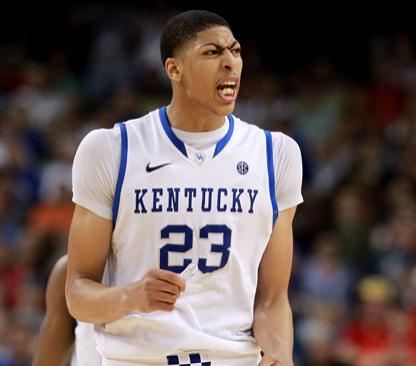
  • Anthony Davis, PF, Kentucky — Davis posted the most impressive freshman season I’ve analyzed. He’s the second rated prospect in YODA behind Shaquille O’Neal’s sophomore season. Similar YODA scores: Kevin Durant and Greg Oden.

Tier Two

Historical: Allen Iverson (SO), Zach Randolph (FR), Carmelo Anthony (FR)

  • Jae Crowder, SF, Marquette
  • Tyler Zeller, C, North Carolina

Tier Three

Historical: Jason Kidd (FR), Josh Howard (SR), Tim Duncan (JR)

  • Marcus Denmon, SG, Missouri

Tier Four

Historical: Paul Pierce (JR), Tony Allen (SO), Gilbert Arenas (FR), Ty Lawson (FR)

  • Bradley Beal, SG, Florida
  • Michael Kidd-Gilchrist, SF, Kentucky

Tier Five

Historical: Caron Butler (SO), Brandon Roy (JR), Rudy Gay (FR), Mike Miller (SO)

  • Damian Lillard, PG, Weber State
  • Draymond Green, PF, Michigan State
  • Thomas Robinson, PF, Kansas
  • Will Barton, SG, Memphis
  • Dion Waiters, SG, Syracuse

Tier Six

Historical: Ryan Anderson (SO), Ben Gordon (JR), Roy Hibbert (SR), Karl Malone (FR)

  • Kendall Marshall, PG, North Carolina
  • Jared Sullinger, PF, Ohio State
  • Miles Plumlee, F/C, Duke
  • Harrison Barnes, SF, North Carolina
  • Terrence Jones, F, Kentucky
  • Andre Drummond, C, Connecticut

Tier Seven

Historical: Antawn Jamison (SO), Deron Williams (SO), Jordan Crawford (SO)

  • Darius Johnson-Odom, SG, Marquette
  • Jeremy Lamb, SG, Connecticut
  • Ricardo Ratliffe, PF, Missouri

Tier Eight

Historical: Chris Singleton (JR), Jarrett Jack (SO), Harold Miner (FR), Charlie Villanueva (SO)

  • Jeff Taylor, SF, Vanderbilt
  • John Jenkins, SG, Vanderbilt
  • Orlando Johnson, SG, UCSB
  • Tony Wroten, PG, Washington
  • Quincy Miller, SF, Baylor

Tier Nine

Historical: Jared Dudley (JR), Gerald Wallace (FR), Hakim Warrick (FR), Lester Hudson (JR), Morris Almond (SR), Michael Redd (SO)

  • John Henson, PF, North Carolina
  • Reggie Hamilton, PG, Oakland
  • Kevin Jones, PF, West Virginia
  • Jordan Taylor, PG, Wisconsin
  • John Shurna, F, Northwestern
  • Devoe Joseph, SG, Oregon
  • Drew Gordon, PF, New Mexico

That’s enough to get through the first round. Tier 9 players are average prospects historically, according to YODA. In the “historical” sections, I’ve included a few representative players. It’s worth nothing that good pros have come from many “tiers,” which is demonstration of the reality that a) evaluating prospects is an inexact science; and b) that MANY young players have the capability to be quality professional players if they work hard enough and smart enough. The reality is that EVERY player arriving in the NBA needs to improve. The difference between a kid who becomes an All-Star and a kid who’s out of the league in three years is very much about the amount of purposeful, deliberate, well-considered work each player puts into developing his game and his body.

Who Do You Want Shooting In The “Clutch”?

Here’s the situation: Your team is involved in a close game (margin no farther apart than 5 points either way) in the 4th quarter or overtime. The question: Who do you want shooting the ball for your team?

The popular answer over the past decade has been Kobe Bryant. According to legend (and even polls of general managers), no one is more clutch than Kobe. No player of recent vintage can surpass (or even match) Kobe’s incredible, incomparable, sublime skills as a “closer” of games. Right?

Kobe fans would love the chance to regale us with details of why he’s such a great closer. They’d list great performances and incredible buzzer beaters, and we could all sit around and marvel at the incomparable daring-do.

Or, we could go to the Play Index and Basketball Reference and look up the numbers.

This season, in the 4th quarter and overtime when the scoring margin is 5 points or fewer (in either direction), Bryant leads the league in shot attempts. But, among the 37 players with at least 40 field goal attempts in the 4th quarter or overtime with the game margin within 5 points, Kobe has the has the 4th WORST shooting percentage — .327. Only Kevin Garnett (.325), OJ Mayo (.308) and John Wall (.238) have shot worse this season in clutch situations.

Well that’s just this year, right? Small sample size.

Since 2000-01, Bryant has 2094 field goal attempts, including 434 three-point attempts. His FG% on those attempts: 41.5%. His 3pt%: 29.7%. His eFG: 44.6%.

Hmm.

I went back through the records and found 246 individual players who generated 768 player seasons since 2000-01 in which the player averaged at least 1.0 FGA per game in “clutch” situations (4th quarter or OT, margin of the game 5 points or fewer). The averages:

  • FG%: 42.4%
  • 3pt%: 34.1%
  • eFG: 46.4%

In other words, the greatest closer of the past decade has actually been a below average shooter in clutch situations.

If we slice off everyone with fewer than 900 FGA (to find a group most like Kobe in terms of longevity and volume), Kobe still ends up below average in shooting from the floor.

  • FG%: .422 vs. Kobe: .415
  • 3pt%: .333 vs. Kobe: .297
  • eFG: .459 vs. Kobe: .446

Make the cut 200 total games in this situation and we get the same story.

The point is not to bash Kobe, but rather to highlight the utility of stats. Fans (and at least some basketball decision makers) “know” what they see. They don’t need stats — those are just for a bunch of geeks.

Except, subtle distinctions are virtually impossible to see. Take two hypothetical players. Both play exactly the same number of minutes for a team. They’re identical players in every way (including attempting 10 field goals). Over 82 games, that’s 820 FGA each. The only difference: One is a 50% shooter, the other a 45% shooter.

Over the course of a season, the difference is 41 made shots — one additional made shot every other game. If you say you can see that difference, you’re lying.

One of the values of stats is to check the claims that slide off the tongue so easily. Did I really see what I thought I saw? Did what others say happened really happen?

We get to find out whether Kobe really is a great clutch shooter, or whether he’s average (or below average) in the clutch. There’s value in that.

The underlying point to the Kobe hagiography is that any story about a basketball player’s successes is incomplete without accounting for the failures as well. When I hear that a player averaged 18 points and 8 rebounds, I don’t have enough information. How often did he shoot? How often did he get to the line? How many assists? How many turnovers? How many offensive rebounds?

Efficiency matters — a lot.

At this point, let me pause and say that I think Kobe is a terrific basketball player. He’s one of the better players of his generation, and he’d almost certainly go on my Rushmore of all-time NBA shooting guards. He’s not Jordan, but that’s not much of a criticism — Jordan was outlandishly, preposterously dominant.

But we’re all done a disservice when legend and hyperbole take the place of reality. Kobe’s done enough to be recognized as a great player. His fans don’t need to make stuff up to prop up his legacy. His overall meh clutch shooting needs to be considered, but there are more than enough accomplishments for Kobe to go down as an all-time great.
Should Basketball Players Be Evaluated Behind A Screen?

In Blink, Malcolm Gladwell tells the story of high-level music auditions. It seems that for eons, those who ran the music world thought that women didn’t have the strength to perform in orchestras. Women were deemed not to have sufficient strength to play certain piano compositions — and to lack the lung capacity and lips to compete with men on brass and woodwind instruments.

In the 1960s, leaders of the music world finally implemented The Screen. Where the auditioning musicians once walked onto a stage or into a room in full view of the judges, they began auditioning from behind a literal screen that prevented judges from seeing who was playing. Instead of assessing auditioners based on visual cues like race, gender, height or attractiveness, judges were forced to focus exclusively on the sound coming from the instrument. In most trials, the musician auditioning was not permitted to even speak.

What happened? The number of women winning auditions quintupled. The very first time the Metropolitan Opera in New York had blind auditions, they were seeking four violinists. Women won all four spots.

I’m reminded of Gladwell’s story by the recent stellar play from Knicks point guard Jeremy Lin. As you can see from the picture above, Lin is of Asian descent. And let’s face it — there haven’t been many Asian-American NBA players in history. I’ve been following the NBA since the late 70s, and I can’t remember even one. The only Asian players to reach the NBA I can recall are bigs from overseas (like Yao Ming).

We all know what basketball players look like, and Lin doesn’t fit the mold. Except that he’s 6-3 with long arms, and that he’s quick, and that he has good speed, and that he can jump a little.

Thrust into the starting lineup by injuries to other players, Lin has performed spectacularly. Nate Silver found 41 players who had similar results to Lin in their first four starts, and concludes that Lin is no fluke. The “screened” eye of stats suggests that Lin is likely to be a solid NBA player — at worst.

How did EVERYONE miss on a player who looks this good? How did Golden State and stat-savvy Houston decide to cut him? How did at least two pro teams take a smart, athletic, skilled player and dump him when he almost certainly could have helped either team?

I’m not about to accuse either franchise of overt anti-Asian discrimination. But I do believe that prejudice played a role in their evaluations of Lin as a player. Not in a conscious, “Asian people can’t play basketball” way, but at the deep-down, subconscious implicit bias level. He doesn’t look “right” to folks who have been conditioned for decades to “know” what good basketball players look like.

And by the way, I don’t think Lin’s ethnicity is the only “blinder” at work in his case. NBA talent evaluators have long overlooked offensive efficiency as a critical factor. The ability to shoot the ball with accuracy lags on the priority list behind height, speed and leaping ability. Never mind intelligence and skill — what’s the guy’s vertical? What’s his standing reach? A great athlete can “develop” the skills and learn the game. At least that’s the theory.

Start researching the NBA and you’ll find an array of blind spots and faulty assumptions from decision-makers. Playing time and salaries are determined mostly by per minute scoring — even though that’s not what wins. Minutes and length of a player’s career are largely determined by draft position — players picked high keep getting chances when more productive players picked later languish.

Want to know who’s going to make the All-Star team? Try picking the leading scorer on the teams with winning records. And no, the coaches (who pick the reserves for the All-Star game) do no better rewarding the game’s best players than the fans do in voting for the starters.

The All-Rookie team is determined almost exclusively by per game scoring.

Despite all the tools available to assist in evaluation, we keep getting “surprises” like Jeremy Lin.

Maybe it’s time NBA talent evaluators took a cue from the music world and started looking at players from behind a screen. Maybe it’s time to worry less about what people look like, and spend more time paying attention to what they’re actually doing.