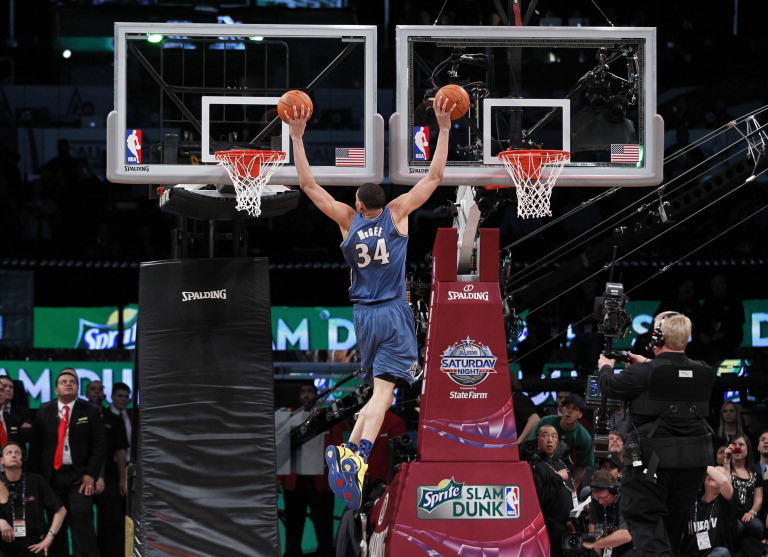
Who Do You Want Shooting In The “Clutch”?

Here’s the situation: Your team is involved in a close game (margin no farther apart than 5 points either way) in the 4th quarter or overtime. The question: Who do you want shooting the ball for your team?

The popular answer over the past decade has been Kobe Bryant. According to legend (and even polls of general managers), no one is more clutch than Kobe. No player of recent vintage can surpass (or even match) Kobe’s incredible, incomparable, sublime skills as a “closer” of games. Right?

Kobe fans would love the chance to regale us with details of why he’s such a great closer. They’d list great performances and incredible buzzer beaters, and we could all sit around and marvel at the incomparable daring-do.

Or, we could go to the Play Index and Basketball Reference and look up the numbers.

This season, in the 4th quarter and overtime when the scoring margin is 5 points or fewer (in either direction), Bryant leads the league in shot attempts. But, among the 37 players with at least 40 field goal attempts in the 4th quarter or overtime with the game margin within 5 points, Kobe has the has the 4th WORST shooting percentage — .327. Only Kevin Garnett (.325), OJ Mayo (.308) and John Wall (.238) have shot worse this season in clutch situations.

Well that’s just this year, right? Small sample size.

Since 2000-01, Bryant has 2094 field goal attempts, including 434 three-point attempts. His FG% on those attempts: 41.5%. His 3pt%: 29.7%. His eFG: 44.6%.

Hmm.

I went back through the records and found 246 individual players who generated 768 player seasons since 2000-01 in which the player averaged at least 1.0 FGA per game in “clutch” situations (4th quarter or OT, margin of the game 5 points or fewer). The averages:

  • FG%: 42.4%
  • 3pt%: 34.1%
  • eFG: 46.4%

In other words, the greatest closer of the past decade has actually been a below average shooter in clutch situations.

If we slice off everyone with fewer than 900 FGA (to find a group most like Kobe in terms of longevity and volume), Kobe still ends up below average in shooting from the floor.

  • FG%: .422 vs. Kobe: .415
  • 3pt%: .333 vs. Kobe: .297
  • eFG: .459 vs. Kobe: .446

Make the cut 200 total games in this situation and we get the same story.

The point is not to bash Kobe, but rather to highlight the utility of stats. Fans (and at least some basketball decision makers) “know” what they see. They don’t need stats — those are just for a bunch of geeks.

Except, subtle distinctions are virtually impossible to see. Take two hypothetical players. Both play exactly the same number of minutes for a team. They’re identical players in every way (including attempting 10 field goals). Over 82 games, that’s 820 FGA each. The only difference: One is a 50% shooter, the other a 45% shooter.

Over the course of a season, the difference is 41 made shots — one additional made shot every other game. If you say you can see that difference, you’re lying.

One of the values of stats is to check the claims that slide off the tongue so easily. Did I really see what I thought I saw? Did what others say happened really happen?

We get to find out whether Kobe really is a great clutch shooter, or whether he’s average (or below average) in the clutch. There’s value in that.

The underlying point to the Kobe hagiography is that any story about a basketball player’s successes is incomplete without accounting for the failures as well. When I hear that a player averaged 18 points and 8 rebounds, I don’t have enough information. How often did he shoot? How often did he get to the line? How many assists? How many turnovers? How many offensive rebounds?

Efficiency matters — a lot.

At this point, let me pause and say that I think Kobe is a terrific basketball player. He’s one of the better players of his generation, and he’d almost certainly go on my Rushmore of all-time NBA shooting guards. He’s not Jordan, but that’s not much of a criticism — Jordan was outlandishly, preposterously dominant.

But we’re all done a disservice when legend and hyperbole take the place of reality. Kobe’s done enough to be recognized as a great player. His fans don’t need to make stuff up to prop up his legacy. His overall meh clutch shooting needs to be considered, but there are more than enough accomplishments for Kobe to go down as an all-time great.

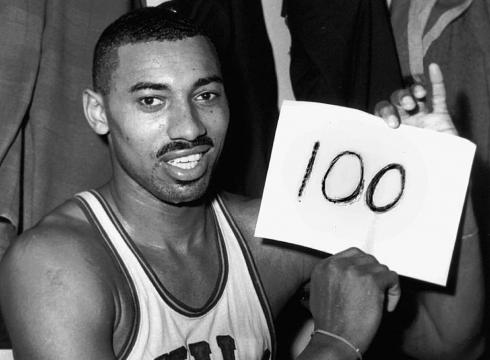
Wilt’s 100-point Game, Perspective Please

Wilt scored 100 points, but Kobe's 81 might have been the more impressive feat.

Like most basketball fans, I’m an admirer of Wilt Chamberlain. He was a dominant figure — no question one of the all-time greats. When I get around to posting my “Rushmore” lists, he’ll make several of them. For those who don’t know, today is the 50th anniversary of the day Wilt scored 100 points in an NBA game — highest individual scoring game ever.

This morning, in inimitable ESPN full-hype style, Mike & Mike celebrated Wilt’s achievement by wondering if it’s the greatest individual performance in sports history. As is normally the case when discussing basketball, the radio conversation was long on cliches and meaningless hype, and short on meaningful analysis. Not a single person mentioned “pace,” for example.

I was left wondering not whether Wilt’s 100 points was the greatest individual performance in sports history, but whether it was even the single greatest scoring performance in NBA history.

So, I’ve dusted of my era translator and taken a look. What I’ve done is take the top scoring games since the 1985-86 season (which is when Basketball Reference’s box score database begins) and translated those games to Wilt’s phenomenal game.

In that 100-point game, Wilt shot 36-63 from the floor and 28-32 from the free throw line. His 100 points accounted for 59% of his team’s 169 points that game.

Compare with Kobe’s 81-point game against Toronto 1/22/06. Kobe shot 28-46 from the floor, 18-20 from the line and accounted for a stunning 66% of the Lakers 122 points. Kobe’s 81 points translated to the game where Wilt scored 100 — 112 points.

Here’s a list of the NBA’s top scoring games since 85-86, resorted by translated points to Wilt’s 100-point game.

What we see is an illustration of how much the game has changed. NBA teams shoot far less frequently in today’s game than they did in Wilt’s. This simple fact reduces opportunities for players to compile the gargantuan numbers Wilt (and other players of that era) posted.

However, viewed through the lens of a player’s “share” of his team’s production, we see similarities between players today and players of yesteryore. Lebron James is like Oscar Robertson. Maybe Shaq is like Wilt. Maybe Dwight Howard is like Bill Russell. This doesn’t diminish the mythical players that came before — it puts them in a context that’s familiar and gives insight into what we’re seeing today.

So, back to Mike & Mike for a second, Wilt’s 100-point game was a great performance, but arguably not the greatest scoring performance in league history. These translations suggest Kobe’s 81-point night might have been the best ever scoring game, followed by David Robinson’s 71, then a tie between Wilt’s 100 and Jordan’s 69.

Let’s celebrate the 50th anniversary of Wilt’s great game. But let’s keep it in proper context and let’s do it with perspective.

Era Translations: Oscar Robertson and Lebron James

When people try to compare players across eras in the NBA, they inevitably run up against the reality that the game has changed in fundamental ways. At the most basic level, teams shoot a lot less — but at a better percentage than they did in the 1960s.

In 1961-62, Wilt Chamberlain famously averaged 50 points and 25 rebounds for an entire season, but in a league that averaged 8619 field goal attempts per team. Last season, the league averaged 6660 FGA per team — about 23% fewer shot attempts. In 61-62, the league shot 42.9% from the floor. In 10-11, the league shot 45.9%.

That means an extra 600+ missed shots available for rebound in Wilt’s era. Another 600+ assist opportunities (although assists were awarded less liberally back then).

So, do we just give up? Do we trot out the old, “You just can’t compare eras…” trope?

No.

Definitely no. 

Positively no.

Decidedly no.

Nuh-uh.

Inspired by a question from my son, I dusted off my era translator spreadsheet and took a look at Oscar Robertson and Lebron James. My method is simple (at least I think so). It looks at a player’s share of his own team’s production and then applies that share to a hypothetical team’s production — in a different era. I swear it’s simpler than it sounds.

Let’s take Oscar Robertson’s monster 1961-62 season. This is the year the Big O averaged a triple-double for the year — 30.8 points, 12.5 rebounds and 11.4 assists per game. Another way of looking at those numbers is to say that Robertson scored 25% of his team’s points, grabbed 17% of his team’s rebounds, and dealt 42% of his team’s assists.

Apply those percentages to the average team in the 2011-12 NBA, and we get per game averages of 24.0 points, 7.5 rebounds and 8.7 assists. Not a triple-double, but still a monster player — a Lebron James-esque figure in today’s NBA.

So, what happens if we go the other direction and translate Lebron’s stats to Oscar Robertson’s team in 1961-62?

This year for Miami, Lebron has scored 26% of the points, grabbed 18% of the rebounds, and delivered 31% of the assists. Translation: 32.7 points, 13.3 rebounds and 8.7 assists in Oscar’s era.

And there you have it — players compared across eras. Not by comparing skills or imagining what Lebron would be like if he was transported via time machine back to 1961, or what Robertson would be like if he’d been born in 1984 like Lebron. Instead, look at each player’s relative contributions to his own team and compare their relative dominance over the players of each player’s own era. Those impacts can be compared.

And in that comparison we can see that Lebron has an Oscar-like impact on today’s game. Kinda cool if you ask me.

Should Basketball Players Be Evaluated Behind A Screen?

In Blink, Malcolm Gladwell tells the story of high-level music auditions. It seems that for eons, those who ran the music world thought that women didn’t have the strength to perform in orchestras. Women were deemed not to have sufficient strength to play certain piano compositions — and to lack the lung capacity and lips to compete with men on brass and woodwind instruments.

In the 1960s, leaders of the music world finally implemented The Screen. Where the auditioning musicians once walked onto a stage or into a room in full view of the judges, they began auditioning from behind a literal screen that prevented judges from seeing who was playing. Instead of assessing auditioners based on visual cues like race, gender, height or attractiveness, judges were forced to focus exclusively on the sound coming from the instrument. In most trials, the musician auditioning was not permitted to even speak.

What happened? The number of women winning auditions quintupled. The very first time the Metropolitan Opera in New York had blind auditions, they were seeking four violinists. Women won all four spots.

I’m reminded of Gladwell’s story by the recent stellar play from Knicks point guard Jeremy Lin. As you can see from the picture above, Lin is of Asian descent. And let’s face it — there haven’t been many Asian-American NBA players in history. I’ve been following the NBA since the late 70s, and I can’t remember even one. The only Asian players to reach the NBA I can recall are bigs from overseas (like Yao Ming).

We all know what basketball players look like, and Lin doesn’t fit the mold. Except that he’s 6-3 with long arms, and that he’s quick, and that he has good speed, and that he can jump a little.

Thrust into the starting lineup by injuries to other players, Lin has performed spectacularly. Nate Silver found 41 players who had similar results to Lin in their first four starts, and concludes that Lin is no fluke. The “screened” eye of stats suggests that Lin is likely to be a solid NBA player — at worst.

How did EVERYONE miss on a player who looks this good? How did Golden State and stat-savvy Houston decide to cut him? How did at least two pro teams take a smart, athletic, skilled player and dump him when he almost certainly could have helped either team?

I’m not about to accuse either franchise of overt anti-Asian discrimination. But I do believe that prejudice played a role in their evaluations of Lin as a player. Not in a conscious, “Asian people can’t play basketball” way, but at the deep-down, subconscious implicit bias level. He doesn’t look “right” to folks who have been conditioned for decades to “know” what good basketball players look like.

And by the way, I don’t think Lin’s ethnicity is the only “blinder” at work in his case. NBA talent evaluators have long overlooked offensive efficiency as a critical factor. The ability to shoot the ball with accuracy lags on the priority list behind height, speed and leaping ability. Never mind intelligence and skill — what’s the guy’s vertical? What’s his standing reach? A great athlete can “develop” the skills and learn the game. At least that’s the theory.

Start researching the NBA and you’ll find an array of blind spots and faulty assumptions from decision-makers. Playing time and salaries are determined mostly by per minute scoring — even though that’s not what wins. Minutes and length of a player’s career are largely determined by draft position — players picked high keep getting chances when more productive players picked later languish.

Want to know who’s going to make the All-Star team? Try picking the leading scorer on the teams with winning records. And no, the coaches (who pick the reserves for the All-Star game) do no better rewarding the game’s best players than the fans do in voting for the starters.

The All-Rookie team is determined almost exclusively by per game scoring.

Despite all the tools available to assist in evaluation, we keep getting “surprises” like Jeremy Lin.

Maybe it’s time NBA talent evaluators took a cue from the music world and started looking at players from behind a screen. Maybe it’s time to worry less about what people look like, and spend more time paying attention to what they’re actually doing.

Pumping the Brakes On Javale McGee

As I wander the vast tundra of the Internet, I keep stumbling across Wizards fans excited about the play of Javale McGee. The general sentiment among the die hard is this: McGee has improved and he’s still young. The action they want: The Wizards need to lock him up now rather than risk seeing him leave in free agency.

Evidence to support the “he’s improved” claim usually includes:

  • an expanded offensive repertoire — specifically the hook and the post-up series
  • better rebounding, and
  • leading the league in blocked shots.

I am not here to terminate all talk of a McGee extension. He has otherworldly physical ability, and I’ve seen signs of development when I watch the games. I think he’s getting better.

But, there’s enough evidence to suggest that pumping the brakes on contract talks would be a wise course of action for the Wizards.

Here’s why.

While he is doing more offensively, he’s never been less efficient at the offensive end. His offensive rating (points produced per 100 individual possessions) stands at 98 — one of the better marks on the team, but well below the league average (about 102.6). Part of this is turnovers (the highest turnover rate of his career), but the bigger part is awful free throw shooting (45.7% from the line so far this season).

The free throw shooting is cause for concern because both his percentage and his per minute free throw attempts have dropped every season of his career so far.

While his overall percentage from the floor is adequate thus far, the numbers at Hoopdata show that he still hasn’t developed an effective shot at any range beyond point-blank. This season, McGee is shooting 68% at the rim — but from 3 feet or more, just 31.7%. At that conversion rate, there’s no reason for him to take a shot unless he’s at the rim.

So, that’s offense. On the defensive end, folks have been getting excited about the blocked shots. And they are spectacular. The problem: in his zeal to block shots, McGee too often fails to make basic plays that good centers manage routinely. For example, on dribble penetration McGee often crouches in the background and attempts to spring out to get the block. The right play — the one Tim Duncan makes — is to step over quickly and impede the penetrator’s path to the basket. Force a tough shot or a pass and let the blocked shot come as a result of presence and positioning, not just athleticism.

In addition, McGee’s lust for blocks leads to excessive goaltending calls. McGee has 8 so far this season — about 1 goaltend for every 5 blocks. Next on the list is Dwight Howard with 5 — about 1 goaltend for 9 blocks.

And, the possession-by-possession data compiled by Synergy rates McGee as the team’s WORST man defender — despite all the blocked shots.

Finally, the on/off data is worrisome. Despite McGee’s much-ballyhooed improvement, the team has been far worse when he’s been on the floor. The data at Basketball Value shows the team being outscored by 20 points per 100 possessions when McGee is on the floor vs. being outscored by 3.5 points when he’s on the bench. That’s a whopping 16.5-point differential.

When McGee has been on the floor, the on/off data suggests the team has been much worse at both ends of the court.

Are these signs definitive? No, of course not. It’s still early in the season, and I’d expect those on/off numbers to moderate as more games are recorded. Maybe he’s just on a cold streak from the free throw line. Maybe he’ll start “getting it” on defense. Maybe the offensive efficiency and shooting percentage will climb as he continues implementing his still-developing offensive repertoire.

But, maybe he’s a human highlight reel that just won’t make enough of the “routine” plays to anchor a winning team. Maybe he’s the definition of “empty stats” — a guy who posts some gaudy numbers that get attention, but always for a loser.

My point here is not to say McGee will or won’t “get it”. My point is that there’s evidence to suggest he hasn’t “gotten it” yet. So, there’s no reason to rush into a contract extension with him. The Wizards have plenty of cap and roster space, plus the right to match any contract offer he receives. The smart move is to wait, watch and evaluate. There’s little to gain — and potentially much to lose — by making a decision now.

What’s It Worth?

When Jimmy Johnson was running the Dallas Cowboys, he directed a staffer to develop a system that placed values on draft picks. That “draft pick value” sheet became the basis for how the Cowboys evaluated draft-day trade proposals and became the de facto standard for the league.

If such a chart exists for the NBA, I’m not aware of it. So, using Neil Paine’s work at basketball-reference, I created an NBA Draft Value chart setting the top pick to 100 and scaling all other picks below.

Is it “exact”? Of course not. This is based on historical averages — the actual value of a pick is likely to vary year to year depending on who’s in the draft. The number one pick when Lebron was available was a more valuable commodity than the number pick this season.

But, for an approximate value measure to evaluate trades of picks — it could be a useful tool. The idea is that by comparing outgoing and incoming DV points, we can tell how a team is doing with its trade. For example, let’s say the Wizards want to trade for 3rd pick in the draft. That pick has a DV of 74. So, to get that pick, the Wiz would have to come up with 74 DV points (or equivalent NBA veterans) to pry the pick from Utah.

What the chart below suggests is that it would be reasonable for Washington to offer the 6th pick (57 DV) and the 34th pick (16 DV) for the 3rd. The Wiz would be trading 73 DV for a pick worth 74. If the Wiz wanted to offer a “premium” to persuade Utah to move down, the Wiz could offer a future 2nd round pick.

Without further ado, here’s the chart:

Pick DV

1

100

2

83

3

74

4

67

5

62

6

57

7

54

8

51

9

48

10

45

11

43

12

41

13

39

14

37

15

35

16

34

17

33

18

31

19

30

20

29

21

28

22

26

23

25

24

25

25

23

26

23

27

22

28

21

29

20

30

19

31

18

32

18

33

17

34

16

35

15

36

15

37

14

38

14

39

13

40

12

41

12

42

11

43

11

44

10

45

9

46

9

47

8

48

8

49

8

50

7

51

6

52

6

53

6

54

5

55

5

56

4

57

4

58

3

59

3

60

3

I’ll likely be refining this chart a bit in the future, but it seems okay to Ye Olde Eyeball Test.

Let me know your thoughts.

A Look at Blatche’s Shooting

Inspired by Michael Lee’s attempt to explain Andray Blatche’s low shooting percentage this season, my latest at the Washington Post breaks down Blatche’s shooting numbers.

In his recent article about Andray Blatche’s “career-best two-game stretch,” Michael Lee explains Blatche’s poor shooting with this:

“His problems began when he broke a bone in his right foot last June and was unable to do much basketball-related activity. He gained weight, arrived in training camp out of shape, and developed problems with his left knee that affected his burst and his lift. With his shot getting blocked inside, Blatche was forced to take jumpers, resulting in a 43.8 field goal percentage that is his worst since his second season.”Sounds plausible, but is this accurate? Did Blatche shoot more jumpers because his shot was getting blocked inside? Is this what caused Blatche’s sub-par shooting? Let’s test these theories against data extracted from the league’s official play-by-play reports.

Turns out, Lee’s explanation doesn’t hold up. But, there may still be some encouraging signs for Blatche’s future.

Read the rest.

Is Nick Young An Efficient Volume Shooter?

Rook6980 poses the question over at BulletsForever. And, he answers it in the affirmative, pinning the decline in Nick Young’s shooting as the season wore on to a knee injury sustained near the All-Star break.

While Rook’s analysis isn’t bad, he overlooked a more meaningful in-season signpost — the trade of Gilbert Arenas, which led to Young becoming a starter.

Here are some telling numbers about Young’s shooting this season, first using TS% (Rook’s preferred metric).

  • Full season TS% — .538
  • Starter — .532
  • Starter, Pre All-Star break — .538
  • Bench (pre-Arenas trade) — .570

As I’ve noted before, Young’s heavy reliance on long 2pt attempts is worrisome long-term. Much of his decline in overall efficiency is related to the drop in effectiveness shooting that long 2pt shot once he became a starter.

Young’s long 2pt percentages:

  • Bench (pre-Arenas trade) — .574
  • Starter — .412
  • Starter, Pre All-Star break — .414

Shooting percentage on long twos for his first three seasons: .403.

The starter “signpost” is more significant than the All-Star break/injury one because that’s when the decline first began, because it marks a step up in the caliber of competition Young faced, and because it marks the point at which opponents began game-planning Young.

Who Can Say They Got A Triple Double?

My latest at the Washington Post. This one answering Javale McGee’s rhetorical defense of his efforts to get a triple double against the Bulls.

“I got a triple-double,” McGee said. “Who can say they got a triple-double?” So asked JaVale McGee in Mike Lee’s blog post about criticism of McGee’s efforts to get a points-rebounds-blocks triple-double at the end of a desultory loss to the Bulls.

Unlike some, I have no problem with McGee going for the stat in a blowout loss. Just like it didn’t bother me when he tried that in-game free throw line dunk at the end of a blowout loss. When else is he going to get a chance to try it in game action? When the team is up two with 30 seconds to play? I sure hope not.

The problem was not the attempt to get the points, but rather McGee’s embarrassing offensive repertoire and his preening, perspectiveless, immature celebration. Getting a triple-double is something to be proud of, but at the end of yet another brutal loss, it was worth a grin and a high-five, not a swing-on-the-rim tech.

Read the rest.


Still Looking Like Tree Rollins

This is not Javale McGee. Just a guy he statistically resembles.

Over the summer, I took a look at some Javale McGee career comps in my WashPost blog.  With ~20 games left in the season, I thought it worth taking a quick look to see who shows up now for McGee.

Search parameters were centers with the following:

  • ortg of at least 109 (McGee is at 110 this season)
  • usage rate of 16 or lower (McGee = 15.4)
  • rebound % 16 or greater (McGee = 16.4)
  • block % 5 or greater (McGee = 6.2)

When I limited the search to just the third season, I came up with one name: Tree Rollins. Again.

Expand to allow any such season from a player 25 or younger, and this is the full list sorted by PER:

  • Tree Rollins
  • Javale McGee
  • Samuel Dalembert
  • Sam Bowie
  • Joel Przybilla
  • Greg Ostertag
  • Hasheem Thabeet

Remove the age restriction, and it brings in the following players and their ages when they reached the statistical criteria mentioned above:

  • Rollins — 24, 26
  • Mutombo — 28, 29, 32, 33, 38, 41
  • Ervin Johnson — 30
  • Brendan Haywood — 30
  • Adonal Foyle — 33
  • Desagna Diop — 26
  • Dalembert — 22, 26
  • Wayne Cooper — 32
  • Camby — 32, 34

Dunno about you, but I’m not exactly overwhelmed by this list.