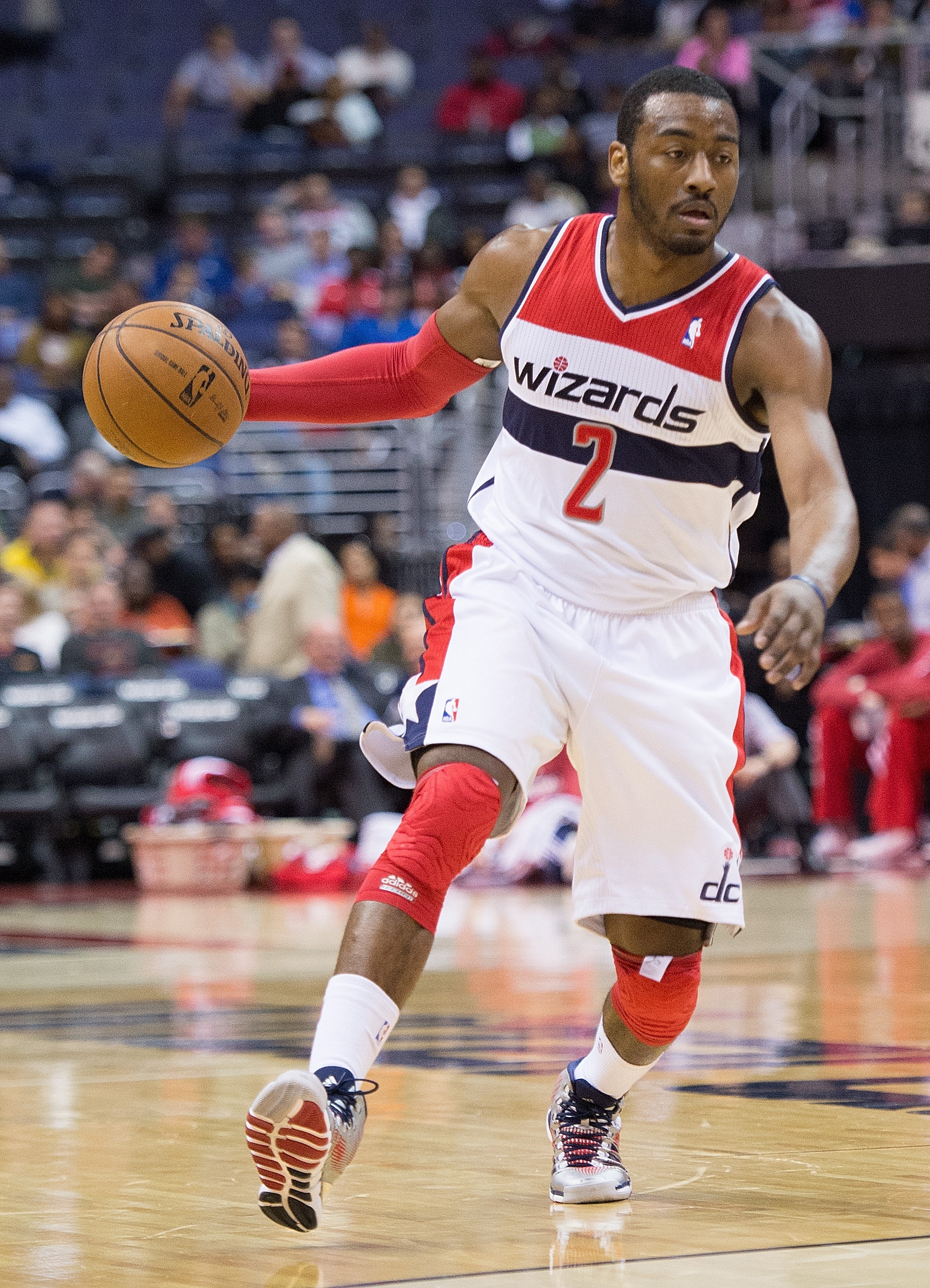
Wizards Update: The Everyone Problem

worried wall

Good thing for the Wizards that the NBA season is long because if it ended today, they’d be out of the playoffs and looking at a 2.8% chance of getting Ben Simmons in the 2016 draft.

Washington is just 7-9 with a scoring differential (weighted for strength of schedule) that ranks 23rd — more than a point per game below 22nd ranked Sacramento. This isn’t what fans (or many analysts) expected after the team escaped the first round of the playoffs each of the past two seasons. Washington was supposed to be an Eastern Conference contender, an echelon below Cleveland, but still a force to be reckoned with.

Not so much.

Leaving aside the issue of whether those expectations were realistic, what’s wrong? Lots. As Dean Oliver wrote, there are four key factors that determine winning and losing in basketball: shooting from the floor (efg), turnovers, rebounding, and free throws. Shooting is the most important of these, and the Wizards are tied for 18th in shooting from the floor. They’re second worst at controlling the ball. They’re 27th in offensive rebounding. They get to the free throw line frequently (sixth best), but overall they rank 28th thus far in offensive efficiency.

The situation isn’t much better on defense. They’re 22nd in defensive efg, average in defensive rebounding, and do a good job of forcing turnovers and keeping opponents off the free throw line. But, making the other team miss is the decisive factor: they rank 20th in defense.

Who’s at fault? Everyone, really.

The front office assembled a roster without a starter-quality power forward. While they made a good trade for Jared Dudley (solid player in exchange for nothing), he’s a small forward they’re asking to masquerade as a stretch four. He can get by in the S4 role off the bench, but his lack of rebounding (low career numbers even for a SF), size and athleticism gets exposed against starters. Kris Humphries is a backup; Drew Gooden a bench-warmer; Nenê is aging and injured.

The team obviously established a goal of preserving cap space for free agents in 2016, but wasted short-term signings on Gary Neal, Alan Anderson and Ryan Hollins.

So, put “front office” at the top of the “at fault” list — even without diving down the rabbit hole of botched draft picks and free agent acquisitions in previous years.

Next up: the coaching staff. This season, the team’s braintrust decided to enter basketball modernity by cutting back on two-point jump shots and taking more threes. This shift should have helped the offense run more efficiently even with the team shooting slightly worse from three-point range, but Randy Wittman and company confounded the issue by coupling changed shot selection with playing faster.

The problem: playing faster has nothing to do with playing better. Smart coaching emphasizes strategies that improve efficiency. Swapping two-point jumpers for threes, at-rim attempts and free throws is smart. Playing faster because it’s fashionable is not. (Especially when analysis of the team the past few years suggests the Wizards may have been better in slower-paced games.)

There’s room on the “blame bus” for the players, and rightfully so — virtually everyone who wears the Wizards uniform is under-performing. The only players with a PPA (see below) higher than last year are Otto Porter and Gary Neal, and Porter’s production has cratered since a promising start.

Despite back-to-back outstanding games (vs. Cleveland and the Lakers), John Wall’s PPA is 15 points lower than last season. Marcin Gortat’s production is down 42 points. Bradley Beal is “about the same” (down three points in PPA), but now in his fourth season still rates just average.

Kris Humphries, Jared Dudley, Ramon Sessions, Nenê, Drew Gooden, and Garrett Temple are all performing worse so far this season. All are showing double-digit drops in PPA.

For crissake, even DeJuan Blair, coming off the worst season of his career, is performing worse.

While they don’t belong on the “blame bus,” the Eastern Conference gets some credit for Washington’s poor start. Last season, a stat goober whose name I can’t remember (please take/give credit where it’s due if you read this and know who I’m talking about) estimated that top five teams in the East gained about three wins in 2014-15 because of the sorry state of the conference. This year, several Eastern teams improved while the Wizards attempted to be about the same.

How can the Wizards get better?

  1. De-emphasize pace. Stop worrying about trying to be like Golden State, and play at a pace that makes sense for the roster currently in place. Change the emphasis to valuing possessions and getting good shots, and look for offensive efficiency to rise.
  2. Get Wall and Gortat back to normal. Both are established veterans with production levels significantly better than what they’ve done thus far. It’s hard to believe they’re going to continue playing this poorly.
  3. Get improvement from Beal and/or Porter. Unfortunately, Beal continues to show improvement. He’s much the same player (in terms of overall impact) as he was in his rookie year. Porter started the season well, but has struggled since as teams developed a scouting report. Now it’s time for Porter to come up with ways to produce anyway.
  4. Make a trade. They don’t have a starter-quality PF on the roster.

The season is still young and the Wizards are probably going to start playing better. But, that’s what the Nationals kept saying, and then they ran out of games and the story of their 2015 season was they just weren’t good enough. For the Wizards, there’s an added concern because they need to be good enough to persuade a prominent free agent to join the young core.

Player Production Average

The ratings below are a metric I developed called Player Production Average (PPA). In PPA, players are credited for things they do that help a team win, and debited for things that don’t, each in proportion to what causes teams to win and lose. PPA is pace neutral, accounts for defense, and includes an adjustment based on the level of competition faced when a player is on the floor. In PPA, average is 100, higher is better, and replacement level is 45.

League-wide PPA scores through games played 12/03/15 are here.

PLAYER GAMES MPG 11/10 11/22 PPA
John Wall 16 33.7 153 129 136
Marcin Gortat 16 28.9 91 112 128
Otto Porter 16 32.1 144 158 104
Bradley Beal 13 35.5 128 108 96
Kris Humphries 16 17.6 90 121 95
Jared Dudley 15 24.7 36 92 90
Ramon Sessions 16 17.8 131 119 84
Nene Hilario 12 17.4 58 90 80
Gary Neal 14 19.6 23 49 64
Drew Gooden 6 12.8 99 51 57
Garrett Temple 14 15.8 38 106 57
Ryan Hollins 1 11.0     -40
Kelly Oubre 11 7.5 -103 -4 -40
DeJuan Blair 6 8.5 -345 -129 -112

Wizards Update: Porter Leading The Way

otto porter

I have to say I’m pretty torn on the Wizards so far. On one hand, they’re 6-4 despite injuries to Bradley Beal, Alan Anderson and Martell Webster, as well as growing pains as they figure out how their personnel can mesh with their new Pace & Space offense.

Sticking with the positives: Otto Porter is having a terrific season (leads the team in PPA — see below), and they’re getting some decent play Ramon Sessions, Nenê and Jared Dudley off the bench.

On the other hand…John Wall — despite his publicly stated desire to be an MVP candidate this season — is performing like a pretty average starter, the team seems to crumble whenever Kris Humphries is on the floor (despite decent production from Humphries), and Marcin Gortat is lost on offense.

Since I believe Wall and Gortat will perform more like they did last season, my biggest area of concern is at power forward. Humphries continues to be fairly productive, and has even added a three-point shot. So far this season, he’s at .412. An analysis I did in July suggested .365 could be anticipated.

The problem: the Wizards collapse when he’s out there. So far, Washington is 5.2 points per 100 possessions worse offensively and 5.9 points per 100 possessions worse defensively (net -11.1 points per 100 possessions) when Humphries is out there. While the results are a bit extreme because of the small sample size, keep in mind the Wizards were worse on both ends of the floor with Humphries last season, and Boston was worse on offense with him out there.

My theory: Humphries plays like my iPhone 4 trying to load an app. When it’s time for business (like catching a pass), there’s a pause, then a blank screen, then a spinning wheel, and then maybe some action. It could be that Humphries is just better against reserves than starters.

Unfortunately, the Wizards don’t really have a viable option to start at power forward. Nenê can’t be relied on in that role, and moving him into the starting lineup leaves the team without a reserve center. I’m dubious about Jared Dudley as a viable option — he’s been a below-average rebounder for a SMALL forward throughout his career. (It’s worth mentioning that in the tiny sample size recorded thus far, Dudley is rebounding at his best rate since his rookie year.)

If the team can’t figure out how to play with Humphries as a starter, they may be forced to start Dudley and take some lumps on the board.

Player Production Average

The ratings below are a metric I developed called Player Production Average (PPA). In PPA, players are credited for things they do that help a team win, and debited for things that don’t, each in proportion to what causes teams to win and lose. PPA is pace neutral, accounts for defense, and includes an adjustment based on the level of competition faced when a player is on the floor. In PPA, average is 100, higher is better, and replacement level is 45.

League-wide PPA scores through games played 11/22/15 are here.


PLAYER GAMES MPG 11/10 PPA
Otto Porter 10 32.9 144 158
John Wall 10 32.7 153 129
Kris Humphries 10 20.8 90 121
Ramon Sessions 10 18.0 131 119
Marcin Gortat 10 27.5 91 112
Bradley Beal 7 33.9 128 108
Garrett Temple 8 15.4 38 106
Jared Dudley 9 21.7 36 92
Nene Hilario 9 18.6 58 90
Drew Gooden 6 12.8 99 51
Gary Neal 10 18.7 23 49
Kelly Oubre 6 10.0 -103 -4
DeJuan Blair 4 8.5 -345 -129


Wizards Renovated Offense Needs Time

beal rips

The Washington Wizards have embarked on a major renovation of their offense, and while the results are decidedly mixed through their first six games, the right thing is to stay the course and see if players can grow into new roles.

Last season, the Wizards were 18th in pace and 28th in three-point attempt rate (the percentage of field goal attempts from three-point range). So far in 2015-16, they’re second in pace (a whopping 8.4 possessions per 48 minutes faster) and 12th in three-point attempt rate.

The positives so far: decent shooting and an uptick in trips to the free throw line. The negatives: the league’s worst turnover rate, a drop-off in rebounding effectiveness, and an elevated opponent shooting percentage.

While patience is warranted as the team figures out how to operate in the new system, the emphasis on playing at a fast pace continues to be a concern for me. Why? Because pace of play has nothing to do with what causes teams to win games. Go through the record of games and seasons, and you’ll find good (and bad) teams that played fast, slow and in-between. What makes sense is for a team to play at a pace where it’s comfortable, where the players are under control, and where it can get good shots and maximize efficiency. If that’s fast, then play fast. If it’s slower, then slow down.

At the risk of oversimplifying, basketball is a game where teams take turns with the ball until the clock runs out. The number of possessions are about the same for each team over the course of a game — sometimes there’s a possession or two variance based on end-of-period exchanges. Playing fast doesn’t get a team extra possessions because no matter how quick they shoot the ball, the other team gets it back. What matters is efficiency — generating more points on your possessions than the other guy does on his.

The emphasis on playing fast — at least as it’s been implemented by the Wizards so far — seems misguided to me. Pushing the ball up the floor every possession is a good strategy because it can stress the defense, catch defenders out of position, and give Washington more time to run its half court offense. But if rushing leads to more turnovers, and weakened defensive rebounding, the strategy is missing the point.

What really concerns me about the “play fast” mantra is the question of whether the Wizards truly have a grasp on what’s important for a team to win. There’s a palpable feeling that they’re mimicking Golden State without a true understanding of why that style of play works for the Warriors, and how it fits Washington’s personnel. What wins games in the NBA? Doing these things better than the opponent (in order of importance): shooting from the floor, controlling turnovers, getting to the free throw line, and rebounding. Pace ain’t on the list.

Player Production Average

The ratings below are a metric I developed called Player Production Average (PPA). In PPA, players are credited for things they do that help a team win, and debited for things that don’t, each in proportion to what causes teams to win and lose. PPA is pace neutral, accounts for defense, and includes an adjustment based on the level of competition faced when a player is on the floor. In PPA, average is 100, higher is better, and replacement level is 45.

PLAYER GAMES MPG PPA
John Wall 6 34.8 153
Otto Porter 6 34.0 144
Ramon Sessions 6 17.2 131
Bradley Beal 6 34.7 128
Drew Gooden 4 15.0 99
Marcin Gortat 6 28.0 91
Kris Humphries 6 20.5 90
Nene Hilario 6 18.0 58
Garrett Temple 4 3.5 38
Jared Dudley 5 21.6 36
Gary Neal 6 17.7 23
Kelly Oubre 3 5.3 -103
DeJuan Blair 2 6.0 -345

In many ways, I find these numbers (drawn from a small sample size) encouraging. The team’s most productive players so far are its youthful trio of high draft picks: John Wall, Otto Porter, and Bradley Beal.

It’s hard to believe veterans like Marcin Gortat and Jared Dudley will continue playing this poorly. Look for Nenê’s production to improve some as well.

On the other hand, don’t expect big jumps in productivity from DeJuan Blair (who apparently has forgotten how to play basketball), Gary Neal and Garrett Temple.

Also, much as I hate to write it, I think Porter’s PPA is ripe for a drop-off. It’s not likely he’ll continue to shoot 70% from two-point range or have a 60-plus percent efg.

Projection: Wizards to Win 42

wall 02My 2015-16 Wizards preview is up at Vice Sports. I won’t steal my own thunder much, except to say that my projection approach says the Wizards will win 41-42 games this season. Not as encouraging as I’d hoped, and I had some mild surprises in the numbers — younger players not being predicted to improve as much as I’d have intuitively expected.

At any rate, please click over and give it a read at Vice.