NBA Playoffs: What Are The Odds?

steph curry

Okay, I’ve tried several different ways to talk myself into predicting that the Wizards will somehow beat the Toronto Raptors in the first round of the playoffs and meet their doom in a second round matchup with the Atlanta Hawks. Hasn’t worked, though.

I know Toronto struggled over the last couple months of the season. So did the Wizards. I know the Raptors have a not-so-good coach. So do the Wizards. In a way, the two teams are opposing images of the other. Washington has a good defense and a crummy offense; Toronto has a terrific offense and a bad defense. The key difference: Toronto is better.

The gap between the teams isn’t oceanic. Washington’s odds in any one particular contest in the upcoming series aren’t awful. They have basically a 41% chance of winning at Toronto and a slightly better than coin flip odds of winning at home. In terms of probability, it would be something like winning three straight coin flips, and then winning a “loaded” toss where the odds have been lowered from 50-50 to 60-40. It’s possible, but not likely.

The Wizards could be helped a bit by Kyle Lowry’s iffy back, but the numbers accumulated over a six-month season say they’ll be lucky to pull off the upset. On the bright side for fans hoping to at least be entertained, there’s only about a 9% chance the Raptors sweep.

As you can see from the table below, the Wizards are significant underdogs against the Raptors. The only teams with worse odds of winning their first round series are the eight seeds (Brooklyn and New Orleans), and the East’s seven seed (Boston). The best chances for first-round upsets come in the more balanced West. Houston vs. Dallas and the Clippers vs. the Spurs look to tight.

The best chance for a seeding upset is likely to happen in the second round where the Clippers would be favored against either Houston or Dallas.

The numbers suggest that Golden State — the league’s best team all season — has the best chance of winning the championship this season. I actually estimate them with a better than 50% chance of being champions. Despite coasting through the last few weeks of the season, Atlanta finished the regular season as the East’s best team by a significant margin. They’ll be tested in the Eastern Conference Finals against Cleveland and Lebron James.

EAST
1st RND HOME ROAD WINNER ODDS
1 vs 8 ATL BRK ATL 91%
2 vs 7 CLE BOS CLE 79%
3 vs 6 CHI MIL CHI 70%
4 vs 5 TOR WAS TOR 70%
2nd RND HOME ROAD WINNER ODDS
1 vs 4 ATL TOR ATL 69%
2 vs 3 CLE CHI CLE 64%
ECF HOME ROAD WINNER ODDS
1 vs 2 ATL CLE ATL 61%
WEST
1st RND HOME ROAD WINNER ODDS
1 vs 8 GSW NOP GSW 92%
2 vs 7 HOU DAL HOU 58%
3 vs 6 LAC SAS LAC 57%
4 vs 5 POR MEM POR 61%
2nd RND HOME ROAD WINNER ODDS
1 vs 4 GSW POR GSW 83%
2 vs 3 HOU LAC LAC 65%
WCF HOME ROAD WINNER ODDS
1 vs 3 GSW LAC GSW 73%
FINALS HOME ROAD WINNER ODDS
1 vs 1 GSW ATL GSW 98%

Wizards Update: A Season of Discontent

wall 02

The Wizards concluded the regular season portion of a #SoWizards season losing back-to-back overtime games. The first of those losses — a double overtime snoozer against Indiana — was perhaps the most #SoWizards moment of the season: on the eve of the playoffs, Randy Wittman played John Wall, Marcin Gortat, Bradley Beal, Otto Porter and Drew Gooden more than 38 minutes each in a desperate effort to win a game that meant literally nothing to the Wizards.

Washington concluded the season 46-35, two wins better than last year’s record (and one game better than my pre-season projection). And yet, there’s a pervasive discontent with the team and its management. Some of the disappointment is a reaction to expectations that were pushed beyond the bonds of reality when the team was rolling through the junior varsity portion of their early-season schedule.

The dissatisfaction may run deeper than simply feeling let down that Washington didn’t get to 50-plus wins for the first time since the 1978-79 season. I think part of the reaction is the collective realization that what’s been sold to Wizards fans the past couple seasons has been kind of a fraud.

Getting above .500 and making the playoffs was supposed to be a sign of growth. It was supposed to be a progression. First, have a chance to win most nights. Second, make the playoffs and gain valuable experience. Third, build on that trip to the playoffs and ride the improvement of the team’s young core to deeper and deeper postseason runs until they can compete for a title.

But, making the playoffs has been built largely on NBA senior citizens who had something left in the tank, but not much of a future. In the span of a few short years, the Wizards paid a steep price in player acquisition resources to construct and old team. Sure, the old guys can be replaced, but the man leading the rebuild is likely to be the same one who steered the franchise into a ditch and then perpetrated the “fraud.” There is little reason to have confidence in Ernie Grunfeld reconstructing the roster in a manner that will make it anything other than a mid-level playoff team.

Meanwhile, their young core — Wall, Beal and Porter — hasn’t improved much. Wall has made the biggest improvement, yet still ranks solidly below the game’s elite. The best that can be said of Beal and Porter is that they possess potential. Whether that potential ends up getting translated into meaningful production is a question mark, especially considering how poorly the team is coached.

In general, fans overrate the impact of coaches. It’s clear, however, the Wizards operate at something of a disadvantage because of Randy Wittman’s antiquated notions of offensive basketball. Washington actually shoots the ball decently, but they’re rendered less efficient than they could be by their reliance on two-point jumpers. As has been pointed out numerous times by numerous commentators, two-point jumpers are exactly the shot the defense wants an opposing offense to take. The Wizards offense is built around that shot.

It’s almost impossible to unpack how much Wittman’s offense hinders the Wizards. I’ll give it a shot during the offseason, though.

On the bright side, there’s the team’s defense — fifth best in the league this year, and in a virtual tie with Golden State for league’s best over the last half of the season.

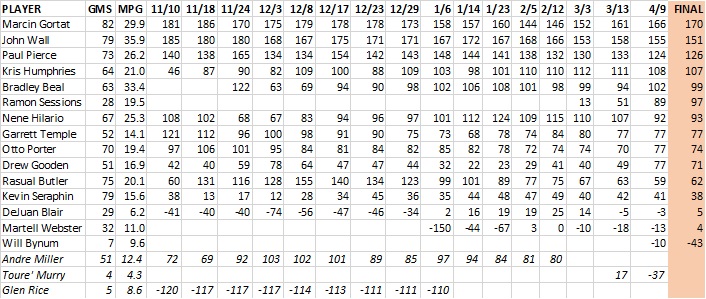
I’m hoping to have some playoffs analysis up tomorrow, but for now, here are the final PPA numbers for the Wizards.

Player Production Average Update

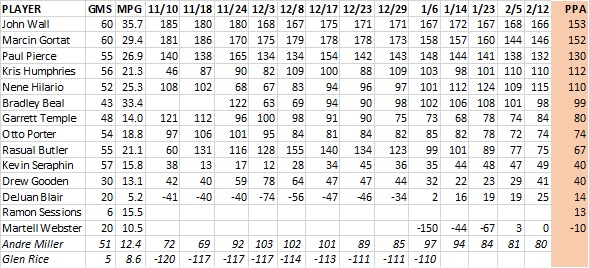
Player Production Average (PPA) is an overall rating stat I developed that credits players for things they do that help a team win and debits them for things that hurt the cause. PPA is pace neutral, accounts for defense, and includes a “degree of difficulty” factor based on the level of competition a player faces while on the floor. In PPA, 100 = average, higher is better and replacement level is 45.

The numbers under each date represent the player’s PPA for the entire season to that date. The number in the far right column (labeled PPA) is the player’s current PPA through games played last night. For a look at how players on other teams rate, visit here.
2015-04-17 -- wiz ppa

Perhaps Wall was cruising over the last couple months of the season. He still ended up with the best PPA of his career (he posted a 139 each of the preceding two seasons), but I’m convinced he’s capable of MUCH more. The areas for biggest improvement remain what they’ve been since he entered the league: shooting from the floor and turnovers.

By my reckoning, this was the second best season of Gortat’s career (the best was a 186 PPA with Phoenix (and Steve Nash) in 2011-12). He was edged out by Wall in total production because Wall played more minutes. He’s not an elite center, but he’s more than solid.

Paul Pierce made news this week with candid comments in an interview with ESPN. While his production has declined during the season, his overall performance has been remarkable for his age. In my historical database (which goes back to 1977-78), Pierce’s 126 PPA is the best season for a 37-year old SF. The closest contenders are Scottie Pippen (120) and Dominique Wilkins (119).

After those three, it’s difficult to generate much to say that’s positive. Beal ended up a hair below average for a third straight season. Nenê continued to decline. This was his least productive season since he was 25 years old. It’s a good thing his contract expires after next season.

The bright side for Washington is that they play in the epically weak Eastern Conference. As mediocre as they are (and they are mediocre), they have a chance in the first round against the vulnerable Toronto Raptors. More on that tomorrow.

Wizards Update: The Home Stretch

sessions ramon

There’s a temptation to note the Wizards have won four in a row and five of their last six and conclude they’re headed for the playoffs in good form. I don’t share that optimism, however. This is a stretch of games where Washington was expected to win with four games against three of the league’s weakest teams — Charlotte (21st in Simple Rating System — a power ranking published by Basketball-Reference.com that combines scoring differential with strength of schedule), New York (30th) and Philadelphia (29th) twice.

Failing to win at least four of the six would have been cause for real concern. Getting an “extra” win against Memphis was encouraging, although it’s worth noting the Grizzlies were coming off a hard-fought win against Oklahoma City the previous night while the Wizards coasted to an easy (and restful — the only starter to play more than 30 minutes was Bradley Beal) over the hapless Knicks.

The Wizards aren’t “fixed,” they’re playing bad opponents. It’s good that they’re beating those teams, but that’s not the same as saying they’re in good shape. Realistically speaking, they continue to look how they’ve looked all season — a slightly better than average team that feasts on the 99-pound weaklings in the East and can sometimes summon the game to challenge (and even beat) a good team if stuff goes right for them and wrong for the other side.

The preceding is talking about the team’s big picture. The overall. They’re excellent on defense, and have been since the end of January. Unfortunately, their offense has been terrible during the same time frame. Since the playoffs are about to start, we’re about to hear a bunch of the old maxim that defense wins in the postseason. Like a lot of truisms, it’s half true. Unless the Wizards are able to operate with some level of offensive efficiency against higher-quality opponents, they’re not going deep in the playoffs.

I’ll get more into postseason matchups when the regular season concludes, but it does help that Washington is in the East. First, because they’ll be in the playoffs at all. Out West, they’d at best be scrapping for the eighth seed. In their actual conference, they’ll have a punchers chance in the first round against Toronto or Chicago.

Player Production Average Update

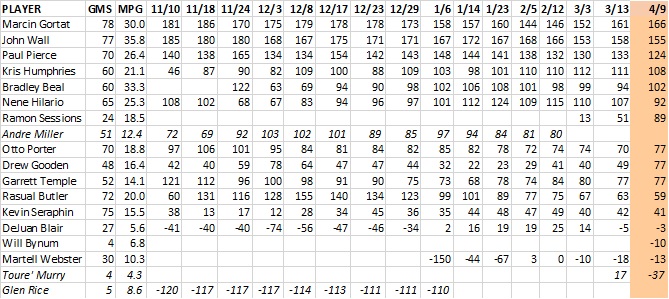
Player Production Average (PPA) is an overall rating stat I developed that credits players for things they do that help a team win and debits them for things that hurt the cause. PPA is pace neutral, accounts for defense, and includes a “degree of difficulty” factor based on the level of competition a player faces while on the floor. In PPA, 100 = average, higher is better and replacement level is 45.

The numbers under each date represent the player’s PPA for the entire season to that date. The number in the far right column (labeled PPA) is the player’s current PPA through games played last night. For a look at how players on other teams rate, visit here.

2015-04-09 -- wiz ppaSearching for encouragement as the playoffs approach? Look at Gortat and Wall — both of whom have been consistently good all season. Beal has played better the past few weeks, as have Sessions, Porter and Gooden.

On the other hand, Nenê and Pierce have struggled. The hope is that they’re recharging for the playoffs. But, they’re also the team’s oldest players, and they could be wearing down from the long season.

Wizards Update: Bouncing Back?

sessions

After a lengthy stretch of losing basketball, the Wizards have won four of their last six. Have they shaken off their mid-season swoon? Are they poised to win like it’s November or December?

No, and not likely.

While the Wizards have played better over the past six games, their offense has remained below average, and their defense has been unsustainably fantabulous. During this 4-2 stretch, Washington has allowed its opponents just 96.5 points per 100 possessions. If they managed to do that over a full season, they’d be one of the 15 best defenses since 1973-74 when the league began collecting the stats necessary to calculate defensive rating. For the season, the Wizards are allowing 102.8 points per 100 possessions.

Another factor: they’ve had the good fortune of meeting injury-depleted teams. And even then, the results have been mixed. They lost to Chicago, which was missing Jimmy Butler, Derrick Rose and Taj Gibson. They eked out a two-point victory against Miami, which didn’t have Chris Bosh, Dwyane Wade or Luol Deng. And, they beat the snot out of Memphis, which lacked Mike Conley, Tony Allen, Marc Gasol and Zach Randolph — also known as the Grizzlies’ four best players.

I know Randy Wittman and Ernie Grunfeld have said the Wizards just need to play better on defense and work harder. I respectfully disagree. Their defense — even during the period of sustained losing — wasn’t bad. The decline has been on offense, and it still needs to be fixed.

Player Production Average Update

Player Production Average (PPA) is an overall rating stat I developed that credits players for things they do that help a team win and debits them for things that hurt the cause. PPA is pace neutral, accounts for defense, and includes a “degree of difficulty” factor based on the level of competition a player faces while on the floor. In PPA, 100 = average, higher is better and replacement level is 45.

The numbers under each date represent the player’s PPA for the entire season to that date. The number in the far right column (labeled PPA) is the player’s current PPA through games played last night. For a look at how players on other teams rate, visit here.

2015-03-13 -- wiz ppa

My apologies for the format. The spreadsheet has reached a width that WordPress struggles to accommodate.

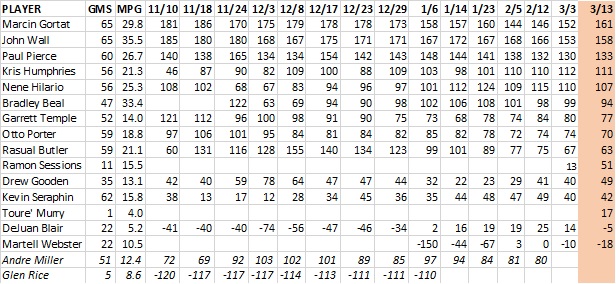
Good weeks for Gortat, Wall, Pierce and Gooden. Not so good for Beal, Temple, Porter and Butler.

Ramon Sessions provided hope with a couple decent games.

Martell Webster isn’t able to physically compete at an NBA level, presumably because of his back.

I’ve thought all season that DeJuan Blair should have been playing ahead of Kevin Seraphin, but Blair looks unable to compete physically at an NBA level because of too much eating and insufficient exercise.

Wizards Update: Death Spiral

wall wtf

When the NBA entered its annual All-Star break, I started work on a piece intended to look at how teams similar to this year’s Wizards throughout league history fared when they reached the playoffs. At the time, Washington was 33-21, and their Simple Rating System (SRS) — a measure of team strength that combines scoring differential with strength of schedule — was +1.67 per game.

In the six games they’ve played since the break, they faced opponents with a combined scoring differential of -1.15. Even an average team would have been expected to win four of the six. The Wizards went 1-5 and were outscored by a whopping 86 points. That’s 14.3 points per game. Even if I throw out the 38-point loss to Cleveland as an aberration, Washington lost the other five by 9.6 points per game. Their SRS now stands at -0.02.

All season, I’ve been writing variations on the theme of “The Wizards Just Ain’t That Good,” but I’m still surprised by their catastrophic collapse since the All-Star break. What’s scary: their remaining 22 games don’t look as easy as they did just a few weeks ago.

Fourteen of their remaining contests are against likely playoff teams. And, the key statistical indicators of team strength I watch are all dipping. This recent stretch of horrific basketball could merely be a rough patch for an average team, but it could also be a signal of an aging group that’s about to flat line.

When I run the numbers through my “who’s gonna win” machine, the results are…well…bad. In a worst-case scenario, the Wizards would limp into the playoffs with just seven wins over their last 22. I think they’ll be better than that, but it’s hard to find more than 11 wins the rest of the way (which, by the way, would give them a final record of 45-37, which happens to be what I projected for them back in October). Barring a miracle about-face, those dreams of a 50-win season will remain just that.

As long as I’m fretting, here’s another reason for Wizards fans to be concerned: this interview of team president Ernie Grunfeld by radio guy Dave Johnson. Presented with respectful softball questions by Johnson, Grunfeld offered his thoughts on how his team could pull out of its skid — and thoroughly misdiagnosed what’s wrong.

In the interview, Grunfeld suggested the team’s biggest problem has been a decline in their defense. He said their results will improve when they play better defense, get out on the fast break and “compete” on a nightly basis.

Here’s a look at the Wizards pre- and post-All-Star break:

TIME PACE ORTG DRTG
Pre-ASB 93.5 105.4 102.9
Post-ASB 96.7 93.4 108.3
CHANGE 3.2 -11.9 -5.4

What the numbers show is that the Wizards have played faster since the All-Star break, but have been worse. Grunfeld gets partial credit on the “play better defense” portion of his prescription since that would be a good thing to do. However, The drop in offensive efficiency is more than double their change in defensive efficiency. That means the team’s struggles are first and foremost because of its offense.

In case you were wondering, forgetting the debacle against Cleveland doesn’t change the analysis. Their defense the past three games has been excellent and yet they lost two because their offense was a horror show. If the Wizards want to start winning, they do need to get better on both ends, but their most important fix will be on offense.

There’s another issue with Grunfeld’s prescription — the data show the team’s offensive and defensive efficiency are uncorrelated. I’ve been tracking offensive and defensive efficiency by pace for years now, and this season’s result is the same as every other year. Good defense doesn’t cause good offense. Good offense doesn’t cause good defense. It’s almost as if offense and defense occur at different ends of the floor.

This season, if the numbers suggest anything it’s the Wizards show a very slight tendency to play better defense when they’re worse on offense. In terms of pace effects, Washington has a very slight tendency to play worse on offense in faster-paced games. But these “effects” are so small they’re basically meaningless.

Player Production Average Update

Player Production Average (PPA) is an overall rating stat I developed that credits players for things they do that help a team win and debits them for things that hurt the cause. PPA is pace neutral, accounts for defense, and includes a “degree of difficulty” factor based on the level of competition a player faces while on the floor. In PPA, 100 = average, higher is better and replacement level is 45.

The numbers under each date represent the player’s PPA for the entire season to that date. The number in the far right column (labeled PPA) is the player’s current PPA through games played last night. For a look at how players on other teams rate, visit here.

2015-03-03 -- wiz ppa

My apologies for the format. The spreadsheet has reached a width that WordPress struggles to accommodate.

Early returns on the Andre Miller for Ramon Sessions trade aren’t good. As the table above shows, Miller had a PPA of 80 with the Wizards; Sessions has managed a Maynor-esque 13 so far. Meanwhile, Miller’s PPA with the Kings is a robust 90 (good for a backup PG). Sessions in Sacramento posted a 16 PPA.

Unsurprisingly for a team that barely ended a five-game losing streak, production for most guys was down. The biggest decliner was John Wall, but he was hardly alone. The team also saw drop-offs from Nenê, Garrett Temple, Rasual Butler, and Kevin Seraphin.

Perhaps the Wizards can turn things around, but it’s an old team that doesn’t have a ton of upside. Over the season’s final 22 contests, Wall will likely play more like he did earlier in the season, but it’s not realistic to think any of the team’s older players have much room for improvement. Maybe Beal or Porter can play better to close out the season, but neither looks ready to provide a surge in production.

Realistically speaking, if the Wizards can go .500 the rest of the way, I’d call it a success. But, winning just seven or eight of their remaining 22 is a realistic possibility as well. That would leave them with 41 or 42 wins, which would almost certainly relegate them to the sixth seed. Where they’d probably draw Cleveland and get bounced from the playoffs in the first round.

So. Wizards.

Wizards Doppelgangers: The Ancients

nene fights

In the classic mode of a franchise finished with rebuilding, and ready to repeat their overwhelming success of the previous season, the Washington Wizards went out this offseason and got older. Yes, I’m sure they’d much prefer if we all thought of it as adding “veterans,” and that’s a fine way of looking at it, if you like.

Understand, I’m not against “veterans,” I’m just aware of the reality that athletes over 30 years old typically do two things: get hurt and get worse. Hopefully, Father Time will give the Wizards a reprieve until the summer of 2016 when Kevin Durant is a free agent.

It could happen.

Last week, I ran the Wizards young backcourt (John Wall and Bradley Beal) through my statistical doppelganger machine. Today, let’s look at the oldsters Washington has added in recent years: Nenê, Marcin Gortat, Paul Pierce, Andre Miller, Drew Gooden and Rasual Butler. (Please take a look back at that link above for notes about the method.)

PLAYER POS SEASON AGE TEAM SIM SCORE PPA SEASON PPA PEAK
Nenê PF 2013-14 31 WAS 100 102 176
Danny Manning PF 1996-97 30 PHO 90 107 157
Clifford Robinson PF 1997-98 31 PHO 90 131 143
Ruben Patterson SF 2006-07 31 MIL 89 126 165
Mickey Johnson PF 1983-84 31 GSW 88 83 145
Elton Brand PF 2009-10 30 PHI 87 100 224
Christian Laettner PF 1997-98 28 ATL 87 127 146
Jermaine O’Neal C 2008-09 30 TOR/MIA 87 93 166
Matt Harpring SF 2005-06 29 UTA 87 105 161
Frank Brickowski C 1992-93 33 MIL 87 117 123
Antoine Carr PF 1992-93 31 SAS 87 106 109

The good news is that these doppelgangers were pretty good players. Nenê had the second highest peak PPA behind Elton Brand’s 224. He also peaked about a year later than the average for this group. Frank Brickowski and Clifford Robinson each peaked past 30.

But, Nenê’s production has slipped the past couple years, as has his availability, and there isn’t much reason to think he’ll regain something close to that peak performance. His comps offer an ideal optimist vs. pessimist test: five of his ten most similar players performed better the following season, give performed worse.

PLAYER POS SEASON AGE TEAM SIM SCORE PPA SEASON PPA PEAK
Marcin Gortat C 2013-14 29 WAS 100 154 186
Bill Laimbeer C 1986-87 29 DET 93 154 175
Mike Gminski C 1989-90 30 PHI 90 129 170
Bill Laimbeer C 1988-89 31 DET 90 144 175
Dave Robisch C 1979-80 30 CLE 90 132 132
P.J. Brown PF 1998-99 29 MIA 89 127 150
Bill Laimbeer C 1985-86 28 DET 89 156 175
Billy Paultz C 1977-78 29 SAS 89 164 164
Tom Gugliotta PF 1999-00 30 PHO 89 147 176
Maurice Lucas PF 1981-82 29 NYK 89 149 149
Luis Scola PF 2008-09 28 HOU 88 143 143

Obviously, Gortat isn’t really an “ancient.” He’s just 30 years old, he’s played relatively few minutes for a player his age, and he’s a fitness fanatic. But, eight of the ten most similar seasons to the one Gortat posted last year were followed by a less productive season.

If I throw out the two least similar seasons from Laimbeer, each of the 10 seasons most similar to Gortat last season were followed by a season that was less productive. Bright side here: it’s not like these comps became catastrophic failures. In general, they remained productive…just not quite as good.

PLAYER POS SEASON AGE TEAM SIM SCORE PPA SEASON PPA PEAK
Paul Pierce SF 2013-14 36 BRK 100 131 173
Toni Kukoc PF 2002-03 34 MIL 85 113 164
Vince Carter SF 2012-13 36 DAL 84 107 200
Chris Mullin* SF 1997-98 34 IND 84 156 182
Sam Perkins PF 1996-97 35 SEA 84 119 147
Bob Lanier* C 1983-84 35 MIL 83 152 138
Chris Mullin* SF 1998-99 35 IND 83 168 182
Sam Perkins PF 1994-95 33 SEA 83 132 147
Sam Perkins PF 1995-96 34 SEA 82 114 147
Chucky Atkins PG 2006-07 32 MEM 82 111 111
Terry Porter PG 1998-99 35 MIA 82 114 211

Gotta say that Pierce’s set of doppelgangers may be the weirdest assemblage of players I’ve gotten from The Machine. I think the challenge here is that not very many players even last to age 36 (plus), so the pool is shallow. Note that Pierce’s most similar player has a Sim Score lower than the 10th most similar for Wall, Beal, Nenê and Gortat. In other words, the list above are kinda similar, but not super close.

Overall, this is a terrific group of players that tended to peak young (around age 25-26 — Pierce peaked at 24), but had long-lasting careers. As would be expected for a group of mid-30s athletes, most declined the following season. However, most remained decent players for another year or two.

PLAYER POS SEASON AGE TEAM SIM SCORE PPA SEASON PPA PEAK
Andre Miller SG 2013-14 37 TOT 100 89 172
Rod Strickland PG 2003-04 37 ORL/TOR 90 81 176
Terry Porter SF 2001-02 38 SAS 88 87 211
Mark Jackson PG 2002-03 37 UTA 86 66 181
Don Buse PG 1983-84 33 KCK 86 96 148
Toni Kukoc SF 2004-05 36 MIL 85 84 164
Muggsy Bogues PG 1998-99 34 GSW 85 111 153
Maurice Cheeks PG 1992-93 36 NJN 85 89 180
Rod Strickland PG 2002-03 36 MIN 85 95 176
Gary Grant PG 1997-98 32 POR 84 108 115
Rickey Green PG 1991-92 37 BOS 84 57 157

Miller’s comps are an interesting assemblage of good-to-great players. I was surprised to see Muggsy Bogues make the list, primarily because I’d forgotten the 5-3 Bogues played so many seasons. Just about everyone on this list had a good career, but…as should be expected for a group this old — all 10 either declined or were out of the league completely the following season.

PLAYER POS SEASON AGE TEAM SIM SCORE PPA SEASON PPA PEAK
Drew Gooden C 2013-14 32 WAS 100 106 169
Nazr Mohammed C 2010-11 33 CHA/OKC 86 98 150
Chris Wilcox PF 2010-11 28 DET 86 121 165
Antonio McDyess PF 2006-07 32 DET 86 115 175
Joe Smith PF 2005-06 30 MIL 85 89 143
Nazr Mohammed C 2009-10 32 CHA 85 150 150
Antonio McDyess PF 2005-06 31 DET 85 91 175
Jermaine O’Neal C 2012-13 34 PHO 83 83 166
Chris Kaman C 2012-13 30 DAL 83 101 130
Frank Brickowski PF 1991-92 32 MIL 83 107 123
Chris Gatling PF 1995-96 28 GSW 83 82 131

For Gooden, I wonder whether these comps are particularly meaningful given that he was signed late in the season and played in fairly few games. This group basically split between those who declined the following season and those who got better. The net effect is that the group average was “about the same.” So, it could be a case of lather-rinse-repeat with Gooden this season — albeit with more total minutes.

PLAYER POS SEASON AGE TEAM SIM SCORE PPA SEASON PPA PEAK
Rasual Butler SG 2013-14 34 IND 100 63 89
Steve Kerr PG 1999-00 34 SAS 92 59 124
Jalen Rose SF 2006-07 34 PHO 89 72 117
Matt Bullard PF 1998-99 31 HOU 87 49 98
Jaren Jackson SG 2000-01 33 SAS 87 44 90
Anthony Bowie SG 1997-98 34 NYK 86 72 97
Eric Piatkowski SG 2004-05 34 CHI 86 79 121
Rashard Lewis PF 2012-13 33 MIA 85 60 165
Steve Kerr PG 2001-02 36 POR 85 64 124
Eric Piatkowski SF 2007-08 37 PHO 84 34 121
Eric Piatkowski SG 2005-06 35 CHI 84 16 121

Last up for today: the 15th man, Rasual Butler. You’ll notice this list is heavy on Eric Piatkowski, which isn’t exactly a great thing. Piatkowski hung around into his late 30s for some reason I don’t remember. Perhaps he had a contract that was being passed around. Perhaps he’s a really nice guy. There wasn’t much reason to keep him because of his on-court performance.

Otherwise, it’s mostly swingmen who peaked at the level of an average starter (Rashard Lewis excepted) and then declined. In limited minutes, Butler will probably play a little above replacement level this season. I’d have preferred this roster spot went to someone younger and with potential to improve.

Tomorrow: the rest of the roster.