My 2015-16 Wizards preview is up at Vice Sports. I won’t steal my own thunder much, except to say that my projection approach says the Wizards will win 41-42 games this season. Not as encouraging as I’d hoped, and I had some mild surprises in the numbers — younger players not being predicted to improve as much as I’d have intuitively expected.
A few years back, I embarked on an effort to develop a statistically-based, objective method of evaluating prospects for the NBA draft. I make no claims that it’s perfect, but I’ve found the results decent enough, albeit not yet subjected to rigorous analysis. That’s coming.
When I get time.
Someday.
On the Wizards message board at RealGM, I referred to the effort a few times as “Ye Olde Draft Analyzer,” someone called it YODA, and the name stuck. YODA isn’t complex — at least not yet. It’s built on the Player Production Average metric I devised that credits players for things they do to help their teams win, and debits them for things they do that hurt the cause — each in proper proportion. YODA takes each player’s production (box score stats) then applies adjustments for position, age, team strength/level of competition, and objective measures of physical attributes (combine measurements and times).
In general, YODA likes efficient players who shoot well, rebound well, assist without committing turnovers, and generate blocks and steals without fouling too much. Being on a good team that plays a challenging schedule is also helpful, but not determinant — players like Kenneth Faried, Paul Millsap and Danny Granger had excellent ratings despite not playing for traditional powers.
YODA’s biggest limitation is international players. I haven’t had the time to research the numbers posted by prospects overseas, or to objectively assess the quality of the competition they face. Rather than guessing, I’ve chosen to leave them out of the process for now. Given the global nature of the draft, that’s a significant limitation, and it’s one I hope to fix for next year.
My belief on draft strategy is that the smart move is to pick the best player available, even if he doesn’t fit an immediate need. My approach is to first rate players in absolute terms, then group them into tiers of “about the same.” The idea is that when several players of “about the same” quality are available when your team’s pick comes, the team can pick the player they think best fits current needs. But, don’t reach into a lower tier for a perceived need. Just pick the better player and make another move down the road, if necessary.
Here’s this year’s draft in order of both absolute value according to YODA, and divided by tier.
TIER ONE
Karl-Anthony Towns, PF, Kentucky
Jahlil Okafor, C, Duke
TIER TWO
D’Angelo Russell, PG, Ohio State
Frank Kaminsky, C, Wisconsin
TIER THREE
Rondae Hollis-Jefferson, SF, Arizona
Kelly Oubre, SF, Kansas (EDITED position due to corrected measurements)
Delon Wright, PG, Utah
Cameron Payne, PG, Murray State
Bobby Portis, PF, Arkansas
TIER FOUR
Justise Winslow, SF, Duke
Myles Turner, C, Texas
TIER FIVE
Jerian Grant, PG, Notre Dame
Robert Upshaw, C, Washington
Willie Cauley-Stein, C, Kentucky
Sam Dekker, SF, Wisconsin
Devin Booker, SG, Kentucky
TIER SIX
Kevon Looney, PF, UCLA
Tyus Jones, PG, Duke
Cliff Alexander, PF/C, Kansas
Terry Rozier, G, Louisville
Justin Anderson, SF, Virginia
Stanley Johnson, SF, Arizona
TIER SEVEN
Briante Weber, PG, VCU
Bryce Jones, SG, Iowa State
Aaron White, PF, Iowa
Trey Lyles, PF, Kentucky
Montrezl Harrell, PF, Louisville
TIER EIGHT
Richaun Holmes, PF, Bowling Green
Pat Connaughton, SG, Notre Dame
R.J. Hunter, SG, Georgia State
In simple terms, the first round grades end with Tier Six. If things go more or less the way the mock drafts predict, the Wizards may be able to select a PG from Tier Three (Delon Wright), or perhaps a PF with potential like Looney.
While I fully expect the Wizards to sell or give away their second round pick, I think there may be some opportunities to get potentially useful players on inexpensive contracts with additional second rounders. I’d be interested in taking a guy like Cliff Alexander, or even Robert Upshaw (assuming he’s medically cleared to play despite a heart condition).
The consensus view on this year’s draft seems to be that it’s top heavy with a steep drop-off in talent after the lottery. I don’t really see that in the numbers. Towns and Okafor are a relatively weak top two, and the drop in ratings isn’t any greater than it is in most years. In other words, it looks like a draft.
Feel free to tweet me if you have questions about specific players. I’ve analyzed most seniors, and virtually all of the early entrants (except for the international players).
EDITED on June 30 when I was able to confirm that Kelly Oubre’s standing reach, as measured at the scouting combine, was incorrect. When the measurement was corrected, Oubre moved from Tier Four to Tier Three.
Just numbers because…no time. This is through games played on May 10, 2015.
Player Production Average (PPA) is an overall rating stat I developed that credits players for things they do that help a team win and debits them for things that hurt the cause. PPA is pace neutral, accounts for defense, and includes a “degree of difficulty” factor based on the level of competition a player faces while on the floor. In PPA, 100 = average, higher is better and replacement level is 45.
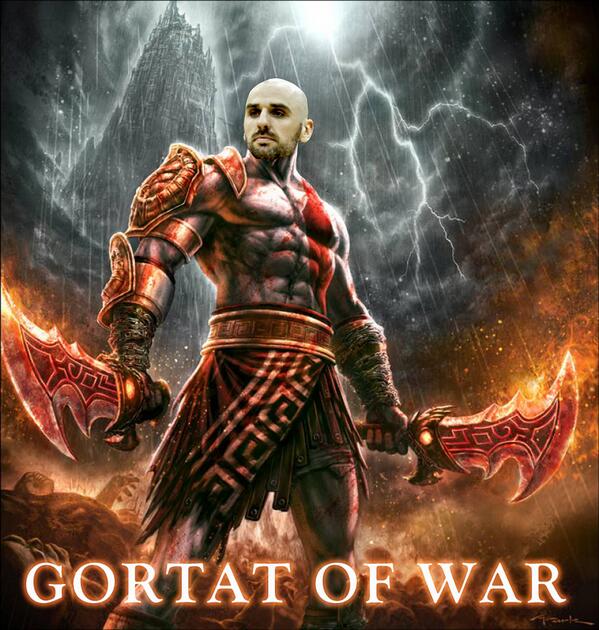
The Washington Wizards vanquished the Toronto Raptors in the first round of the NBA playoffs thanks to an innovative approach conceived by team president Ernie Grunfeld, funded by owner Ted Leonsis, and implemented by head coach Randy Wittman. Drawing upon unique abilities possessed by point guard John Wall, Wittman and Grunfeld developed a plan that in the days before the playoffs sent Wall and center Marcin Gortat on a (until now) top secret mission to prehistoric times.
“It was just a little time travel,” Wall said, stifling a yawn. “Just doing whatever I can to help my teammates out.”
” ‘Time travel?’ He said that?” Wittman snapped when told of Wall’s comment. “Okay, first of all, it’s not time travel. It’s just a way of using John’s ability to alter the space-time continuum to bridge the interdimensional gap between this reality and another in which conditions very much like our prehistoric era continue to exist.”
According to sources, Wall was essential to executing the project, but Gortat volunteered.
“We were going to play Raptor,” the Polish center said. “This way I could study real raptor, see how it move, see how it fight, see how it love. I fight six velociraptor at same time — hand-to-hand. After that, Toronto Raptor not so tough.”
While Gortat engaged in mortal battle with ferocious dinosaurs from the later Cretaceous Period, Wall did no fighting and did not engage with the ferocious reptiles.
“I’m competitive, but I’m not a fighter,” Wall said. “i just mostly slept.”
While Wall’s account of an extended nap — made necessary, he said, by the rigors of time travel — had its charm, it did not stand up to investigation. In reality, Wall executed the second part of the Grunfeldian Plan, and tracked down a pubescent Paul Pierce.
“Paul’s one of the oldest players in the league, and we were concerned about his physical condition,” said Wizards vice president Tommy Sheppard, speaking on condition of anonymity. “By sending John and March back seventy-one million years, we felt we could get March first-hand experience with some velociraptors and we could do something to help Paul get back to top form. This was definitely a two birds, one stone kind of thing.”
Wall’s mission was to locate the young Pierce and persuade him to provide biological samples, including blood, spinal fluid and stem cells. The samples would then be combined in Wittman’s laboratory, located deep beneath the Verizon Center, into a genetic cocktail that would rejuvenate the aging Pierce.
“Gotta say it didn’t take much convincing,” Wall said when he learned that details of his trip were known. “Once I told him about his later self being on a team in the playoffs, his competitive nature kicked in and he wanted to help. ‘Course I first had to beat him in a game of Micropachycephalosaurus before he’d do it, but basketball hadn’t even been invented back then so I had a little bit of an advantage. It was tough, but…well…you saw what happened in round one. Look man, Pierce ain’t changed a bit.”
Successful execution of the Grunfeldian Plan had several positive effects fans could see. Gortat and Pierce performed spectacularly in round one. And, freed from the rigors of researching and theorizing about interdimensional temporal travel, Wittman was able to refocus his attention on coaching the team.
“I looked at the numbers and said to the guys ‘What the hell is this?’ ” Wittman said. “Why are we taking so many two-point jumpers? What’s wrong with you people? Do I have to think of everything? Attack the hoop and shoot threes.”
The plan nearly backfired, however, when Wall, exhausted from interdimensional travel, searching for the younger version of Pierce, and the epic game of Micropachycephalosaurus, played horribly in game one. Sources with knowledge of the situation said Wall recovered thanks to some remaining bottles of Caron Butler’s “Tuff Juice.”
While details remain scarce, preparation for the team’s second round matchup with the Atlanta Hawks involved a journey to Middle Earth where Gortat taught teammates the art of riding the Great Eagles of Manwë. Sources could not corroborate the story with cell phone photos or video by publication time. I was able to obtain this image of a young Marcin Gortat riding one of the Great Eagles in Middle Earth, which Gortat claims is located not far from where he was born in Lodz, Poland.
A young Marcin Gortat riding a Great Eagle of Manwë.
Player Production Average: First Round
Player Production Average (PPA) is an overall rating stat I developed that credits players for things they do that help a team win and debits them for things that hurt the cause. PPA is pace neutral, accounts for defense, and includes a “degree of difficulty” factor based on the level of competition a player faces while on the floor. In PPA, 100 = average, higher is better and replacement level is 45.
WASHINGTON WIZARDS
POS
GMS
MPG
PPA
Marcin Gortat
C
4
31.3
294
Paul Pierce
SF
4
28.5
209
Will Bynum
SG
1
4.0
183
John Wall
PG
4
38.0
165
Otto Porter
SF
4
32.0
147
Kris Humphries
PF
1
5.0
146
Bradley Beal
SG
4
41.8
116
Drew Gooden
PF
4
20.5
107
Nene Hilario
PF
4
24.3
82
Ramon Sessions
PG
4
16.5
67
Kevin Seraphin
C
3
11.0
50
Martell Webster
SF
1
4.0
36
Rasual Butler
SF
2
3.5
-85
TORONTO RAPTORS
POS
GMS
MPG
PPA
Greg Stiemsma
C
1
2.0
535
Jonas Valanciunas
C
4
26.5
142
Patrick Patterson
PF
4
26.5
122
Amir Johnson
PF
4
28.0
91
DeMar DeRozan
SG
4
39.8
75
Terrence Ross
SF
4
26.8
38
Lou Williams
SG
4
25.5
26
Greivis Vasquez
PG
4
25.3
14
Kyle Lowry
PG
4
32.8
-6
Tyler Hansbrough
PF
4
12.0
-13
James Johnson
PF
2
6.0
-118
While the playoffs are the most important part of the NBA season, fans and analysts tend to go overboard in using postseason results to reach new conclusions. The Wizards were impressive in round one, but it’s worth keeping in mind that any given round of the post-season (especially a four-game sweep) is the very definition of Small Sample Size Theater. Bradley Beal led the Wizards with 167 minutes in the first round.
I’d caution against overreaching in using the win over Toronto to make a significant reassessment of the Wizards. They’ll get a tougher test against the Hawks.
That said, the good news from round one was getting good production from the team’s youthful triumvirate. Washington was led by Gortat and Pierce, both of whom were outlandishly efficient, and got outstanding play from Wall and Otto Porter, and solid production from Bradley Beal.
Unsurprisingly (considering Washington’s resounding series win), five Wizards were more productive than the most productive Toronto player. The Raptors were hampered by an extreme lack of production from its backcourt, including a net negative performance from All-Star Kyle Lowry.
Meanwhile, Gortat was the league’s most productive player in the first round, and Pierce’s production ranked eighth.
Okay, I’ve tried several different ways to talk myself into predicting that the Wizards will somehow beat the Toronto Raptors in the first round of the playoffs and meet their doom in a second round matchup with the Atlanta Hawks. Hasn’t worked, though.
I know Toronto struggled over the last couple months of the season. So did the Wizards. I know the Raptors have a not-so-good coach. So do the Wizards. In a way, the two teams are opposing images of the other. Washington has a good defense and a crummy offense; Toronto has a terrific offense and a bad defense. The key difference: Toronto is better.
The gap between the teams isn’t oceanic. Washington’s odds in any one particular contest in the upcoming series aren’t awful. They have basically a 41% chance of winning at Toronto and a slightly better than coin flip odds of winning at home. In terms of probability, it would be something like winning three straight coin flips, and then winning a “loaded” toss where the odds have been lowered from 50-50 to 60-40. It’s possible, but not likely.
The Wizards could be helped a bit by Kyle Lowry’s iffy back, but the numbers accumulated over a six-month season say they’ll be lucky to pull off the upset. On the bright side for fans hoping to at least be entertained, there’s only about a 9% chance the Raptors sweep.
As you can see from the table below, the Wizards are significant underdogs against the Raptors. The only teams with worse odds of winning their first round series are the eight seeds (Brooklyn and New Orleans), and the East’s seven seed (Boston). The best chances for first-round upsets come in the more balanced West. Houston vs. Dallas and the Clippers vs. the Spurs look to tight.
The best chance for a seeding upset is likely to happen in the second round where the Clippers would be favored against either Houston or Dallas.
The numbers suggest that Golden State — the league’s best team all season — has the best chance of winning the championship this season. I actually estimate them with a better than 50% chance of being champions. Despite coasting through the last few weeks of the season, Atlanta finished the regular season as the East’s best team by a significant margin. They’ll be tested in the Eastern Conference Finals against Cleveland and Lebron James.
The Wizards concluded the regular season portion of a #SoWizards season losing back-to-back overtime games. The first of those losses — a double overtime snoozer against Indiana — was perhaps the most #SoWizards moment of the season: on the eve of the playoffs, Randy Wittman played John Wall, Marcin Gortat, Bradley Beal, Otto Porter and Drew Gooden more than 38 minutes each in a desperate effort to win a game that meant literally nothing to the Wizards.
Washington concluded the season 46-35, two wins better than last year’s record (and one game better than my pre-season projection). And yet, there’s a pervasive discontent with the team and its management. Some of the disappointment is a reaction to expectations that were pushed beyond the bonds of reality when the team was rolling through the junior varsity portion of their early-season schedule.
The dissatisfaction may run deeper than simply feeling let down that Washington didn’t get to 50-plus wins for the first time since the 1978-79 season. I think part of the reaction is the collective realization that what’s been sold to Wizards fans the past couple seasons has been kind of a fraud.
Getting above .500 and making the playoffs was supposed to be a sign of growth. It was supposed to be a progression. First, have a chance to win most nights. Second, make the playoffs and gain valuable experience. Third, build on that trip to the playoffs and ride the improvement of the team’s young core to deeper and deeper postseason runs until they can compete for a title.
But, making the playoffs has been built largely on NBA senior citizens who had something left in the tank, but not much of a future. In the span of a few short years, the Wizards paid a steep price in player acquisition resources to construct and old team. Sure, the old guys can be replaced, but the man leading the rebuild is likely to be the same one who steered the franchise into a ditch and then perpetrated the “fraud.” There is little reason to have confidence in Ernie Grunfeld reconstructing the roster in a manner that will make it anything other than a mid-level playoff team.
Meanwhile, their young core — Wall, Beal and Porter — hasn’t improved much. Wall has made the biggest improvement, yet still ranks solidly below the game’s elite. The best that can be said of Beal and Porter is that they possess potential. Whether that potential ends up getting translated into meaningful production is a question mark, especially considering how poorly the team is coached.
In general, fans overrate the impact of coaches. It’s clear, however, the Wizards operate at something of a disadvantage because of Randy Wittman’s antiquated notions of offensive basketball. Washington actually shoots the ball decently, but they’re rendered less efficient than they could be by their reliance on two-point jumpers. As has been pointed out numerous times by numerous commentators, two-point jumpers are exactly the shot the defense wants an opposing offense to take. The Wizards offense is built around that shot.
It’s almost impossible to unpack how much Wittman’s offense hinders the Wizards. I’ll give it a shot during the offseason, though.
On the bright side, there’s the team’s defense — fifth best in the league this year, and in a virtual tie with Golden State for league’s best over the last half of the season.
I’m hoping to have some playoffs analysis up tomorrow, but for now, here are the final PPA numbers for the Wizards.
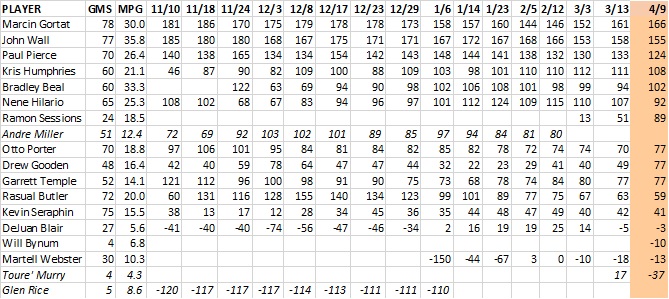
Player Production Average Update
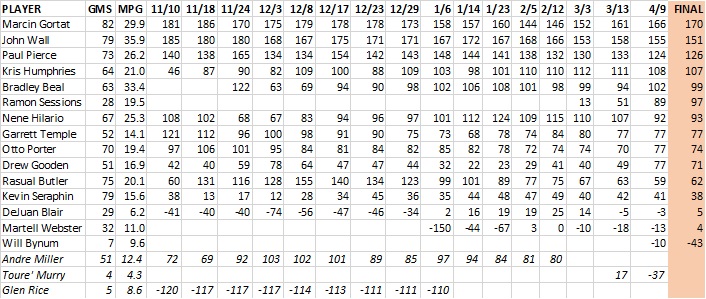
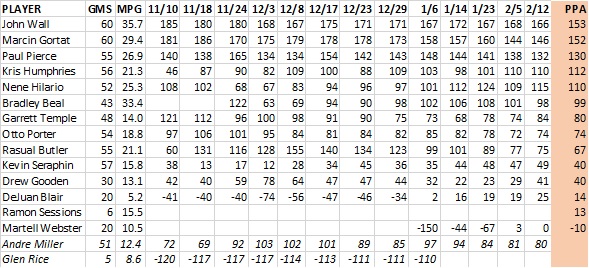
Player Production Average (PPA) is an overall rating stat I developed that credits players for things they do that help a team win and debits them for things that hurt the cause. PPA is pace neutral, accounts for defense, and includes a “degree of difficulty” factor based on the level of competition a player faces while on the floor. In PPA, 100 = average, higher is better and replacement level is 45.
The numbers under each date represent the player’s PPA for the entire season to that date. The number in the far right column (labeled PPA) is the player’s current PPA through games played last night. For a look at how players on other teams rate, visit here.
Perhaps Wall was cruising over the last couple months of the season. He still ended up with the best PPA of his career (he posted a 139 each of the preceding two seasons), but I’m convinced he’s capable of MUCH more. The areas for biggest improvement remain what they’ve been since he entered the league: shooting from the floor and turnovers.
By my reckoning, this was the second best season of Gortat’s career (the best was a 186 PPA with Phoenix (and Steve Nash) in 2011-12). He was edged out by Wall in total production because Wall played more minutes. He’s not an elite center, but he’s more than solid.
Paul Pierce made news this week with candid comments in an interview with ESPN. While his production has declined during the season, his overall performance has been remarkable for his age. In my historical database (which goes back to 1977-78), Pierce’s 126 PPA is the best season for a 37-year old SF. The closest contenders are Scottie Pippen (120) and Dominique Wilkins (119).
After those three, it’s difficult to generate much to say that’s positive. Beal ended up a hair below average for a third straight season. Nenê continued to decline. This was his least productive season since he was 25 years old. It’s a good thing his contract expires after next season.
The bright side for Washington is that they play in the epically weak Eastern Conference. As mediocre as they are (and they are mediocre), they have a chance in the first round against the vulnerable Toronto Raptors. More on that tomorrow.
There’s a temptation to note the Wizards have won four in a row and five of their last six and conclude they’re headed for the playoffs in good form. I don’t share that optimism, however. This is a stretch of games where Washington was expected to win with four games against three of the league’s weakest teams — Charlotte (21st in Simple Rating System — a power ranking published by Basketball-Reference.com that combines scoring differential with strength of schedule), New York (30th) and Philadelphia (29th) twice.
Failing to win at least four of the six would have been cause for real concern. Getting an “extra” win against Memphis was encouraging, although it’s worth noting the Grizzlies were coming off a hard-fought win against Oklahoma City the previous night while the Wizards coasted to an easy (and restful — the only starter to play more than 30 minutes was Bradley Beal) over the hapless Knicks.
The Wizards aren’t “fixed,” they’re playing bad opponents. It’s good that they’re beating those teams, but that’s not the same as saying they’re in good shape. Realistically speaking, they continue to look how they’ve looked all season — a slightly better than average team that feasts on the 99-pound weaklings in the East and can sometimes summon the game to challenge (and even beat) a good team if stuff goes right for them and wrong for the other side.
The preceding is talking about the team’s big picture. The overall. They’re excellent on defense, and have been since the end of January. Unfortunately, their offense has been terrible during the same time frame. Since the playoffs are about to start, we’re about to hear a bunch of the old maxim that defense wins in the postseason. Like a lot of truisms, it’s half true. Unless the Wizards are able to operate with some level of offensive efficiency against higher-quality opponents, they’re not going deep in the playoffs.
I’ll get more into postseason matchups when the regular season concludes, but it does help that Washington is in the East. First, because they’ll be in the playoffs at all. Out West, they’d at best be scrapping for the eighth seed. In their actual conference, they’ll have a punchers chance in the first round against Toronto or Chicago.
Player Production Average Update
Player Production Average (PPA) is an overall rating stat I developed that credits players for things they do that help a team win and debits them for things that hurt the cause. PPA is pace neutral, accounts for defense, and includes a “degree of difficulty” factor based on the level of competition a player faces while on the floor. In PPA, 100 = average, higher is better and replacement level is 45.
The numbers under each date represent the player’s PPA for the entire season to that date. The number in the far right column (labeled PPA) is the player’s current PPA through games played last night. For a look at how players on other teams rate, visit here.
Searching for encouragement as the playoffs approach? Look at Gortat and Wall — both of whom have been consistently good all season. Beal has played better the past few weeks, as have Sessions, Porter and Gooden.
On the other hand, Nenê and Pierce have struggled. The hope is that they’re recharging for the playoffs. But, they’re also the team’s oldest players, and they could be wearing down from the long season.
After a lengthy stretch of losing basketball, the Wizards have won four of their last six. Have they shaken off their mid-season swoon? Are they poised to win like it’s November or December?
No, and not likely.
While the Wizards have played better over the past six games, their offense has remained below average, and their defense has been unsustainably fantabulous. During this 4-2 stretch, Washington has allowed its opponents just 96.5 points per 100 possessions. If they managed to do that over a full season, they’d be one of the 15 best defenses since 1973-74 when the league began collecting the stats necessary to calculate defensive rating. For the season, the Wizards are allowing 102.8 points per 100 possessions.
Another factor: they’ve had the good fortune of meeting injury-depleted teams. And even then, the results have been mixed. They lost to Chicago, which was missing Jimmy Butler, Derrick Rose and Taj Gibson. They eked out a two-point victory against Miami, which didn’t have Chris Bosh, Dwyane Wade or Luol Deng. And, they beat the snot out of Memphis, which lacked Mike Conley, Tony Allen, Marc Gasol and Zach Randolph — also known as the Grizzlies’ four best players.
I know Randy Wittman and Ernie Grunfeld have said the Wizards just need to play better on defense and work harder. I respectfully disagree. Their defense — even during the period of sustained losing — wasn’t bad. The decline has been on offense, and it still needs to be fixed.
Player Production Average Update
Player Production Average (PPA) is an overall rating stat I developed that credits players for things they do that help a team win and debits them for things that hurt the cause. PPA is pace neutral, accounts for defense, and includes a “degree of difficulty” factor based on the level of competition a player faces while on the floor. In PPA, 100 = average, higher is better and replacement level is 45.
The numbers under each date represent the player’s PPA for the entire season to that date. The number in the far right column (labeled PPA) is the player’s current PPA through games played last night. For a look at how players on other teams rate, visit here.
My apologies for the format. The spreadsheet has reached a width that WordPress struggles to accommodate.
Good weeks for Gortat, Wall, Pierce and Gooden. Not so good for Beal, Temple, Porter and Butler.
Ramon Sessions provided hope with a couple decent games.
Martell Webster isn’t able to physically compete at an NBA level, presumably because of his back.
I’ve thought all season that DeJuan Blair should have been playing ahead of Kevin Seraphin, but Blair looks unable to compete physically at an NBA level because of too much eating and insufficient exercise.
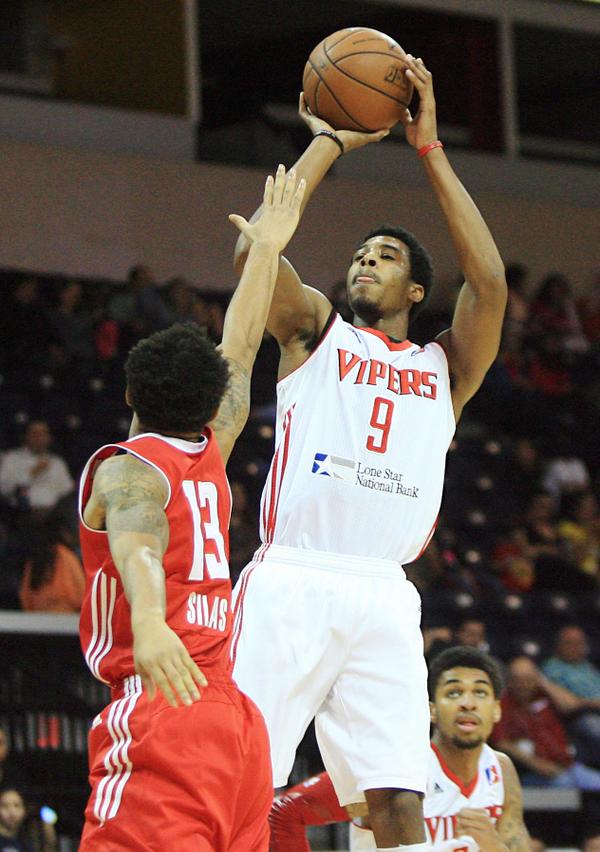
There are positives in Murry’s game, of course. He has good size and athleticism, and judging by the numbers, he’s active and plays hard. So far this season, he’s averaging 20.2 points, 9.6 rebounds, 9.3 assists and 2.5 assists per 100 possessions with two different D-League teams.
Yet, his Player Production Average (PPA) for the season is just 89. Yes, despite those impressive per 100 possession numbers, he still rates below average in the D-League this year. He’s been a bit better with Rio Grande, but even then he rates right about average (PPA: 98).
(For those who might not be regular readers: Player Production Average (PPA) is an overall rating stat I developed that credits players for things they do that help a team win and debits them for things that hurt the cause. PPA is pace neutral, accounts for defense, and includes a “degree of difficulty” factor based on the level of competition a player faces while on the floor. In PPA, 100 = average and higher is better.)
So what’s the problem? Points, rebounds, assists and steals are all on the “plus” side of the player evaluation ledger. Unfortunately, Murry also has high numbers on the “minus” side. This includes poor shooting and lots of turnovers.
Here’s a comparison of Murry’s shooting to the rest of the D-League this year:
Stat
Murry
D-League
efg
.452
.518
2pt%
.475
.512
3pt%
.254
.354
If there’s a reason to think he’ll shoot better in the NBA than he has in the D-League, I’d love to see it. In the minors this season, Murry shoots more frequently than average per 100 possessions, but scores less. His assists are nice, but are offset by high turnovers. Overall this season, his offensive rating is 102 points per 100 possessions in a league that has an offensive rating of 110. Even if we ignore his less-good stint with Idaho, his offensive rating is still just 105, which is well below average.
Murry is a good defender, according to the defense part of PPA. He generates steals, which could be good depending on how (meaning: does he steal the ball by being in good position and having great anticipation, or is he disrupting the team concept by gambling in passing lanes?), and he’s aggressive on the defensive glass. Both his teams this season have been terrible defensively — more than five points per 100 possessions worse than average. It’s hard to blame him for that considering he has just 670 total D-League minutes this year. Overall, my approach suggests he’s an above average defender.
This is fine, but…in basketball, situational substitutions are difficult to make. Teams have to take the whole player — good and bad. What matters is a player’s overall impact. And Murry’s is decidedly average. D-League average. Given what’s been ailing the Wizards lately, if they were going to skew toward one end of the court, offense would seem more logical. In my analysis, it’s unlikely Murry will help much. Barring a Butler-like hot streak, Murry will be a deficit on offense who might hold his own defensively.
Could the Wizards have done better? Well, there are several guards in the D-League who have been more productive. This includes the tiny Tim Frazier, who was terrible in six games with Philadelphia last month. Other guys who look more promising in the numbers:
David Stockton, Reno — Small (just 5-11), but efficient. His offensive rating is 119 so far this season. Excellent shooter with impressive assist numbers. His team has been terrible defensively, but he rates as having an average defensive impact. Came to training camp with Washington, so maybe they’ve already seen enough to conclude they don’t want him. D-League PPA: 162
Seth Curry, Erie — Doesn’t have a well-rounded game, BUT he’s an adequate defender who shoots like a Curry. PPA: 152.
Elliott Williams, Santa Cruz — A 6-5 SG type who’s a willing passer and has shot the ball well this season. Decent defender on a good defensive team. PPA: 147.
D.J. Seeley, Delaware — A 6-4 SG and willing passer who has shot well this season (.435 on 186 3pt attempts). Too many turnovers for my liking. And he rates a shade below average defensively. PPA: 133.
Aaron Craft, Santa Cruz — Small, quick, strong and tough-as-graphene. Craft was one of the best collegiate defenders I ever saw, and that’s showing up in his D-League numbers as well. Still a suspect three-point shooter, but he’s a good passer, doesn’t commit turnovers, and seems to know a thing or two about running a team. PPA: 122.
Vander Blue, Los Angeles — A 6-4 SG out of Marquette, which means he plays hard and defends. He’s not really a PG, but he’s a much improved shooter — .421 from 3pt range on 126 attempts. PPA: 119.
None of these guys are guaranteed producers, of course. All have their “warts,” as does Murry. If the Wizards wanted a 3&D type, Williams, Seeley and Blue would seem to be better options. Stockton and Craft are “pure PGs” and the front office may imagine they have that backup role covered with Ramon Sessions.
Signing Murry isn’t a disaster. But, he doesn’t match what the Wizards need, and he isn’t much of a prospect for the future. In that sense, it is something of a missed opportunity.
EDIT — Since publishing, Nick Bilka asked on Twitter about Chris Babb. He looks like a better option as well. Babb is a 6-5 SG who rebounds decently, defends adequately and shoots the three well. PPA: 141.
When the NBA entered its annual All-Star break, I started work on a piece intended to look at how teams similar to this year’s Wizards throughout league history fared when they reached the playoffs. At the time, Washington was 33-21, and their Simple Rating System (SRS) — a measure of team strength that combines scoring differential with strength of schedule — was +1.67 per game.
In the six games they’ve played since the break, they faced opponents with a combined scoring differential of -1.15. Even an average team would have been expected to win four of the six. The Wizards went 1-5 and were outscored by a whopping 86 points. That’s 14.3 points per game. Even if I throw out the 38-point loss to Cleveland as an aberration, Washington lost the other five by 9.6 points per game. Their SRS now stands at -0.02.
All season, I’ve been writing variations on the theme of “The Wizards Just Ain’t That Good,” but I’m still surprised by their catastrophic collapse since the All-Star break. What’s scary: their remaining 22 games don’t look as easy as they did just a few weeks ago.
Fourteen of their remaining contests are against likely playoff teams. And, the key statistical indicators of team strength I watch are all dipping. This recent stretch of horrific basketball could merely be a rough patch for an average team, but it could also be a signal of an aging group that’s about to flat line.
When I run the numbers through my “who’s gonna win” machine, the results are…well…bad. In a worst-case scenario, the Wizards would limp into the playoffs with just seven wins over their last 22. I think they’ll be better than that, but it’s hard to find more than 11 wins the rest of the way (which, by the way, would give them a final record of 45-37, which happens to be what I projected for them back in October). Barring a miracle about-face, those dreams of a 50-win season will remain just that.
As long as I’m fretting, here’s another reason for Wizards fans to be concerned: this interview of team president Ernie Grunfeld by radio guy Dave Johnson. Presented with respectful softball questions by Johnson, Grunfeld offered his thoughts on how his team could pull out of its skid — and thoroughly misdiagnosed what’s wrong.
In the interview, Grunfeld suggested the team’s biggest problem has been a decline in their defense. He said their results will improve when they play better defense, get out on the fast break and “compete” on a nightly basis.
Here’s a look at the Wizards pre- and post-All-Star break:
TIME
PACE
ORTG
DRTG
Pre-ASB
93.5
105.4
102.9
Post-ASB
96.7
93.4
108.3
CHANGE
3.2
-11.9
-5.4
What the numbers show is that the Wizards have played faster since the All-Star break, but have been worse. Grunfeld gets partial credit on the “play better defense” portion of his prescription since that would be a good thing to do. However, The drop in offensive efficiency is more than double their change in defensive efficiency. That means the team’s struggles are first and foremost because of its offense.
In case you were wondering, forgetting the debacle against Cleveland doesn’t change the analysis. Their defense the past three games has been excellent and yet they lost two because their offense was a horror show. If the Wizards want to start winning, they do need to get better on both ends, but their most important fix will be on offense.
There’s another issue with Grunfeld’s prescription — the data show the team’s offensive and defensive efficiency are uncorrelated. I’ve been tracking offensive and defensive efficiency by pace for years now, and this season’s result is the same as every other year. Good defense doesn’t cause good offense. Good offense doesn’t cause good defense. It’s almost as if offense and defense occur at different ends of the floor.
This season, if the numbers suggest anything it’s the Wizards show a very slight tendency to play better defense when they’re worse on offense. In terms of pace effects, Washington has a very slight tendency to play worse on offense in faster-paced games. But these “effects” are so small they’re basically meaningless.
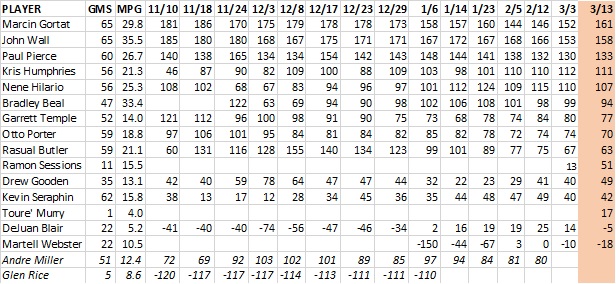
Player Production Average Update
Player Production Average (PPA) is an overall rating stat I developed that credits players for things they do that help a team win and debits them for things that hurt the cause. PPA is pace neutral, accounts for defense, and includes a “degree of difficulty” factor based on the level of competition a player faces while on the floor. In PPA, 100 = average, higher is better and replacement level is 45.
The numbers under each date represent the player’s PPA for the entire season to that date. The number in the far right column (labeled PPA) is the player’s current PPA through games played last night. For a look at how players on other teams rate, visit here.
My apologies for the format. The spreadsheet has reached a width that WordPress struggles to accommodate.
Early returns on the Andre Miller for Ramon Sessions trade aren’t good. As the table above shows, Miller had a PPA of 80 with the Wizards; Sessions has managed a Maynor-esque 13 so far. Meanwhile, Miller’s PPA with the Kings is a robust 90 (good for a backup PG). Sessions in Sacramento posted a 16 PPA.
Unsurprisingly for a team that barely ended a five-game losing streak, production for most guys was down. The biggest decliner was John Wall, but he was hardly alone. The team also saw drop-offs from Nenê, Garrett Temple, Rasual Butler, and Kevin Seraphin.
Perhaps the Wizards can turn things around, but it’s an old team that doesn’t have a ton of upside. Over the season’s final 22 contests, Wall will likely play more like he did earlier in the season, but it’s not realistic to think any of the team’s older players have much room for improvement. Maybe Beal or Porter can play better to close out the season, but neither looks ready to provide a surge in production.
Realistically speaking, if the Wizards can go .500 the rest of the way, I’d call it a success. But, winning just seven or eight of their remaining 22 is a realistic possibility as well. That would leave them with 41 or 42 wins, which would almost certainly relegate them to the sixth seed. Where they’d probably draw Cleveland and get bounced from the playoffs in the first round.
 My 2015-16 Wizards preview is up at Vice Sports. I won’t steal my own thunder much, except to say that my projection approach says the Wizards will win 41-42 games this season. Not as encouraging as I’d hoped, and I had some mild surprises in the numbers — younger players not being predicted to improve as much as I’d have intuitively expected.












 The First Draft by Kevin Broom