Wizards Update: Just the Numbers

four

As Dean Oliver first wrote, there are four key factors that determine who wins and loses in the NBA. In order of importance: shooting, rebounding, getting to the free throw line and turnovers. So far this season, the data suggests that variation in efg differential accounts for about 44% of variation in scoring differential; rebounding accounts for 26%, getting to the free throw line about 18%, and turnovers about 11%.

How are the Wizards doing? They’re 25th in efg differential, 24th in rebounding differential, 9th in turnover differential and 10th in free throw differential. All that combines to rank 23rd in average scoring margin, which means they haven’t played even as well as their 19th ranked winning percentage might suggest.

At this point, Basketball-Reference forecasts the Wizards to win about 36 games and indicates the team’s odds of winning the draft lottery (2.5%) are about the same as them making the playoffs this season (2.4%).

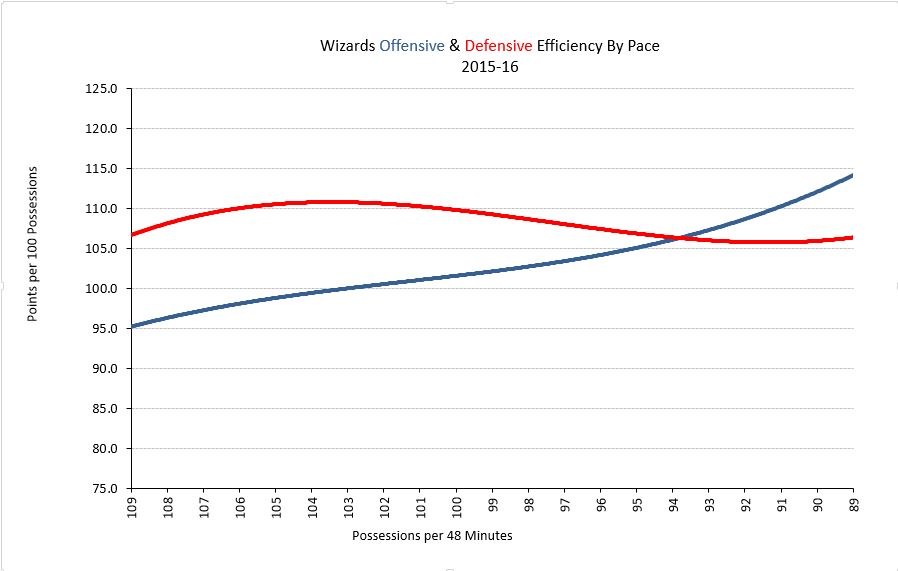
While the team embarked on an effort to play faster, the results through 25 games indicates they may still benefit by slowing down. The defense appears to be largely unaffected by pace, but the numbers suggest the team may be a bit more efficient in slower-paced games. The effect is small, but at this point the team needs every advantage it can get.

rtg by pace

Player Production Average

The ratings below are a metric I developed called Player Production Average (PPA). In PPA, players are credited for things they do that help a team win, and debited for things that don’t, each in proportion to what causes teams to win and lose. PPA is pace neutral, accounts for defense, and includes an adjustment based on the level of competition faced when a player is on the floor. In PPA, average is 100, higher is better, and replacement level is 45.

League-wide PPA scores through games played 12/20/15 are here.

PLAYER GAMES MPG 11/10 11/22 12/3 12/13 PPA
John Wall 25 35.1 153 129 136 168 157
Marcin Gortat 22 30.2 91 112 128 133 132
Otto Porter 24 32.3 144 158 104 116 107
Jared Dudley 24 26.9 36 92 90 85 98
Ramon Sessions 25 19.7 131 119 84 90 87
Bradley Beal 17 36.5 128 108 96 87 87
Nene Hilario 12 17.4 58 90 80 74 79
Gary Neal 23 22.4 23 49 64 75 78
Kris Humphries 20 18.1 90 121 95 80 78
Garrett Temple 23 18.0 38 106 57 54 70
Ryan Hollins 5 9.6 -40 60 59
Drew Gooden 6 12.8 99 51 57 56 56
Kelly Oubre 18 9.3 -103 -4 -40 -44 9
DeJuan Blair 14 9.5 -345 -129 -112 -45 -34

As I’ve been writing seemingly for years now, the Wizards continue to lack elite production. Click over to the full league numbers and you’ll find 11 players with at least 500 minutes who have a PPA of at least 200. Wall ranks 10th among point guards, but in a virtual tie with Reggie Jackson and Rajon Rondo.

This isn’t Wall’s “fault” exactly, he’s a very good player. But he needs more help than he’s getting. Beal ranks 24th among shooting guards, Porter 16th among small forwards, Gortat 18th among centers, and Dudley 31st among power forwards.

Wizards Update: A Silver Lining

As if the 2015-16 Wizards season wasn’t crummy enough, the team released news over the weekend that Bradley Beal would miss at least a couple weeks with yet another stress reaction in his leg. While this was a bummer of a development — especially when combined with Beal’s fourth consecutive season of pedestrian production — I’m writing today not to induce depression, but to give hope.

Wizards point guard John Wall began the season well: after a strong performance against the Spurs, Wall’s PPA (see below) sat at a heady 184 — not an MVP candidate, but probably in the conversation for All-NBA, and definitely All-Star level.

And then, for some reason (possibly a previously undisclosed ankle injury) his production tanked. After four consecutive good-to-great games to start the year, eight of his next ten games rated below average in PPA. In two of the games (at Boston and home against Toronto), Wall rated a net negative; a scary place for the team’s star. After posting a -70 vs. the Raptors, Wall’s PPA for the season stood at a slightly below average 96.

And then…the calendar switched to December and Wall abruptly began playing like an MVP candidate. In the eight games since that -70, Wall has produced a PPA of 300 or better four times, and another three better than 200. His lone dud was a 74 against Phoenix.

Wall’s PPA for October and November was 96. In December: 278. For context, here are the top five full-season PPA scores on record:

  1. Lebron James, MIA, 2012-13 — 282
  2. Stephen Curry, GSW, 2014-15 — 277
  3. Lebron James, CLE, 2008-09 — 275
  4. Michael Jordan, CHI, 1990-91 — 268
  5. Lebron James, CLE, 2009-10 — 267

Now, even posting a 278 the rest of the way won’t get Wall into this year’s MVP conversation because Curry’s PPA is another 70 points better, but still. Wall has been playing great the past couple weeks, and seems to be turning his season around. That’s a genuine reason for optimism.

Player Production Average

The ratings below are a metric I developed called Player Production Average (PPA). In PPA, players are credited for things they do that help a team win, and debited for things that don’t, each in proportion to what causes teams to win and lose. PPA is pace neutral, accounts for defense, and includes an adjustment based on the level of competition faced when a player is on the floor. In PPA, average is 100, higher is better, and replacement level is 45.

League-wide PPA scores through games played 12/03/15 are here.

PLAYER GAMES MPG 11/10 11/22 12/3 PPA
John Wall 22 35.0 153 129 136 168
Marcin Gortat 19 29.6 91 112 128 133
Otto Porter 22 33.0 144 158 104 116
Ramon Sessions 22 19.0 131 119 84 90
Bradley Beal 17 36.5 128 108 96 87
Jared Dudley 21 26.5 36 92 90 85
Kris Humphries 17 17.6 90 121 95 80
Gary Neal 20 22.0 23 49 64 75
Nene Hilario 12 17.4 58 90 80 74
Ryan Hollins 5 9.6 -40 60
Drew Gooden 6 12.8 99 51 57 56
Garrett Temple 20 17.6 38 106 57 54
Kelly Oubre 15 6.9 -103 -4 -40 -44
DeJuan Blair 12 8.5 -345 -129 -112 -45

If I could have one Christmas present for the Wizards, it’d be a starting quality power forward.

Wizards Update: The Everyone Problem

worried wall

Good thing for the Wizards that the NBA season is long because if it ended today, they’d be out of the playoffs and looking at a 2.8% chance of getting Ben Simmons in the 2016 draft.

Washington is just 7-9 with a scoring differential (weighted for strength of schedule) that ranks 23rd — more than a point per game below 22nd ranked Sacramento. This isn’t what fans (or many analysts) expected after the team escaped the first round of the playoffs each of the past two seasons. Washington was supposed to be an Eastern Conference contender, an echelon below Cleveland, but still a force to be reckoned with.

Not so much.

Leaving aside the issue of whether those expectations were realistic, what’s wrong? Lots. As Dean Oliver wrote, there are four key factors that determine winning and losing in basketball: shooting from the floor (efg), turnovers, rebounding, and free throws. Shooting is the most important of these, and the Wizards are tied for 18th in shooting from the floor. They’re second worst at controlling the ball. They’re 27th in offensive rebounding. They get to the free throw line frequently (sixth best), but overall they rank 28th thus far in offensive efficiency.

The situation isn’t much better on defense. They’re 22nd in defensive efg, average in defensive rebounding, and do a good job of forcing turnovers and keeping opponents off the free throw line. But, making the other team miss is the decisive factor: they rank 20th in defense.

Who’s at fault? Everyone, really.

The front office assembled a roster without a starter-quality power forward. While they made a good trade for Jared Dudley (solid player in exchange for nothing), he’s a small forward they’re asking to masquerade as a stretch four. He can get by in the S4 role off the bench, but his lack of rebounding (low career numbers even for a SF), size and athleticism gets exposed against starters. Kris Humphries is a backup; Drew Gooden a bench-warmer; Nenê is aging and injured.

The team obviously established a goal of preserving cap space for free agents in 2016, but wasted short-term signings on Gary Neal, Alan Anderson and Ryan Hollins.

So, put “front office” at the top of the “at fault” list — even without diving down the rabbit hole of botched draft picks and free agent acquisitions in previous years.

Next up: the coaching staff. This season, the team’s braintrust decided to enter basketball modernity by cutting back on two-point jump shots and taking more threes. This shift should have helped the offense run more efficiently even with the team shooting slightly worse from three-point range, but Randy Wittman and company confounded the issue by coupling changed shot selection with playing faster.

The problem: playing faster has nothing to do with playing better. Smart coaching emphasizes strategies that improve efficiency. Swapping two-point jumpers for threes, at-rim attempts and free throws is smart. Playing faster because it’s fashionable is not. (Especially when analysis of the team the past few years suggests the Wizards may have been better in slower-paced games.)

There’s room on the “blame bus” for the players, and rightfully so — virtually everyone who wears the Wizards uniform is under-performing. The only players with a PPA (see below) higher than last year are Otto Porter and Gary Neal, and Porter’s production has cratered since a promising start.

Despite back-to-back outstanding games (vs. Cleveland and the Lakers), John Wall’s PPA is 15 points lower than last season. Marcin Gortat’s production is down 42 points. Bradley Beal is “about the same” (down three points in PPA), but now in his fourth season still rates just average.

Kris Humphries, Jared Dudley, Ramon Sessions, Nenê, Drew Gooden, and Garrett Temple are all performing worse so far this season. All are showing double-digit drops in PPA.

For crissake, even DeJuan Blair, coming off the worst season of his career, is performing worse.

While they don’t belong on the “blame bus,” the Eastern Conference gets some credit for Washington’s poor start. Last season, a stat goober whose name I can’t remember (please take/give credit where it’s due if you read this and know who I’m talking about) estimated that top five teams in the East gained about three wins in 2014-15 because of the sorry state of the conference. This year, several Eastern teams improved while the Wizards attempted to be about the same.

How can the Wizards get better?

  1. De-emphasize pace. Stop worrying about trying to be like Golden State, and play at a pace that makes sense for the roster currently in place. Change the emphasis to valuing possessions and getting good shots, and look for offensive efficiency to rise.
  2. Get Wall and Gortat back to normal. Both are established veterans with production levels significantly better than what they’ve done thus far. It’s hard to believe they’re going to continue playing this poorly.
  3. Get improvement from Beal and/or Porter. Unfortunately, Beal continues to show improvement. He’s much the same player (in terms of overall impact) as he was in his rookie year. Porter started the season well, but has struggled since as teams developed a scouting report. Now it’s time for Porter to come up with ways to produce anyway.
  4. Make a trade. They don’t have a starter-quality PF on the roster.

The season is still young and the Wizards are probably going to start playing better. But, that’s what the Nationals kept saying, and then they ran out of games and the story of their 2015 season was they just weren’t good enough. For the Wizards, there’s an added concern because they need to be good enough to persuade a prominent free agent to join the young core.

Player Production Average

The ratings below are a metric I developed called Player Production Average (PPA). In PPA, players are credited for things they do that help a team win, and debited for things that don’t, each in proportion to what causes teams to win and lose. PPA is pace neutral, accounts for defense, and includes an adjustment based on the level of competition faced when a player is on the floor. In PPA, average is 100, higher is better, and replacement level is 45.

League-wide PPA scores through games played 12/03/15 are here.

PLAYER GAMES MPG 11/10 11/22 PPA
John Wall 16 33.7 153 129 136
Marcin Gortat 16 28.9 91 112 128
Otto Porter 16 32.1 144 158 104
Bradley Beal 13 35.5 128 108 96
Kris Humphries 16 17.6 90 121 95
Jared Dudley 15 24.7 36 92 90
Ramon Sessions 16 17.8 131 119 84
Nene Hilario 12 17.4 58 90 80
Gary Neal 14 19.6 23 49 64
Drew Gooden 6 12.8 99 51 57
Garrett Temple 14 15.8 38 106 57
Ryan Hollins 1 11.0     -40
Kelly Oubre 11 7.5 -103 -4 -40
DeJuan Blair 6 8.5 -345 -129 -112

Wizards Update: Porter Leading The Way

otto porter

I have to say I’m pretty torn on the Wizards so far. On one hand, they’re 6-4 despite injuries to Bradley Beal, Alan Anderson and Martell Webster, as well as growing pains as they figure out how their personnel can mesh with their new Pace & Space offense.

Sticking with the positives: Otto Porter is having a terrific season (leads the team in PPA — see below), and they’re getting some decent play Ramon Sessions, Nenê and Jared Dudley off the bench.

On the other hand…John Wall — despite his publicly stated desire to be an MVP candidate this season — is performing like a pretty average starter, the team seems to crumble whenever Kris Humphries is on the floor (despite decent production from Humphries), and Marcin Gortat is lost on offense.

Since I believe Wall and Gortat will perform more like they did last season, my biggest area of concern is at power forward. Humphries continues to be fairly productive, and has even added a three-point shot. So far this season, he’s at .412. An analysis I did in July suggested .365 could be anticipated.

The problem: the Wizards collapse when he’s out there. So far, Washington is 5.2 points per 100 possessions worse offensively and 5.9 points per 100 possessions worse defensively (net -11.1 points per 100 possessions) when Humphries is out there. While the results are a bit extreme because of the small sample size, keep in mind the Wizards were worse on both ends of the floor with Humphries last season, and Boston was worse on offense with him out there.

My theory: Humphries plays like my iPhone 4 trying to load an app. When it’s time for business (like catching a pass), there’s a pause, then a blank screen, then a spinning wheel, and then maybe some action. It could be that Humphries is just better against reserves than starters.

Unfortunately, the Wizards don’t really have a viable option to start at power forward. Nenê can’t be relied on in that role, and moving him into the starting lineup leaves the team without a reserve center. I’m dubious about Jared Dudley as a viable option — he’s been a below-average rebounder for a SMALL forward throughout his career. (It’s worth mentioning that in the tiny sample size recorded thus far, Dudley is rebounding at his best rate since his rookie year.)

If the team can’t figure out how to play with Humphries as a starter, they may be forced to start Dudley and take some lumps on the board.

Player Production Average

The ratings below are a metric I developed called Player Production Average (PPA). In PPA, players are credited for things they do that help a team win, and debited for things that don’t, each in proportion to what causes teams to win and lose. PPA is pace neutral, accounts for defense, and includes an adjustment based on the level of competition faced when a player is on the floor. In PPA, average is 100, higher is better, and replacement level is 45.

League-wide PPA scores through games played 11/22/15 are here.


PLAYER GAMES MPG 11/10 PPA
Otto Porter 10 32.9 144 158
John Wall 10 32.7 153 129
Kris Humphries 10 20.8 90 121
Ramon Sessions 10 18.0 131 119
Marcin Gortat 10 27.5 91 112
Bradley Beal 7 33.9 128 108
Garrett Temple 8 15.4 38 106
Jared Dudley 9 21.7 36 92
Nene Hilario 9 18.6 58 90
Drew Gooden 6 12.8 99 51
Gary Neal 10 18.7 23 49
Kelly Oubre 6 10.0 -103 -4
DeJuan Blair 4 8.5 -345 -129


Wizards Renovated Offense Needs Time

beal rips

The Washington Wizards have embarked on a major renovation of their offense, and while the results are decidedly mixed through their first six games, the right thing is to stay the course and see if players can grow into new roles.

Last season, the Wizards were 18th in pace and 28th in three-point attempt rate (the percentage of field goal attempts from three-point range). So far in 2015-16, they’re second in pace (a whopping 8.4 possessions per 48 minutes faster) and 12th in three-point attempt rate.

The positives so far: decent shooting and an uptick in trips to the free throw line. The negatives: the league’s worst turnover rate, a drop-off in rebounding effectiveness, and an elevated opponent shooting percentage.

While patience is warranted as the team figures out how to operate in the new system, the emphasis on playing at a fast pace continues to be a concern for me. Why? Because pace of play has nothing to do with what causes teams to win games. Go through the record of games and seasons, and you’ll find good (and bad) teams that played fast, slow and in-between. What makes sense is for a team to play at a pace where it’s comfortable, where the players are under control, and where it can get good shots and maximize efficiency. If that’s fast, then play fast. If it’s slower, then slow down.

At the risk of oversimplifying, basketball is a game where teams take turns with the ball until the clock runs out. The number of possessions are about the same for each team over the course of a game — sometimes there’s a possession or two variance based on end-of-period exchanges. Playing fast doesn’t get a team extra possessions because no matter how quick they shoot the ball, the other team gets it back. What matters is efficiency — generating more points on your possessions than the other guy does on his.

The emphasis on playing fast — at least as it’s been implemented by the Wizards so far — seems misguided to me. Pushing the ball up the floor every possession is a good strategy because it can stress the defense, catch defenders out of position, and give Washington more time to run its half court offense. But if rushing leads to more turnovers, and weakened defensive rebounding, the strategy is missing the point.

What really concerns me about the “play fast” mantra is the question of whether the Wizards truly have a grasp on what’s important for a team to win. There’s a palpable feeling that they’re mimicking Golden State without a true understanding of why that style of play works for the Warriors, and how it fits Washington’s personnel. What wins games in the NBA? Doing these things better than the opponent (in order of importance): shooting from the floor, controlling turnovers, getting to the free throw line, and rebounding. Pace ain’t on the list.

Player Production Average

The ratings below are a metric I developed called Player Production Average (PPA). In PPA, players are credited for things they do that help a team win, and debited for things that don’t, each in proportion to what causes teams to win and lose. PPA is pace neutral, accounts for defense, and includes an adjustment based on the level of competition faced when a player is on the floor. In PPA, average is 100, higher is better, and replacement level is 45.

PLAYER GAMES MPG PPA
John Wall 6 34.8 153
Otto Porter 6 34.0 144
Ramon Sessions 6 17.2 131
Bradley Beal 6 34.7 128
Drew Gooden 4 15.0 99
Marcin Gortat 6 28.0 91
Kris Humphries 6 20.5 90
Nene Hilario 6 18.0 58
Garrett Temple 4 3.5 38
Jared Dudley 5 21.6 36
Gary Neal 6 17.7 23
Kelly Oubre 3 5.3 -103
DeJuan Blair 2 6.0 -345

In many ways, I find these numbers (drawn from a small sample size) encouraging. The team’s most productive players so far are its youthful trio of high draft picks: John Wall, Otto Porter, and Bradley Beal.

It’s hard to believe veterans like Marcin Gortat and Jared Dudley will continue playing this poorly. Look for Nenê’s production to improve some as well.

On the other hand, don’t expect big jumps in productivity from DeJuan Blair (who apparently has forgotten how to play basketball), Gary Neal and Garrett Temple.

Also, much as I hate to write it, I think Porter’s PPA is ripe for a drop-off. It’s not likely he’ll continue to shoot 70% from two-point range or have a 60-plus percent efg.

About the Wizards New Offense

wittmanbeal

As a sorta codicil to my Wizards preview at Vice Sports, here’s some background on why the Wizards new “pace & space” offense may not provide as much of a boost to the record as those of us pushing for it might have hoped. And no, this has nothing to do with the house-building performance in the opener at Orlando.

Last season, the Wizards took lots of what Randy Wittman called “good shots.” Wittman’s “good” shots were what us analysts called “the worst shots in the game.” In other words: two-point jumpers. As chronicled in many places around the Internets, the best shots are at-rim, threes, and free throws.

How much better could Washington’s offense have been last season? As economist (and creator of the Wins Produced metric) David Berri might write, with a bit of math I estimated they could have added as much as 1.5 points per 100 possessions merely by having league average shot selection. That may not sound like much, but it translates to 3-4 wins, assuming their defense was the same. In other words, 49-50 wins instead of 46.

So, why am I projecting 42 wins this year instead of 45 or 46? The issue is RELATIVE advantage. Many teams around the league are going to variations of the pace and space. Many teams want to play faster and change their shot mix to emphasize at-rim and three-point attempts.

Improvement from the Wizards offense may be counter-balanced by efficiency improvements in the offenses of other teams, and by the emergence of better defensive strategies as more teams adopt similar offensive playing styles. While the Wizards may be more efficient, other team are likely to be more efficient too — at least until defenses start figuring things out. At which point games will come down to overall talent, execution and as yet undetermined strategic innovations.

Your mileage may vary, but I don’t have much faith in Randy Wittman and his coaching staff to lead the next innovation. That means we’re back to base talent, and the Wizards are about middle of the pack in that area. At least until they sign Kevin Durant next summer.

Projection: Wizards to Win 42

wall 02My 2015-16 Wizards preview is up at Vice Sports. I won’t steal my own thunder much, except to say that my projection approach says the Wizards will win 41-42 games this season. Not as encouraging as I’d hoped, and I had some mild surprises in the numbers — younger players not being predicted to improve as much as I’d have intuitively expected.

At any rate, please click over and give it a read at Vice.

The 2015 NBA Draft According to YODA

yoda2A few years back, I embarked on an effort to develop a statistically-based, objective method of evaluating prospects for the NBA draft. I make no claims that it’s perfect, but I’ve found the results decent enough, albeit not yet subjected to rigorous analysis. That’s coming.

When I get time.

Someday.

On the Wizards message board at RealGM, I referred to the effort a few times as “Ye Olde Draft Analyzer,” someone called it YODA, and the name stuck. YODA isn’t complex — at least not yet. It’s built on the Player Production Average metric I devised that credits players for things they do to help their teams win, and debits them for things they do that hurt the cause — each in proper proportion. YODA takes each player’s production (box score stats) then applies adjustments for position, age, team strength/level of competition, and objective measures of physical attributes (combine measurements and times).

In general, YODA likes efficient players who shoot well, rebound well, assist without committing turnovers, and generate blocks and steals without fouling too much. Being on a good team that plays a challenging schedule is also helpful, but not determinant — players like Kenneth Faried, Paul Millsap and Danny Granger had excellent ratings despite not playing for traditional powers.

YODA’s biggest limitation is international players. I haven’t had the time to research the numbers posted by prospects overseas, or to objectively assess the quality of the competition they face. Rather than guessing, I’ve chosen to leave them out of the process for now. Given the global nature of the draft, that’s a significant limitation, and it’s one I hope to fix for next year.

My belief on draft strategy is that the smart move is to pick the best player available, even if he doesn’t fit an immediate need. My approach is to first rate players in absolute terms, then group them into tiers of “about the same.” The idea is that when several players of “about the same” quality are available when your team’s pick comes, the team can pick the player they think best fits current needs. But, don’t reach into a lower tier for a perceived need. Just pick the better player and make another move down the road, if necessary.

Here’s this year’s draft in order of both absolute value according to YODA, and divided by tier.

TIER ONE

  • Karl-Anthony Towns, PF, Kentucky
  • Jahlil Okafor, C, Duke

TIER TWO

  • D’Angelo Russell, PG, Ohio State
  • Frank Kaminsky, C, Wisconsin

TIER THREE

  • Rondae Hollis-Jefferson, SF, Arizona
  • Kelly Oubre, SF, Kansas (EDITED position due to corrected measurements)
  • Delon Wright, PG, Utah
  • Cameron Payne, PG, Murray State
  • Bobby Portis, PF, Arkansas

TIER FOUR

  • Justise Winslow, SF, Duke
  • Myles Turner, C, Texas

TIER FIVE

  • Jerian Grant, PG, Notre Dame
  • Robert Upshaw, C, Washington
  • Willie Cauley-Stein, C, Kentucky
  • Sam Dekker, SF, Wisconsin
  • Devin Booker, SG, Kentucky

TIER SIX

  • Kevon Looney, PF, UCLA
  • Tyus Jones, PG, Duke
  • Cliff Alexander, PF/C, Kansas
  • Terry Rozier, G, Louisville
  • Justin Anderson, SF, Virginia
  • Stanley Johnson, SF, Arizona

TIER SEVEN

  • Briante Weber, PG, VCU
  • Bryce Jones, SG, Iowa State
  • Aaron White, PF, Iowa
  • Trey Lyles, PF, Kentucky
  • Montrezl Harrell, PF, Louisville

TIER EIGHT

  • Richaun Holmes, PF, Bowling Green
  • Pat Connaughton, SG, Notre Dame
  • R.J. Hunter, SG, Georgia State

In simple terms, the first round grades end with Tier Six. If things go more or less the way the mock drafts predict, the Wizards may be able to select a PG from Tier Three (Delon Wright), or perhaps a PF with potential like Looney.

While I fully expect the Wizards to sell or give away their second round pick, I think there may be some opportunities to get potentially useful players on inexpensive contracts with additional second rounders. I’d be interested in taking a guy like Cliff Alexander, or even Robert Upshaw (assuming he’s medically cleared to play despite a heart condition).

The consensus view on this year’s draft seems to be that it’s top heavy with a steep drop-off in talent after the lottery. I don’t really see that in the numbers. Towns and Okafor are a relatively weak top two, and the drop in ratings isn’t any greater than it is in most years. In other words, it looks like a draft.

Feel free to tweet me if you have questions about specific players. I’ve analyzed most seniors, and virtually all of the early entrants (except for the international players).

EDITED on June 30 when I was able to confirm that Kelly Oubre’s standing reach, as measured at the scouting combine, was incorrect. When the measurement was corrected, Oubre moved from Tier Four to Tier Three.

NBA Playoffs: PPA Update Through Round Two

Just numbers because…no time. This update includes all playoff games through the completion of round two.

Player Production Average (PPA) is an overall rating stat I developed that credits players for things they do that help a team win and debits them for things that hurt the cause. PPA is pace neutral, accounts for defense, and includes a “degree of difficulty” factor based on the level of competition a player faces while on the floor. In PPA, 100 = average, higher is better and replacement level is 45.

Hoping to have some thoughts up about the Wizards tomorrow. Wish me luck.

Player POS Age Tm G MPG PPA
DeMarre Carroll SF 28 ATL 12 35.2 204
Al Horford C 28 ATL 12 33.8 188
Paul Millsap PF 29 ATL 12 35.4 146
Jeff Teague PG 26 ATL 12 32.3 128
Kyle Korver SG 33 ATL 12 38.1 111
Shelvin Mack PG 24 ATL 7 4.9 97
Mike Muscala PF 23 ATL 6 10.8 94
Mike Scott PF 26 ATL 8 11.1 84
Dennis Schroder PG 21 ATL 12 19.8 51
Pero Antic PF 32 ATL 12 14.7 37
Kent Bazemore SG 25 ATL 12 16.5 34
John Jenkins SG 23 ATL 2 2.5 -85
Elton Brand PF 35 ATL 2 2.0 -212
Jae Crowder SF 24 BOS 4 25.0 126
Jared Sullinger PF 22 BOS 4 20.0 110
Tyler Zeller C 25 BOS 4 22.5 85
Isaiah Thomas PG 25 BOS 4 29.8 67
Marcus Smart PG 20 BOS 4 22.5 57
Evan Turner SG 26 BOS 4 29.5 51
Brandon Bass PF 29 BOS 4 21.5 49
Avery Bradley SG 24 BOS 4 33.3 23
Kelly Olynyk C 23 BOS 4 13.3 20
Jonas Jerebko PF 27 BOS 4 17.0 -13
Gerald Wallace SF 32 BOS 1 4.0 -67
Luigi Datome SF 27 BOS 3 4.7 -86
Phil Pressey PG 23 BOS 2 2.5 -156
Brook Lopez C 26 BRK 6 39.0 166
Alan Anderson SG 32 BRK 6 23.7 122
Joe Johnson SG 33 BRK 6 41.5 103
Jarrett Jack PG 31 BRK 6 25.5 94
Deron Williams PG 30 BRK 6 32.0 87
Markel Brown SG 23 BRK 2 5.0 68
Thaddeus Young PF 26 BRK 6 31.7 55
Bojan Bogdanovic SF 25 BRK 6 34.3 48
Mason Plumlee C 24 BRK 6 8.2 30
Earl Clark PF 27 BRK 2 6.5 -45
Darius Morris PG 24 BRK 1 5.0 -83
Mirza Teletovic PF 29 BRK 3 5.3 -113
Jerome Jordan C 28 BRK 1 5.0 -166
Jimmy Butler SG 25 CHI 12 42.2 183
Pau Gasol PF 34 CHI 10 31.7 174
E’Twaun Moore SG 25 CHI 3 3.0 146
Mike Dunleavy SF 34 CHI 12 32.4 143
Doug McDermott SF 23 CHI 3 3.3 125
Joakim Noah C 29 CHI 12 32.9 116
Derrick Rose PG 26 CHI 12 37.8 111
Taj Gibson PF 29 CHI 12 23.0 95
Nazr Mohammed C 37 CHI 3 4.7 64
Kirk Hinrich SG 34 CHI 10 12.6 53
Nikola Mirotic PF 23 CHI 11 14.9 20
Tony Snell SF 23 CHI 11 12.7 9
Aaron Brooks PG 30 CHI 12 11.0 -11
Kevin Love PF 26 CLE 4 26.8 167
Kyrie Irving PG 22 CLE 10 37.1 158
Tristan Thompson PF 23 CLE 10 32.4 150
LeBron James SF 30 CLE 10 41.7 140
Iman Shumpert SG 24 CLE 10 33.3 137
Timofey Mozgov C 28 CLE 10 25.2 111
J.R. Smith SG 29 CLE 8 27.9 111
Mike Miller SF 34 CLE 3 10.3 73
Shawn Marion SF 36 CLE 3 4.0 48
Matthew Dellavedova SG 24 CLE 10 18.2 40
James Jones SF 34 CLE 10 11.8 32
Kendrick Perkins C 30 CLE 6 4.0 -47
Joe Harris SG 23 CLE 2 2.0 -253
Al-Farouq Aminu SF 24 DAL 5 30.0 176
Tyson Chandler C 32 DAL 5 32.0 160
Charlie Villanueva PF 30 DAL 5 8.6 135
Monta Ellis SG 29 DAL 5 39.4 111
Dirk Nowitzki PF 36 DAL 5 36.2 110
Jose Barea PG 30 DAL 5 30.8 68
Raymond Felton PG 30 DAL 3 12.0 19
Rajon Rondo PG 28 DAL 2 18.5 16
Bernard James C 29 DAL 1 2.0 0
Greg Smith PF 24 DAL 1 1.0 0
Amar’e Stoudemire PF 32 DAL 5 15.0 -2
Devin Harris PG 31 DAL 4 18.5 -13
Richard Jefferson SF 34 DAL 4 12.8 -29
Chandler Parsons SF 26 DAL 1 37.0 -32
Dwight Powell PF 23 DAL 2 1.5 -79
Stephen Curry PG 26 GSW 10 38.7 208
Draymond Green SF 24 GSW 10 37.1 153
Andrew Bogut C 30 GSW 10 25.9 147
James Michael McAdoo PF 22 GSW 3 1.7 141
Klay Thompson SG 24 GSW 10 37.5 133
Harrison Barnes SF 22 GSW 10 32.9 127
Andre Iguodala SG 31 GSW 10 27.6 105
Justin Holiday SG 25 GSW 3 1.7 85
Festus Ezeli C 25 GSW 10 5.4 65
Shaun Livingston PG 29 GSW 10 15.8 61
Leandro Barbosa SG 32 GSW 10 9.7 30
David Lee PF 31 GSW 5 11.0 27
Marreese Speights PF 27 GSW 7 7.3 23
Brandon Rush SG 29 GSW 2 2.0 -145
Dwight Howard C 29 HOU 12 33.3 178
James Harden SG 25 HOU 12 36.4 175
Clint Capela C 20 HOU 12 7.6 97
Josh Smith PF 29 HOU 12 22.6 95
Trevor Ariza SF 29 HOU 12 38.1 95
Terrence Jones PF 23 HOU 12 24.0 88
Jason Terry SG 37 HOU 12 27.6 83
Corey Brewer SF 28 HOU 12 25.5 46
Pablo Prigioni PG 37 HOU 12 19.9 32
Nick Johnson SG 22 HOU 7 4.3 -6
Joey Dorsey PF 31 HOU 6 2.2 -33
Kostas Papanikolaou SF 24 HOU 7 2.4 -188
Chris Paul PG 29 LAC 12 37.1 224
DeAndre Jordan C 26 LAC 14 34.4 188
Blake Griffin PF 25 LAC 14 39.8 183
Spencer Hawes PF 26 LAC 8 7.1 101
Matt Barnes SF 34 LAC 14 29.2 65
J.J. Redick SG 30 LAC 14 38.6 61
Austin Rivers PG 22 LAC 14 17.9 53
Dahntay Jones SF 34 LAC 11 1.6 21
Jamal Crawford SG 34 LAC 14 27.1 21
Lester Hudson SG 30 LAC 7 5.4 17
Glen Davis PF 29 LAC 14 10.3 -4
Hedo Turkoglu SF 35 LAC 11 5.0 -20
Ekpe Udoh PF 27 LAC 4 3.0 -54
Jordan Adams SG 20 MEM 4 2.5 208
Russ Smith PG 23 MEM 2 1.5 184
Marc Gasol C 30 MEM 11 37.8 155
Jon Leuer PF 25 MEM 4 2.3 138
Mike Conley PG 27 MEM 8 30.4 137
Tony Allen SG 33 MEM 10 27.9 134
Courtney Lee SG 29 MEM 11 33.4 133
Kosta Koufos C 25 MEM 11 11.5 132
JaMychal Green PF 24 MEM 5 1.6 93
Vince Carter SG 38 MEM 11 17.8 79
Beno Udrih PG 32 MEM 10 17.5 68
Zach Randolph PF 33 MEM 11 34.7 66
Nick Calathes SG 25 MEM 9 14.0 23
Jeff Green SF 28 MEM 11 27.1 14
Zaza Pachulia C 30 MIL 6 21.5 141
Jared Dudley SG 29 MIL 6 18.3 122
John Henson C 24 MIL 6 25.5 117
Khris Middleton PF 23 MIL 6 38.7 88
Jerryd Bayless PG 26 MIL 6 20.0 53
Tyler Ennis PG 20 MIL 1 16.0 48
Giannis Antetokounmpo SG 20 MIL 6 33.5 48
Michael Carter-Williams PG 23 MIL 6 31.8 44
O.J. Mayo SG 27 MIL 6 26.0 41
Jorge Gutierrez PG 26 MIL 1 12.0 25
Ersan Ilyasova PF 27 MIL 6 23.7 22
Johnny O’Bryant PF 21 MIL 1 12.0 -1
Miles Plumlee C 26 MIL 1 16.0 -65
Alexis Ajinca C 26 NOP 3 3.3 242
Anthony Davis PF 21 NOP 4 43.0 197
Dante Cunningham PF 27 NOP 4 18.8 142
Quincy Pondexter SF 26 NOP 4 31.0 95
Omer Asik C 28 NOP 4 19.8 91
Eric Gordon SG 26 NOP 4 35.8 85
Ryan Anderson PF 26 NOP 4 23.8 81
Jrue Holiday PG 24 NOP 3 18.3 58
Tyreke Evans SF 25 NOP 4 31.3 50
Norris Cole PG 26 NOP 4 26.5 -38
Allen Crabbe SG 22 POR 2 19.5 149
Meyers Leonard C 22 POR 5 21.2 143
Alonzo Gee SF 27 POR 1 3.0 133
Joel Freeland C 27 POR 2 3.5 96
C.J. McCollum SG 23 POR 5 33.2 93
Robin Lopez C 26 POR 5 23.4 89
LaMarcus Aldridge PF 29 POR 5 41.6 80
Nicolas Batum SF 26 POR 5 41.8 67
Chris Kaman C 32 POR 3 12.3 56
Damian Lillard PG 24 POR 5 40.2 54
Steve Blake PG 34 POR 5 8.6 -25
Arron Afflalo SG 29 POR 3 20.0 -128
Tim Frazier PG 24 POR 2 1.5 -309
Tim Duncan PF 38 SAS 7 35.7 213
Kawhi Leonard SF 23 SAS 7 35.7 154
Patrick Mills PG 26 SAS 7 16.0 153
Marco Belinelli SG 28 SAS 7 16.6 136
Boris Diaw PF 32 SAS 7 28.3 96
Danny Green SG 27 SAS 7 29.1 86
Manu Ginobili SG 37 SAS 7 18.7 80
Cory Joseph PG 23 SAS 4 5.5 77
Jeff Ayres PF 27 SAS 3 4.0 44
Tiago Splitter C 30 SAS 7 17.6 23
Tony Parker PG 32 SAS 7 30.0 -17
Aron Baynes C 28 SAS 4 10.0 -51
Matt Bonner PF 34 SAS 7 5.1 -69
Greg Stiemsma C 29 TOR 1 2.0 526
Jonas Valanciunas C 22 TOR 4 26.5 141
Patrick Patterson PF 25 TOR 4 26.5 121
Amir Johnson PF 27 TOR 4 28.0 90
DeMar DeRozan SG 25 TOR 4 39.8 75
Terrence Ross SF 23 TOR 4 26.8 38
Lou Williams SG 28 TOR 4 25.5 26
Greivis Vasquez PG 28 TOR 4 25.3 14
Kyle Lowry PG 28 TOR 4 32.8 -5
Tyler Hansbrough PF 29 TOR 4 12.0 -12
James Johnson PF 27 TOR 2 6.0 -115
Marcin Gortat C 30 WAS 10 30.7 186
Paul Pierce SF 37 WAS 10 29.8 149
John Wall PG 24 WAS 7 39.0 142
Kris Humphries PF 29 WAS 1 5.0 141
Bradley Beal SG 21 WAS 10 41.8 132
Otto Porter SF 21 WAS 10 33.1 120
Nene Hilario PF 32 WAS 10 25.7 73
Drew Gooden PF 33 WAS 10 17.8 62
Ramon Sessions PG 28 WAS 10 21.8 46
Will Bynum SG 32 WAS 3 10.3 44
Martell Webster SF 28 WAS 1 4.0 35
Kevin Seraphin C 25 WAS 6 12.0 34
Garrett Temple SG 28 WAS 4 6.5 -57
Rasual Butler SF 35 WAS 2 3.5 -81

NBA Playoffs: PPA Update

Just numbers because…no time. This is through games played on May 10, 2015.

Player Production Average (PPA) is an overall rating stat I developed that credits players for things they do that help a team win and debits them for things that hurt the cause. PPA is pace neutral, accounts for defense, and includes a “degree of difficulty” factor based on the level of competition a player faces while on the floor. In PPA, 100 = average, higher is better and replacement level is 45.

Player POS Tm G MPG PPA
DeMarre Carroll SF ATL 9 35.2 212
Al Horford C ATL 9 32.2 182
Paul Millsap PF ATL 9 35.7 174
Kyle Korver SG ATL 9 38.2 147
Jeff Teague PG ATL 9 32.1 108
Shelvin Mack PG ATL 7 4.9 96
Mike Scott PF ATL 8 11.1 83
Mike Muscala PF ATL 3 8.0 66
Dennis Schroder PG ATL 9 17.9 63
Pero Antic PF ATL 9 16.7 34
Kent Bazemore SG ATL 9 17.7 32
John Jenkins SG ATL 2 2.5 -85
Elton Brand PF ATL 2 2.0 -212
Jae Crowder SF BOS 4 25.0 126
Jared Sullinger PF BOS 4 20.0 110
Tyler Zeller C BOS 4 22.5 85
Isaiah Thomas PG BOS 4 29.8 67
Marcus Smart PG BOS 4 22.5 57
Evan Turner SG BOS 4 29.5 50
Brandon Bass PF BOS 4 21.5 49
Avery Bradley SG BOS 4 33.3 23
Kelly Olynyk C BOS 4 13.3 20
Jonas Jerebko PF BOS 4 17.0 -13
Gerald Wallace SF BOS 1 4.0 -68
Luigi Datome SF BOS 3 4.7 -87
Phil Pressey PG BOS 2 2.5 -158
Brook Lopez C BRK 6 39.0 166
Alan Anderson SG BRK 6 23.7 122
Joe Johnson SG BRK 6 41.5 103
Jarrett Jack PG BRK 6 25.5 94
Deron Williams PG BRK 6 32.0 87
Markel Brown SG BRK 2 5.0 68
Thaddeus Young PF BRK 6 31.7 55
Bojan Bogdanovic SF BRK 6 34.3 48
Mason Plumlee C BRK 6 8.2 30
Earl Clark PF BRK 2 6.5 -47
Darius Morris PG BRK 1 5.0 -84
Mirza Teletovic PF BRK 3 5.3 -115
Jerome Jordan C BRK 1 5.0 -168
Jimmy Butler SG CHI 10 42.2 195
Pau Gasol PF CHI 9 32.6 191
Nazr Mohammed C CHI 2 5.5 155
Mike Dunleavy SF CHI 10 32.1 137
Derrick Rose PG CHI 10 37.6 123
Joakim Noah C CHI 10 31.9 120
Doug McDermott SF CHI 2 3.5 119
Taj Gibson PF CHI 10 23.5 117
Kirk Hinrich SG CHI 8 10.4 89
Nikola Mirotic PF CHI 9 14.7 10
Tony Snell SF CHI 9 14.4 7
E’Twaun Moore SG CHI 2 3.0 -5
Aaron Brooks PG CHI 10 11.5 -14
Kevin Love PF CLE 4 26.8 165
Timofey Mozgov C CLE 8 25.5 152
Kyrie Irving PG CLE 8 40.0 143
Tristan Thompson PF CLE 8 30.6 141
LeBron James SF CLE 8 41.9 120
Iman Shumpert SG CLE 8 31.9 113
J.R. Smith SG CLE 6 26.7 107
Mike Miller SF CLE 2 14.5 84
Shawn Marion SF CLE 3 4.0 48
James Jones SF CLE 8 12.6 28
Matthew Dellavedova SG CLE 8 16.3 20
Kendrick Perkins C CLE 4 5.0 -4
Joe Harris SG CLE 1 2.0 -217
Al-Farouq Aminu SF DAL 5 30.0 177
Tyson Chandler C DAL 5 32.0 161
Charlie Villanueva PF DAL 5 8.6 135
Monta Ellis SG DAL 5 39.4 111
Dirk Nowitzki PF DAL 5 36.2 109
Jose Barea PG DAL 5 30.8 68
Raymond Felton PG DAL 3 12.0 18
Rajon Rondo PG DAL 2 18.5 15
Bernard James C DAL 1 2.0 0
Greg Smith PF DAL 1 1.0 0
Amar’e Stoudemire PF DAL 5 15.0 -3
Devin Harris PG DAL 4 18.5 -14
Richard Jefferson SF DAL 4 12.8 -30
Chandler Parsons SF DAL 1 37.0 -33
Dwight Powell PF DAL 2 1.5 -81
Stephen Curry PG GSW 7 39.6 179
Andrew Bogut C GSW 7 25.9 159
Harrison Barnes SF GSW 7 32.3 151
Draymond Green SF GSW 7 38.7 149
Klay Thompson SG GSW 7 37.1 130
Festus Ezeli C GSW 7 6.3 55
Andre Iguodala SG GSW 7 28.0 53
Shaun Livingston PG GSW 7 14.4 49
Leandro Barbosa SG GSW 7 12.6 35
Marreese Speights PF GSW 7 7.3 21
Justin Holiday SG GSW 1 1.0 0
David Lee PF GSW 2 4.5 -106
James Michael McAdoo PF GSW 1 1.0 -285
James Harden SG HOU 9 35.7 190
Dwight Howard C HOU 9 32.7 167
Jason Terry SG HOU 9 26.8 95
Clint Capela C HOU 9 7.8 82
Terrence Jones PF HOU 9 24.4 78
Trevor Ariza SF HOU 9 37.4 64
Josh Smith PF HOU 9 22.2 61
Pablo Prigioni PG HOU 9 20.7 34
Corey Brewer SF HOU 9 26.0 15
Nick Johnson SG HOU 5 5.6 -7
Joey Dorsey PF HOU 5 2.4 -36
Kostas Papanikolaou SF HOU 5 3.0 -199
Chris Paul PG LAC 9 36.0 230
DeAndre Jordan C LAC 11 34.3 193
Blake Griffin PF LAC 11 39.4 193
Spencer Hawes PF LAC 5 6.2 102
Austin Rivers PG LAC 11 18.3 90
Matt Barnes SF LAC 11 30.3 90
Dahntay Jones SF LAC 9 1.7 87
J.J. Redick SG LAC 11 38.7 81
Jamal Crawford SG LAC 11 27.5 41
Lester Hudson SG LAC 5 6.8 31
Glen Davis PF LAC 11 11.5 1
Hedo Turkoglu SF LAC 10 5.1 -23
Ekpe Udoh PF LAC 4 3.0 -57
Jordan Adams SG MEM 2 1.0 853
Russ Smith PG MEM 1 1.0 284
Mike Conley PG MEM 5 27.8 192
Marc Gasol C MEM 8 37.1 172
Courtney Lee SG MEM 8 33.5 161
Tony Allen SG MEM 8 32.1 151
Kosta Koufos C MEM 8 11.8 141
Beno Udrih PG MEM 7 19.6 92
Vince Carter SG MEM 8 15.8 73
JaMychal Green PF MEM 2 1.0 69
Zach Randolph PF MEM 8 35.5 66
Nick Calathes SG MEM 6 17.3 18
Jeff Green SF MEM 8 25.6 7
Jon Leuer PF MEM 2 2.0 -37
Zaza Pachulia C MIL 6 21.5 140
Jared Dudley SG MIL 6 18.3 122
John Henson C MIL 6 25.5 118
Khris Middleton PF MIL 6 38.7 88
Jerryd Bayless PG MIL 6 20.0 53
Tyler Ennis PG MIL 1 16.0 47
Giannis Antetokounmpo SG MIL 6 33.5 47
Michael Carter-Williams PG MIL 6 31.8 43
O.J. Mayo SG MIL 6 26.0 41
Jorge Gutierrez PG MIL 1 12.0 24
Ersan Ilyasova PF MIL 6 23.7 21
Johnny O’Bryant PF MIL 1 12.0 -3
Miles Plumlee C MIL 1 16.0 -66
Alexis Ajinca C NOP 3 3.3 244
Anthony Davis PF NOP 4 43.0 198
Dante Cunningham PF NOP 4 18.8 143
Quincy Pondexter SF NOP 4 31.0 95
Omer Asik C NOP 4 19.8 91
Eric Gordon SG NOP 4 35.8 85
Ryan Anderson PF NOP 4 23.8 81
Jrue Holiday PG NOP 3 18.3 58
Tyreke Evans SF NOP 4 31.3 49
Norris Cole PG NOP 4 26.5 -39
Allen Crabbe SG POR 2 19.5 150
Meyers Leonard C POR 5 21.2 144
Alonzo Gee SF POR 1 3.0 133
Joel Freeland C POR 2 3.5 96
C.J. McCollum SG POR 5 33.2 93
Robin Lopez C POR 5 23.4 89
LaMarcus Aldridge PF POR 5 41.6 79
Nicolas Batum SF POR 5 41.8 66
Chris Kaman C POR 3 12.3 56
Damian Lillard PG POR 5 40.2 54
Steve Blake PG POR 5 8.6 -26
Arron Afflalo SG POR 3 20.0 -130
Tim Frazier PG POR 2 1.5 -312
Tim Duncan PF SAS 7 35.7 213
Kawhi Leonard SF SAS 7 35.7 154
Patrick Mills PG SAS 7 16.0 154
Marco Belinelli SG SAS 7 16.6 136
Boris Diaw PF SAS 7 28.3 96
Danny Green SG SAS 7 29.1 86
Manu Ginobili SG SAS 7 18.7 80
Cory Joseph PG SAS 4 5.5 77
Jeff Ayres PF SAS 3 4.0 43
Tiago Splitter C SAS 7 17.6 23
Tony Parker PG SAS 7 30.0 -18
Aron Baynes C SAS 4 10.0 -52
Matt Bonner PF SAS 7 5.1 -70
Greg Stiemsma C TOR 1 2.0 530
Jonas Valanciunas C TOR 4 26.5 141
Patrick Patterson PF TOR 4 26.5 121
Amir Johnson PF TOR 4 28.0 90
DeMar DeRozan SG TOR 4 39.8 74
Terrence Ross SF TOR 4 26.8 38
Lou Williams SG TOR 4 25.5 26
Greivis Vasquez PG TOR 4 25.3 14
Kyle Lowry PG TOR 4 32.8 -6
Tyler Hansbrough PF TOR 4 12.0 -13
James Johnson PF TOR 2 6.0 -117
Marcin Gortat C WAS 7 32.6 227
John Wall PG WAS 5 38.2 175
Paul Pierce SF WAS 7 29.4 160
Otto Porter SF WAS 7 33.3 153
Kris Humphries PF WAS 1 5.0 140
Bradley Beal SG WAS 7 41.3 109
Drew Gooden PF WAS 7 18.3 101
Ramon Sessions PG WAS 7 22.6 62
Nene Hilario PF WAS 7 24.6 54
Will Bynum SG WAS 2 8.5 35
Martell Webster SF WAS 1 4.0 34
Kevin Seraphin C WAS 5 8.8 -19
Garrett Temple SG WAS 2 11.0 -46
Rasual Butler SF WAS 2 3.5 -82