That Path to the Eastern Conference Finals

partingredsea08

In my last post, I alluded to a kind of parting of the seas for the Wizards in the Eastern Conference playoffs. The reasoning is pretty simple: the Wizards should be considered strong favorites over either the Pacers or the Hawks. That’s right, either.

If this was a “normal” NBA season, Washington would be a heavy underdog to the top seeded Pacers. But, if this was a “normal” season, the Wizards wouldn’t have been the fifth seed with 44 wins, Atlanta wouldn’t have been in the playoffs with a sub-.500 record, and Indiana wouldn’t have disintegrated over the last two months of the season (and wouldn’t have had to fight and claw to get to a seventh game against such a pedestrian opponent).

This is an abnormal season, though, and the weak Eastern Conference coupled with the stumble-bum Pacers at the top have given the Wizards their best chance of reaching the NBA’s final four since…1979.

That the Wizards would be favored vs. Atlanta is unsurprising. The Hawks weren’t much good during the regular season. They struggled after center Al Horford tore a pectoral muscle (again), and limped into the playoffs. The Pacers need a bit more explanation — which I provided nearly a month ago when I wondered whether Washington should tank for seventh so they could face Indiana in the first round.

If you want more detail, please click and read on that link. The upshot is this: since the All-Star break, the Pacers have been a very different team. They’ve actually had a negative scoring differential, which is something I don’t think I’ve ever seen for an extended stretch from a highly seeded team. Indeed, since the All-Star break, the Pacers have had the scoring differential of a 34-win team (over an 82-game schedule), just one game better than the eighth seed Hawks. Over that same time frame, Washington’s differential was that of a 52-win team.

Don’t go getting too excited about that differential: the Wizards played an incredibly easy schedule after the All-Star break. Still, it’s illustrative of the significant changes in the Eastern Conference. Since that All-Star break, the Wizards had the third best efficiency differential of the East’s playoff teams. The Pacers had the second worst.

So, what are the odds? Applying a combination of full season numbers, post All-Star break numbers, and playoff performance, I estimate Washington having the following chances of beating these possible Eastern Conference playoff opponents:

  1. Indiana — 64%
  2. Miami — 27%
  3. Toronto — 50%
  4. Chicago — 100%
  5. Washington — 0%
  6. Brooklyn — 67%
  7. Charlotte — eliminated
  8. Atlanta — 81%

The odds will fluctuate a bit after that seventh game, but the fundamental point remains: Washington is in a terrific position to reach the Eastern Conference Finals. Getting farther is a dicier proposition, especially if they end up facing Miami.

Round One Wrap-Up

The 4-1 first round win over the Chicago Bulls is done, but there are still a few points worth making. While there’s been some chatter about how flawed the Bulls are (including by me), Chicago actually looked pretty strong entering the post-season. It’s trademark defense was excellent down the stretch, and its offense was about average. The Eastern Conference team with the best efficiency differential after the All-Star break? The Bulls.

Washington’s first round victory wasn’t a case of getting a crappy opponent, it was a case of the Wizards outplaying a decent team. Give credit where it’s due: a big reason the Bulls looked so bad is that the Wizards were on their game.

Finally, here’s a look at the Player Production Averages (PPA) for the series. PPA is an overall rating metric I developed that credits players for things they do that help a team win, and debits them for things that don’t. It’s a per-minute stat that’s pace-neutral, accounts for defense, and includes a “degree of difficulty” factor based on the level of competition a player faces while on the floor. In PPA, 100 = average, higher is better, and 45 = replacement level. (Don’t pay much attention to the extreme scores at the bottom of the table — tiny sample sizes don’t mean much of anything.)

TEAM Player GMS MPG PPA
CHI Taj Gibson 5 30.8 210
WAS Trevor Ariza 5 39.0 193
WAS Bradley Beal 5 41.0 152
CHI Mike Dunleavy 5 32.6 139
WAS Trevor Booker 5 24.2 134
WAS John Wall 5 38.6 128
WAS Martell Webster 5 18.0 113
WAS Nene Hilario 4 35.8 107
CHI Joakim Noah 5 42.0 97
WAS Marcin Gortat 5 36.0 97
CHI Jimmy Butler 5 43.6 88
CHI Carlos Boozer 5 24.2 58
CHI Kirk Hinrich 5 33.4 22
WAS Andre Miller 5 10.4 10
CHI D.J. Augustin 5 28.2 5
WAS Kevin Seraphin 1 1.0 0
WAS Drew Gooden 4 9.0 -35
CHI Tony Snell 5 9.2 -47
CHI Nazr Mohammed 2 2.5 -189
WAS Al Harrington 3 2.3 -364
WAS Garrett Temple 4 0.3 -1889

Interesting that the most productive player in the series was Taj Gibson, who played just 30.8 minutes per game. Meanwhile, Chicago started Carlos Boozer and played him 24.2 minutes per game despite production that wasn’t much better than replacement level.

Also interesting to me is how the production numbers differ from popular perception. One “experts” poll named Nenê as Washington’s first round “MVP.” When it comes down to doing the things that cause teams to win, he rated sixth best for the Wizards — behind Ariza, Beal, Booker, Wall and Webster.

In total, eight players rated “above average” in this series. Six of those players wore Wizards uniforms. While Gibson was good throughout the series, the only other Bull above average was Dunleavy, and most of his production came in a single game.

Path Opening for Wizards to Make Deep Playoff Run

Ariza dominating

As enjoyable as the Wizards-Bulls series has been so far (for Wizards fans, at least), there’s a tangible feeling that Washington has drawn to an inside straight. (That’s a fancy poker way of saying they’ve gotten lucky.) Yes, I’m aware the Wizards have looked good in the playoffs — teams look good when they win.

I’m also aware that the “experts” at ESPN and TNT (and elsewhere) have declared this Washington as a near-perfect squad with “no weaknesses.” But, much (most?) of the commentary has been a veritable catalog of cognitive biases. Over the course of six months and 82 games, the Wizards were average. A perfectly average team playing against their schedule would be expected to win 43-44 games. They won 44. That’s not a team without weakness — it’s an average team.

In the playoffs, they’re beating the Bulls — a slightly better than average team overall this season, but also a team with a major flaw: one of the league’s worst offenses.

Meanwhile, the Indiana Pacers have continued their post-All-Star break swoon and are struggling to keep pace with the sub.500 Atlanta Hawks. The Wizards should be favored against either team in a second round matchup. Which would put Washington into the conference finals against (probably) the Miami Heat.

It’s the 2013-14 NBA Eastern Conference, where being meh is good enough because nearly everyone else is meh-er.

In many ways, the Wizards this season are a fascinating experiment in perception. On one hand, there’s a solidly average regular season and no top-end production. On the other hand, there’s a likely first-round win against the Bulls and a good chance they make a run to the Eastern Conference Finals.

Folks in the “they’re really not that good” camp can point to the historically weak conference and Indiana’s meltdown, which carved out the path. But…it’s not Washington’s fault their opponents suck. The only thing they can do is play their game and beat whoever’s put in front of them. Being average when others are bad might be a functional equivalent of being good.

For me, it’s clear that the Wizards are an average team that’s drawn a flawed opponent in the first round and has a very good chance of getting a flawed opponent in the second round as well. That said, being average this season and next is probably good enough to hang around in the playoffs for the next year or two before Washington’s older players decline and other teams rebuild sufficiently. Washington won’t be a realistic title contender (even if they make the Eastern Conference Finals), but it’ll be fun to see them playing in May.

In other words, have fun, but don’t go overboard revising conclusions drawn from six months and 82 games worth of data over a few weeks against a couple opponents. What would be cause for some revision? Beating the Heat and making it to the Finals.

At any rate, here are a couple looks at the Wizards-Bulls first round series through the first four games. First up, here’s Player Production Average. PPA is an overall evaluation stat I developed. It’s designed to credit players for things they do that help a team win and “debit” them for things that don’t — each in proper proportion. It’s a pace-adjusted, per minute stat that accounts for defense and includes a degree of difficulty factor based on the level of competition a player faces while on the floor. In PPA, 100 = average, higher is better and 45 = replacement level.)

Player TEAM G MPG PPA
Taj Gibson CHI 4 32.3 215
Trevor Ariza WAS 4 39.5 212
Mike Dunleavy CHI 4 32.3 168
Bradley Beal WAS 4 40.8 161
Martell Webster WAS 4 18.5 135
John Wall WAS 4 38.5 121
Trevor Booker WAS 4 24.5 99
Marcin Gortat WAS 4 36.8 86
Joakim Noah CHI 4 41.8 85
Carlos Boozer CHI 4 23.3 76
Nene Hilario WAS 3 34.7 74
Jimmy Butler CHI 4 43.8 70
Andre Miller WAS 4 10.8 63
D.J. Augustin CHI 4 29.5 43
Kirk Hinrich CHI 4 32.0 0
Kevin Seraphin WAS 1 1.0 0
Drew Gooden WAS 4 9.0 -33
Tony Snell CHI 4 10.3 -59
Nazr Mohammed CHI 2 2.5 -180
Al Harrington WAS 3 2.3 -346
Garrett Temple WAS 3 0.3 -1408

The top two producers have been Taj Gibson and Trevor Ariza. Mike Dunleavy’s high rating is largely a product of a single terrific game in a small sample size. Bradley Beal is having a good series. John Wall and Martell Webster have also been solid.

Folks have gotten excited about Nenê’s play, but the big man hasn’t really played all that well outside of game one.

Want to see why Chicago is struggling? Their only above average performers in these four games have been Gibson and Dunleavy. Noah, Boozer and Butler have been subpar. Augustin and Hinrich have been wretched — especially Hinrich who has given the Bulls 32.0 minutes per game of nothing.

Last, here’s a look at estimated wins added (call them eWins) for the series:

Player TEAM G MPG eWINS
Trevor Ariza WAS 4 39.5 0.68
Taj Gibson CHI 4 32.3 0.56
Bradley Beal WAS 4 40.8 0.53
Mike Dunleavy CHI 4 32.3 0.44
John Wall WAS 4 38.5 0.38
Joakim Noah CHI 4 41.8 0.29
Marcin Gortat WAS 4 36.8 0.26
Jimmy Butler CHI 4 43.8 0.25
Martell Webster WAS 4 18.5 0.20
Trevor Booker WAS 4 24.5 0.20
Nene Hilario WAS 3 34.7 0.16
Carlos Boozer CHI 4 23.3 0.14
D.J. Augustin CHI 4 29.5 0.10
Andre Miller WAS 4 10.8 0.05
Kirk Hinrich CHI 4 32.0 0.00
Kevin Seraphin WAS 1 1.0 0.00
Nazr Mohammed CHI 2 2.5 -0.02
Drew Gooden WAS 4 9.0 -0.02
Garrett Temple WAS 3 0.3 -0.03
Tony Snell CHI 4 10.3 -0.05
Al Harrington WAS 3 2.3 -0.05

This eWins approach uses total production to estimate each player’s individual share of team wins. It works reasonably well over the full season. For the series, it has the Wizards with a 2.4 to 1.7 eWins lead, which is reflective of a couple very close games (Washington’s overtime win in game two, and Chicago’s narrow game three victory.)

Wizards Slouching Toward the Playoffs

The numbers in the table below are this week’s Player Production Average (PPA) update. PPA is a metric I developed that credits players for things that contribute to winning and debits them for things that don’t — each in proper proportion. PPA is pace adjusted, accounts for defense and includes a degree of difficulty factor. In PPA, 100 = average, higher is better and 45 = replacement level. PPA is a per minute stat.

PLAYER GMS MPG LW PPA
Marcin Gortat 77 32.9 150 153
Trevor Ariza 73 35.7 151 143
John Wall 78 36.6 141 138
Trevor Booker 68 21.4 115 119
Drew Gooden 20 18.6 127 114
Nene Hilario 50 29.9 101 100
Andre Miller 24 14.4 104 91
Bradley Beal 69 34.7 89 89
Martell Webster 74 28.1 82 80
Jan Vesely 33 14.2 68 68
Kevin Seraphin 50 11.4 35 37
Chris Singleton 24 10.4 34 32
Garrett Temple 71 8.9 25 25
Glen Rice 11 9.9 20 20
Otto Porter 33 8.2 13 19
Al Harrington 30 14.9 13 8
Eric Maynor 23 9.3 8 8

Rough week for the Wizards, which is reflected in the individual numbers. On the positive side were Marcin Gorat, (who continues to have a good season), Trevor Booker (who many fans want removed from the rotation), and Otto Porter (who performed better, but still rates well below replacement level).

Even with a bad week, Trevor Ariza is having a career season. He gets a bit of a pass for the last few games — he’s been beset with the flu, and really shouldn’t have even been on the floor.

John Wall’s production fell for a third straight week. It’s been fashionable to celebrate Wall’s improvement and his ascendancy to All-Star status, but it’s worth noting that his 138 PPA this season is virtually identical to the 139 he posted last year.

Here’s a visualization of each player’s PPA through the season. Since this is basically a weekly rolling season average, the larger fluctuations at the beginning followed by a flatter line toward the end is to be expected. Note the fairly steady climb of Gortat’s PPA — he’s been playing better as the season has progressed. The production slip from Wall the past three weeks is also apparent.

Check out the steady production from Booker. Webster’s season-long decline is apparent in his graph.

Drew Gooden’s production has fallen steeply after a hot start. He may not be the godsend Wizards fans had hoped for. Andre Miller’s play has been up and down, but at least sorta trending up.

ppa trend

Should the Wizards Tank for 7th?

Could 7 be a lucky number for the Wizards?

Last week, I estimated the Wizards’ odds of winning a seven-game series against the teams most likely to make the Eastern Conference playoffs. It was a useful exercise in seeing how Washington stacks up against possible opponents, but it used numbers from the full season, which means my approach didn’t necessarily capture team form lately.

And, the performance of the other seven teams in the playoffs has changed markedly in some cases since the All-Star break. The biggest shift has been the Indiana Pacers meltdown. After opening the season with a 40-12 record, Indy has gone just 13-13 after the All-Star break. More worrisome for the Pacers: they’ve had a negative efficiency differential over the past 26 games — despite an easy schedule.

Let me say that another way: since the All-Star break, the Pacers have been outscored by their opponents. The only other Eastern Conference playoff team to do that — the New York Knicks.

The decline has been an across the board failure for Indiana. Both their offense and defense have gotten worse, neither is showing much sign of improvement, and it may create an “upset” opportunity for whoever gets that seventh seed.

Using team stats since the All-Star break, the Pacers have the scoring differential of a 32-win team (over an 82-game schedule). That’s the weakest performance of any Eastern Conference team by eight games. Next closest is New York, which has played like a 40-win team. Over the same stretch, the Wizards have played like a 47-win team.

So, what’s wrong with Indiana? First, there may have been some significant overrating based on last year’s playoffs. In 2012-13, the Pacers were good-but-not-great during the regular season. Then they went on a strong playoff run. Before this season, the guys over at Boxscore Geeks cautioned that many were overreacting to those playoffs, and projected Indy as a sub-.500 team. That prediction wasn’t so great either — even with their crummy post-All-Star break performance, Indy has 53 wins, but the Boxscore Geeks made a critical point — the Pacers were being crowned as championship contenders without top-end talent, without a season’s worth of sustained excellence — without demonstrating they could consistently play at a championship level.

Early in the season, Indy looked like it would be a worthy rival for the Heat, but that’s old news. Why? There are few “big” things that jump out. Their offensive decline has been significant, but it seems to be an accumulation of little things — a slight decline in their shooting and a narrower rebounding margin.

What’s really making them vulnerable has been the drop in their defensive efficiency. The numbers practically leap off the screen. There are four key categories that define who wins basketball games — shooting, ball handling (turnovers), rebounds, and getting to the free throw line. The Pacers have been worse at all four on defense since the All-Star break. The most significant drop has been in the most important category: shooting.

To make this even simpler, since the All-Star break Indiana has shot worse, has allowed their opponent to shoot significantly better, has grabbed fewer defensive rebounds, and has forced fewer turnovers. While none of the changes is major (except defensive efg), the across-the-board declines add up.

Looking at the individual players suggests that there’s plenty of “blame” to go around. Roy Hibbert is probably first in line — his production (as measured by my stat, Player Production Average (PPA) — where 100 = average, higher is better, and replacement level = 45) is a shade below league average. His PPA of 98 is down 32 from last season, and 57 from two seasons ago. But, David West’s PPA is down 25, and George Hill’s is down by 20.

Paul George and Lance Stephenson are both improved from last season (George from a 133 to a 164; Stephenson from a 94 to a 121), BUT both are down significantly from pre-All-Star production levels. Through the first 25-30 games, George was posting an All-NBA level 200+ PPA. Stephenson was in the 150 range, which is roughly All-Star level.

And oh yeah, the team has also been hurt by roster decisions that weakened their bench. Specifically, they let Tyler Hansbrough (PPA: 82) depart, and replaced him by trading for Luis Scola (PPA: 43). Ian Mahinimi continues to be terrible. And, the trade for Evan Turner has been a predictable debacle.

All of this is a fairly long way of saying that the Wizards might be smart to position themselves as the seventh seed in the East. The Pacers could pull things back together and play as they did earlier in the season, but their recent performances don’t indicate that’s likely. If recent performance levels continue into the playoffs, Indiana could be in for a short, embarrassing 2014 postseason — no matter who they face.

Wizards Trade for Backcourt Upgrade

NBA: Playoffs-Denver Nuggets at Golden State Warriors

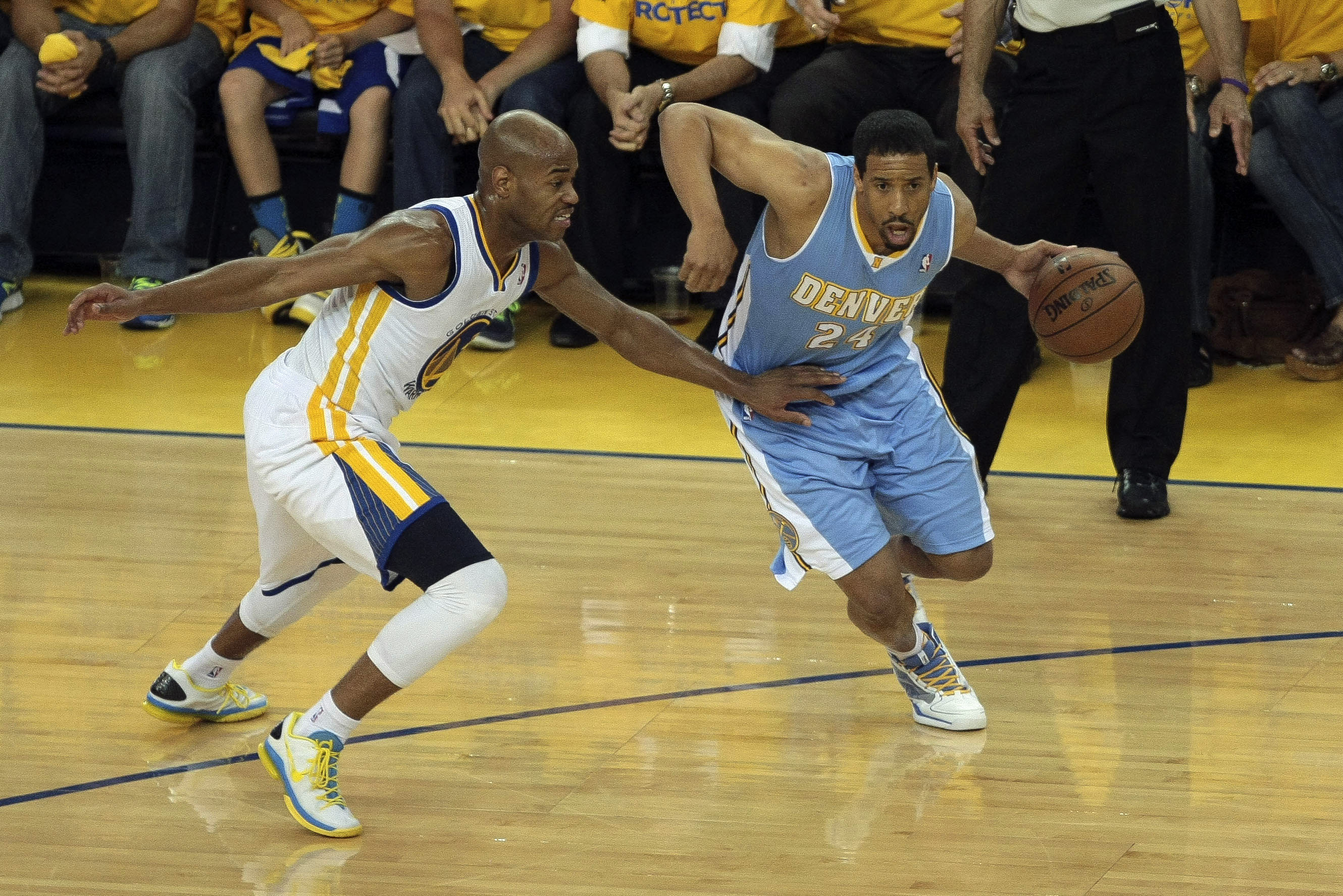
The Wizards made a deal at the trade deadline, swapping Eric Maynor, Jan Vesely and a second round pick in 2015 in a three-team trade that landed 37-year old Nuggets PG Andre Miller. The trade provides Washington with a much-needed reserve guard, and costs the team little in the long-term.

For their stated goal of making the playoffs, this is a good trade. Miller has declined some in his NBA dotage, but is still productive in his 15th season. Regular readers are likely familiar with my Player Production Average metric (PPA), which credits players for things that contribute to wins, debits them for things that don’t — each in proper proportion. PPA is pace-neutral, accounts for defense and includes a “degree of difficulty” factor. In PPA, 100 = average and higher is better.

Miller’s PPA this season: 94. Last season it was a 96. The previous season: 84. This is a significant dropoff from the 140-range PPAs he posted in his early 30s, but it’s still more than adequate for a third guard. For comparison, Temple’s PPA this season: 20. Maynor’s: 8.

Acquiring Miller doesn’t affect Washington’s cap situation going forward. Vesely’s contract is up at the end of the season. Maynor had another year at $2.1 million, but only $2 million of Miller’s salary for next season is guaranteed. If the Wizards decide to bring him back, it would be the equivalent of signing a free agent PG for $2.525 million. The money they owed Maynor is a sunk cost they would have had to pay regardless.

And yet, I’m ambivalent about the trade. First, I don’t like giving up that second round pick. Some object based on the likelihood of it being a high second rounder. I really don’t care where it falls. In my analysis, second round picks are grossly undervalued by many teams, including the Wizards. They’re opportunities to take chances on guys with ability, but with a “wart” or two. They’re opportunities to obtain inexpensive talent to fill roles — or perhaps more. If it was me, I’d want lots of second round picks to have more shots at finding the next Gilbert Arenas or Carlos Boozer or Chase Budinger or Isaiah Thomas or Marc Gasol or Marcin Gortat or Nikola Pekovic or DeJuan Blair or DeAndre Jordan or Ersan Ilyasvoa or Amir Johnson or etc., etc., etc.

Remember, second rounders typically sign non-guaranteed contracts — if they get a contract at all. They can be sent to the D-League, seasoned overseas, or simply straight out released if they don’t work. Low-risk investment with the possibility of a significant reward. Even if only half your second rounders turn into rotation players, they’re still providing valuable production at bargain price. But I digress.

The second reason I’m ambivalent is that it highlights a long series of mistakes and mismanagement by Ernie Grunfeld and the Wizards front office. It’s nice they could acquire Miller, but they shipped out Maynor — the free agent prize, who just six months ago was supposed to be their upgrade at backup PG. Now they’re paying a second round pick to dump him. Vesely, of course, was the sixth overall pick in the draft (chosen ahead of Kawhi Leonard and Kenneth Faried), who has totaled almost as many turnovers plus fouls as he did rebounds or points.

Over the past few seasons, the Wizards have managed to turn near-max cap space, future 1st and 2nd round picks, a 6th overall pick, and a BAE into Gortat, Ariza and Miller. All of whom have expiring contracts.

And third, I look back with some frustration on the ones that got away. In particular, I think of Shelvin Mack — a guy the Wizards cut twice to keep less productive players — who’s having a solid year in Atlanta.

But, Miller does improve the team’s bench. He should give Randy Wittman lineup options at the end of games, and his success sharing the backcourt with Ty Lawson in Denver bodes well for a partnership with Wall in DC. He’s an experience, efficient pro, who will help the Wizards make the playoffs, even if they still figure to be a first-round out. In that sense, the trade is fine. But it’s a shame the deal was even necessary.

Washington Wizards: Total Mediocrity

beal shoots

Ask a Wizards fan to describe the team, and odds are he’d say the starters are pretty good, but the bench is awful. And he’d probably take a shot at Randy Wittman’s coaching — something Wittman would deserve for no other reason than the passion he’s instilling for two-point jump shots (aka The Worst Shots in the Game; or The Shots the Defense Wants You to Take).

However, an analysis of starting lineups and benches around the league suggests that these assumptions may not be accurate. The analysis used my overall player rating metric, called Player Production Average (PPA), weighted by minutes played. I ran an overall minutes-weighted PPA for each team’s most commonly used starting five, and then for each team’s bench.

PPA credits players for things that contribute to winning and debits them for things that don’t — each in proper proportion. PPA is pace adjusted, accounts for defense and includes a degree of difficulty factor. In PPA, 100 = average, higher is better and 45 = replacement level.

The league’s average starting lineup produced a PPA of 129. Washington’s starters ranks 14th overall with a 127. The average bench produced a PPA of 67. Washington’s bench ranks 15th with a 69.

I’m as surprised as you are.

I suspect that a big reason the Wizards bench rates in the middle is because of Wittman’s short seven-and-a-half man rotation. Most nights, Wittman uses what amounts to a two-man bench of Martell Webster and either Nenê or Booker (whichever didn’t start). Nenê was counted as a starter, by the way. Garrett Temple plays only long enough for John Wall to catch his breath. The rest of the squad gets spot minutes when they can.

What does this show? This is a thoroughly mediocre team — starters AND bench.

Here’s a table showing minutes-weighted PPA scores for the starters and bench of each NBA team, sorted by Starter PPA:

TEAM STARTER PPA BENCH PPA Starter Rank Bench Rank
MIA 173 74 1 11
LAC 166 70 2 14
SAS 165 101 3 1
MIN 158 51 4 26
OKC 156 76 5 8
POR 156 52 6 25
GSW 153 40 7 30
ATL 148 76 8 9
IND 145 56 9 23
HOU 145 67 10 17
DAL 140 83 11 5
NOP 132 77 12 7
DEN 128 72 13 12
WAS 127 69 14 15
CLE 126 42 15 29
PHO 126 85 16 3
TOR 121 65 17 19
DET 120 51 18 27
NYK 119 71 19 13
SAC 118 63 20 20
MEM 118 85 21 4
CHI 116 75 22 10
CHA 116 55 23 24
LAL 114 69 24 16
UTA 109 58 25 22
PHI 107 43 26 28
ORL 106 59 27 21
BRK 100 88 28 2
BOS 93 67 29 18
MIL 70 79 30 6
         
AVG. 129 67    

A few observations:

  • Only Boston and Milwaukee have starting lineups that rate below the league average PPA (100). Incredibly, the Bucks bench rates as slightly more productive than the starters.
  • San Antonio has the league’s third best starting lineup AND the most productive bench.
  • Oklahoma City has the fifth best starting lineup, which is downright incredible because it includes 876 minutes of Kendrick Perkins (PPA: 24).
  • Minnesota is continuing its decades-long practice of not putting an adequate roster around a high-quality PF named Kevin. In years past, the “Kevin” was Garnett. The past few years, it’s been Love. The Timberwolves roll with the 4th best starters and the 5th worst bench.
  • Brooklyn is kind of a reverse image of Minnesota. The Nets’ starting lineup has been bad (minutes-weighted PPA of 100 — good for third worst), but they have the league’s 2nd most productive bench.

Moving on to the Wizards’ PPA update…no real surprises.

PLAYER GMS MPG LW PPA
Trevor Ariza 38 34.8 144 151
John Wall 43 37.0 147 143
Trevor Booker 34 21.2 137 136
Marcin Gortat 43 32.6 135 136
Nenê Hilario 36 29.6 102 104
Martell Webster 41 30.4 105 100
Bradley Beal 34 32.9 84 89
Jan Vesely 28 16.0 72 72
Chris Singleton 14 10.6 60 60
Glen Rice 11 9.9 18 21
Kevin Seraphin 31 9.9 20 17
Eric Maynor 22 9.5 13 13
Al Harrington 7 18.6 7 6
Otto Porter 21 9.8 3 4
Garrett Temple 41 11.5 6 3

Trevor Ariza had a good week while the rest of the team performed “about the same.” Webster’s production slipped for a fourth consecutive update — he’s now right at league average. If Washington is to break out of this rut of mediocrity, they need someone to significantly boost his production. The prime candidate would seem to be Bradley Beal, who had a terrific second half last season.

Wizards Lack of Depth Continues to Hurt

Get used to repeats of that old Wizards pattern — keeping the score tight (even holding a lead in the fourth quarter) only to lose in the end. The problem isn’t that Washington lacks a mystical “ability to close,” it’s that their bench can’t hold the leads its starters provide, and its starters wear down at the end of competitive games.

This is not the fault of Randy Wittman and the coaching staff. Most of the failing bench players are producing at levels consistent with career norms. Eric Maynor, a fan whipping boy so far this season, is playing worse than usual, but not abnormally so. He’s been unproductive throughout his career — that’s he’s even less productive should surprise no one. The same is true of Kevin Seraphin, Jan Vesely, Chris Singleton and Garrett Temple. They’ve established themselves as unproductive. There’s little reason beyond hope to imagine them becoming productive.

With the “make the playoffs or else” mandate, Wittman has little option but to play his key players heavy minutes and pray they don’t get hurt. And that’s exactly what’s happening. John Wall and Bradley Beal lead the league in minutes per game at PG and SG. Among SFs, Trevor Ariza ranks eighth and Martell Webster sits 15th. Marcin Gortat is second in minutes per game among centers. The fragile Nene plays the 12th most minutes per game for a PF.

If this was the playoffs, there’d be little reason for concern. But there are 62 games remaining in the regular season, and they’ve already sustained injuries to Ariza, Webster, Nene and Beal. Another injury could put the playoffs out of reach. That would be a shame (as would limping into the playoffs) because at full strength, it’s core rotation players could at least put a scare in a post-season opponent. They’ll need to get (and stay) healthy to do that, however.

For a further demonstration of Wittman’s lack of options, peruse the table below, which shows the (approximately) weekly update of Player Production Average (PPA). PPA is a player rating stat I developed. It credits players for things that contribute to winning and debits them for things that don’t — each in proper proportion. PPA is pace adjusted, accounts for defense and includes a degree of difficulty factor. In PPA, 100 = average, higher is better and 45 = replacement level.

PLAYER GMS MPG LW PPA
Trevor Ariza 15 36.1 146 172
John Wall 20 37.8 169 168
Marcin Gortat 20 34.6 152 150
Martell Webster 19 32.5 156 148
Nene Hilario 16 32.6 133 134
Trevor Booker 12 16.5 96 114
Bradley Beal 13 40.2 81 81
Jan Vesely 14 18.1 75 54
Chris Singleton 6 17.5 51 29
Eric Maynor 19 10.3 35 16
Al Harrington 7 18.6 6 7
Glen Rice 9 8.0 -10 4
Garrett Temple 18 10.1 -14 -23
Kevin Seraphin 15 7.9 -27 -32
Otto Porter 2 10.5 -70

Ariza is playing a lot like he’s in a contract year, which is to say — superbly. His production is All-Star level, though it would astonish me if he actually received the honor. But, with Lebron more a PF these days, it’s arguable that Ariza has been the East’s second best SF so far this season (behind Paul George).

Recovered from injuries last season, Gortat is producing at a good level again. Like Ariza, his timing is superb — he’s in a contract year as well.

Wall seems to have settled in at All-Star level production. PPA currently has him rated as the top PG in the East, and fifth most productive overall behind Chris Paul, Stephen Curry, Ty Lawson and Mike Conley.

This week’s update shows Vesely’s production dropping off. Hopefully he can turn things around. Whether or not he does, the coaching staff would be wise to give more minutes to Booker, who continues to be an “about average” producer. That’s nothing to get excited about, but it makes him a solid reserve.

Finally, note that the Wizards have seven players who rate below replacement level so far this season. Collectively, they’ve played 823 minutes — nearly 17% of the team’s total. This is a direct result of the front office’s persistent failure to properly assess players, and their inability to address the team’s glaring need for depth. This misjudgment is costing the team wins now, and could cost them even more as the season wears on.

Inside Wall’s Three-Game Binge

It’s hard to overstate how much fun it’s been watching John Wall erupt these past three games. Wall, whose shooting woes have been well documented, abruptly became a gunner — knocking down an array of shots from everywhere on the floor. The shooting display, paired with skilled passing and overwhelming athleticism left opponents flummoxed, teammates impressed, and fans buzzing with what might be…if he can keep it up.

How abrupt was the change in Wall’s performance level? Regular readers are familiar with my overall rating stat, Player Production Average (PPA). It’s a summary measure I developed that credits players for things they do that help a team win and debits them for things that don’t — each in proper proportion, of course. PPA is pace-adjusted, accounts for defense, and includes a degree of difficulty factor. In PPA, average = 100, higher is better, and replacement level is 45.

Through the first 11 games this season, Wall’s PPA was a pedestrian 106. His non-scoring numbers were good, but his shooting was terrible. Here are his PPA scores for each of the past three games:

  • at Toronto — 280
  • New York — 178
  • LA Lakers — 293

Over the past three games combined, his PPA was 249. To put this in perspective, last season Lebron James was the league’s most productive player with a PPA of 284. Second place was Chris Paul with a 244. In other words, if Wall maintains this level of play, he’ll be producing like an MVP.

His onslaught this past week earned him the league’s Player of the Week honor, and evoked his sensational March from last season. For that month, Wall had a PPA of 201 — a score that would rank him in the top five players in the league most seasons.

The most important question is whether he can maintain this level of performance, and it’s at this point that enthusiasm should be tempered. A little. Wall’s numbers are up across the board, but the surge in his overall impact is because of his stellar shooting.

Consider his shot selection (data courtesy nbawowy.com):

SPLIT At-Rim Mid-Range Long 2pt 3pt
1st 11 gms 28% 16% 32% 24%
Last 3 32% 16% 42% 11%
March 28% 28% 36% 8%

This table shows where Wall’s field goal attempts have been coming from. He’s been getting to the rim a little more often the past three games than he did early in the season (and last March), but the bulk of his shots are still jumpers. For my taste, he’s still shooting too many low-yield shots from mid-range and long two-point range. Indeed, 58% of his FGA are from what stat goobers not-so-affectionately call “sh*t” shots.

SPLIT TOTAL FGA At-RIM FGM AT-RIM FGA AT-RIM FG% MID-RANGE FGM MID-RANGE FGA MID-RANGE FG% LONG 2pt FGM LONG 2pt FGA LONG 2pt% 3FGM 3FGA 3pt%
1st 11 gms 170 27 47 0.574 6 28 0.214 16 55 0.291 12 40 0.300
Last 3 57 16 18 0.889 5 9 0.556 11 24 0.458 3 6 0.500
March 275 45 78 0.577 34 76 0.447 44 99 0.444 10 22 0.455

A few things jump out at me. First, his incredible percentage (.889) on at-rim attempts. Wall’s been finishing well at the hoop, and he’s been drawing a ton of fouls. He’s obviously not going to keep shooting near 90% on at-rim attempts, but they’re still his most efficient shot (when he can get it), and his forays to the basket have other excellent results such as drawing fouls (Wall’s a superb free throw shooter) and opening up teammates for shots.

The mid-range shooting percentage isn’t sustainable, but he doesn’t shoot much from there so it doesn’t matter much. His long two-point attempts are a bigger issue because he’s shot from that range frequently throughout his career. His percentage from that range the past week has been acceptable (.458), although it’s still not a very productive shot for him.

Pts Per Shot At-Rim Mid-Range Long 2pt 3pt
1st 11 gms 1.15 0.43 0.58 0.90
Last 3 1.78 1.11 0.92 1.50
March 1.15 0.89 0.89 1.36

Like the rest of the league, Wall is most productive when he gets to the rim or he shoot three-pointers. Obviously it’s not realistic to expect all of his shots to come from those two areas — sometimes he has to take what’s available. But, the principle doesn’t change.

In some ways, the numbers should be downright scary to the rest of the league. Even with 42% of his shots being low-efficiency long twos over the past three games, Wall scored 99 points on just 57 field goal attempts. If opponents start overreacting to Wall’s decent shooting on jumpers, it should pave the way for attacking the hoop. Which will make Wall even more efficient and even more dangerous.