The Wizards have run their “without Nenê” record to 5-2 — a subject well-covered by the Washington Post’s Michael Lee this morning. Lee even broke out “points per 100 possessions,” which was nice to see. My only quibble with the story was that it didn’t mention Washington’s ultra-soft schedule, which may have ended up on the cutting room floor as editors tried to make the story fit into their print edition.
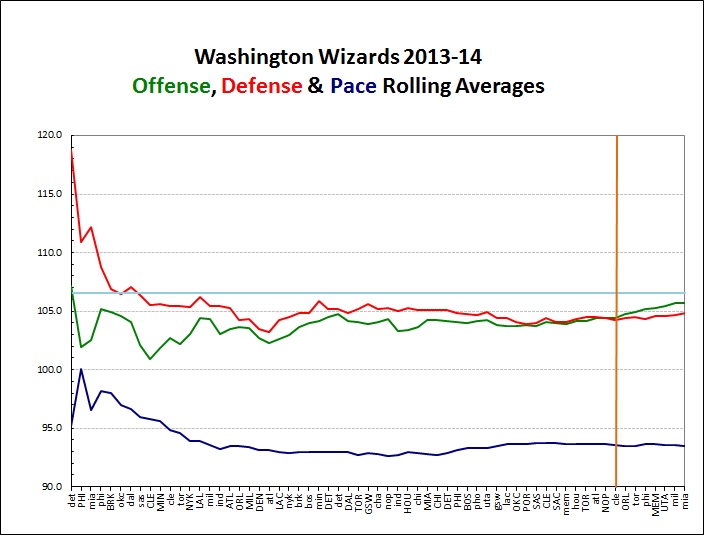
Here’s a quick look at the Wizards season — rolling averages of their offensive and defensive ratings (points scored/allowed per 100 possessions), as well as pace (possessions per 48 minutes).
Red = defensive rating Green = offensive rating Dark blue = pace Light blue = league average offensive rating Orange = date of Nenê’s knee injury
That the Wizards have had a nice run without Nenê shouldn’t be much of a surprise. His overall play (see the PPA table below) has been mediocre, and while he’s helped the team on defense, he’s hurt them on offense. And, the Wizards have faced a series of cupcake opponents — four of their last seven have been in full tank mode. Their win against Toronto is the only one that could be considered a surprise. Even using the Nenê on/off numbers from the date he got hurt, the Wizards should have been expected to win at least four.
What have the Wizards done differently without their big man? They’ve been WAY more efficient on offense (115.3 points per 100 possessions over the last seven games vs. a season average of 105.7), but worse on defense (a defensive rating of 109.7 vs. 104.9 for the season).
The offense was largely expected. As noted previously, Washington has been more efficient without Nenê this season. The defense is worrisome. They got shredded by Orlando (28th ranked offense), Memphis (about average), and Milwaukee (27th on offense). The Heat also toasted them pretty good, but no shock — Miami boasts one of the league’s top three offensive units.
Also helping the Wizards get by without Nenê: the additions of Drew Gooden and Andre Miller. In still-tiny sample sizes for each, they’ve both been exactly what the team needed. Gooden has dominated opposing reserves — at least on the offensive end — and has provided much-needed rebounding and efficient scoring off the bench. Miller has been a steady veteran facilitator who somehow produces despite playing in “epic movie slow-motion” mode.
Miller’s production is sustainable — it’s about the same as what he was doing in Denver before he got sent home because of an argument with Nuggets coach Brian Shaw. Gooden’s production will almost certainly moderate, though he’s likely to still be useful the rest of the season. Gooden’s career PPA is 122, and he’s just two seasons removed from a 141. He’s never been this efficient on offense, though. And, his good play to this point is likely to earn him more minutes, which means he’ll end up facing more starters than he’s gone up against so far this season. Worth mentioning: his defense has long been a concern, and so far he grades out as well-below average in the defense part of PPA.
To the update. What is PPA? It stands for Player Production Average, which is a metric I developed that credits players for things that contribute to winning and debits them for things that don’t — each in proper proportion. PPA is pace adjusted, accounts for defense and includes a degree of difficulty factor. In PPA, 100 = average, higher is better and 45 = replacement level. PPA is a per minute stat.
PLAYER
GMS
MPG
LW
PPA
Trevor Ariza
58
35.9
159
159
Marcin Gortat
63
32.8
141
149
Drew Gooden
5
13.4
-146
149
John Wall
63
36.8
150
144
Trevor Booker
53
20.7
115
114
Nene Hilario
49
30.1
103
103
Andre Miller
9
13.7
52
96
Bradley Beal
54
33.9
93
94
Martell Webster
59
28.9
88
90
Jan Vesely
33
14.2
69
69
Chris Singleton
20
11.4
54
45
Kevin Seraphin
43
12.2
42
42
Garrett Temple
59
10.5
21
21
Glen Rice
11
9.9
21
21
Eric Maynor
23
9.3
8
8
Otto Porter
29
8.8
2
3
Al Harrington
16
15.3
-9
-6
Trevor Ariza continues to maintain a high level of play. In PPA, he ranks 4th in the league among SFs with at least 500 total minutes; third overall in total production. Marcin Gortat’s production ticked up this week, while John Wall’s went down.
I really think it’s time to shelve talk of Wall being a superstar. He’s very good and he has great potential, but there’s still a loooooooong ways to go for him to be considered an elite player.
Nice to see Martell Webster’s PPA go up slightly — the first time since December 17th that his PPA hasn’t dropped in one of my updates.
With or without Nenê, the week ahead could be a good one for the Wizards. My odds estimator suggests Washington should be favorites to win each of their next four games, although the matchups with Orlando and Sacramento fall into “coin flip” territory. Their odds of actually winning all four are only about 10%, but 3-1 is realistic.
Now for the payoff to that Upworthy headline: Mike Wise is right. Well, his basic conclusion that Grunfeld will keep his job is correct. But just about everything else he wrote? Ill-informed, error-riddled, poorly reasoned garbage.
Among the barbershop banter going around Verizon Center’s media room Wednesday night was the topic of which Washington Wizards small forward had to go in the offseason to avert a talent-and-minutes logjam: Trevor Ariza, Martell Webster or Otto Porter Jr.?
By the time arguments were made on each player’s behalf (given his age and upside, everyone agreed moving Porter after his rookie year would be downright foolish), it dawned on the half-dozen or so of us: We were talking about players who might have to leave Washington because of too much depth at their position. No one could remember such a discussion about a Wizards roster this decade.
This was when I realized Ernie Grunfeld had definitely saved his job.
Several things are downright amazing in these four sentences. Face palm “amazing,” not “John Wall just threw down a breakaway 360 windmill” amazing.
First, mediaites are just now talking about the Wizards having a lot of guys at small forward? Second, this is somehow a good thing? And third: it took Wise until March 5 to “realize” Grunfeld’s job was saved?
Yeah, the Wizards do have a theoretical logjam at SF. People paying attention to the Wizards recognized a potential logjam at that spot before last year’s draft. That’s before the team selected Otto Porter — which was as predictable as…well…Wise writing an inane column for the Washington Post.
That potential logjam — recognized before last year’s draft — called into question the Wizards’ entire offseason strategy. Picking Porter to play SF was a fine move, especially if you’re a “best player available” proponent (as I am). Trading two second round picks for one and selecting SG/SF Glen Rice Jr. was another perfectly acceptable move. Keeping Trevor Ariza for the final year of his contract (instead of trading him) was also a fine move, as was re-signing Martell Webster.
What was decidedly NOT sensible was doing all four in the same offseason. And, a number of smart observers who pay attention and give actual thought to how to construct a good NBA team have been saying so since June 2013.
Grunfeld’s choice to invest so many resources at one position left the Wizards lacking depth up front, which was yet another thing that concerned fans who were paying attention. Washington was counting on two 30+ year old bigs, and 30+ year old athletes predictably do two things: get hurt and get worse.
What happened? Thirty-one year old Emeka Okafor got hurt before the season started, which meant that the Wizards NEEDED to acquire a replacement if they hoped to salvage their season. We’ll get into that in more detail very soon.
Meanwhile, 31-year old Nenê hit the 30+ exacta by both declining AND getting hurt.
More from Wise:
On a playoff-or-bust edict from his owner since training camp, out of injury alibis and facing the prospect of no postseason for a sixth straight spring, the oft-slammed team president launched a deep three-pointer in late October.
Grunfeld acquired a journeyman center from Phoenix and some loose change for an injured Emeka Okafor and a protected first-round draft pick.
That player, Marcin Gortat, has started 60 of 61 games this season.
Gortat has double figures in points and rebounds in 24 of those games.
He has bailed out his team down low, especially now that his bookend 6-foot-11 big man, Nene, is out for at least another month because of a sprained knee ligament. When Nene is healthy, the two play off each other brilliantly; the more Gortat bangs inside on offense, the more Nene can do his ballet outside the key.
That first paragraph is pure sophistry. Trading for Gortat wasn’t a “deep three,” it was a layup, a sure thing. Ditto for the trade to obtain Okafor and Ariza. Wise is suggesting that Grunfeld was taking a chance to get the team back in the playoffs. A competent GM would have addressed the team’s glaring need for frontcourt depth during the offseason instead of burning all of his assets on small forwards and a backup point guard who had been demonstrably terrible for four seasons.
The trade for Gortat isn’t evidence of Grunfeld’s executive acumen, but prime evidence of his incompetence. When the team’s starting center was out of commission, they couldn’t turn to their bench and have even a reasonable hope that the next man up could do an adequate job. Nope, they had to burn a future asset — likely to be in one of the deepest, most talented drafts of the past decade — to achieve the very modest short-term goals for this season.
“With March and Nene, we can match up with anybody inside,” Grunfeld said at halftime of a victory over the Jazz on Wednesday night as he leaned against a wall in the club suite where he watches games.
“It was big at that time we made the trade because we knew Emeka was hurt. To bring in a big guy who plays both offense and defense and has a very positive attitude, we were very happy.”
Ernie won’t talk about his future, pleading that I write about something else. Ted Leonsis won’t talk about Ernie’s future, just as he won’t talk about George McPhee’s future with the Capitals. All Monumental Sports business apparently will be handled this summer.
But while McPhee may need a Stanley Cup playoff run of at least two or more rounds to warrant an extension, the signs of Grunfeld being re-signed are growing daily.
ESPN has calculated the odds of Washington returning to the playoffs for the first time since 2008 as 100 percent (since Golden State and Portland don’t yet have that designation, it apparently does help to play in the Eastern Conference).
I’ve already addressed the content of the Grunfeld quotes. What he says is accurate enough, if looked at in a vacuum. The trade for Gortat (which cost the team a future first round pick) wouldn’t have been necessary if they’d done a reasonable job of adding depth in the offseason. Or, if they’d used the cap space they traded for Okafor and Ariza to get younger players that could be just as productive and have the prospect of improving.
It was nice to see Wise at least acknowledge the benefits of playing in the weak sister Eastern Conference. To add some teeth to the aside, keep in mind that Washington’s record (compiled against the league’s 8th easiest schedule) would rank 10th in the Western Conference. At 32-29, they’d be four games out of 8th place.
Realistically, Washington’s record would be worse in the tougher conference. In my analysis, they’d fall 11th. In the East, they’re fourth or fifth.
More from Wise:
I’ll admit it: I thought Ernie was finally toast. Though I’ve consistently defended him on essentially the same grounds Leonsis has used — Grunfeld is executing the gradual rebuilding plan his employer instructed him to — I wasn’t sure he could recover from re-signing Gilbert Arenas and Andray Blatche to a combined $146 million in 2008 and 2010.
But the recycling king did it, turning Arenas into Rashard Lewis, then into Okafor and Ariza (a trade widely criticized as the Wizards taking on two aging role players for too many guaranteed years and millions) and finally Okafor into Gortat.
The first paragraph from this excerpt is absurdity. The Wizards talked about doing a gradual rebuild, but when presented with resources to acquire young, productive players with a future, they instead traded for older players who could speedwalk them back to mediocrity.
The Arenas for Lewis trade was a solid move. Trading the cap space for older players was shortcutting the rebuild.
Note that last line: “…and finally Okafor into Gortat.” No, it was Okafor AND a first round pick for Gortat. Here’s the total price: maximum cap space, a future first round pick and a future second round pick for Ariza and Gortat. And, if the Wizards want them back, it’ll cost them max cap space again.
More Wise:
This is a very good core group, with its two best players 20 and 23 years old, respectively. The Wizards have put themselves in position salary-cap wise to spend in free agency the next two seasons.
Everything here is wrong. The core group is not “very good,” it’s average. Its best players are 28 and 23 (Ariza and Wall). The Wizards have NOT put themselves in a good position to spend in free agency. The last point is one I addressed last November.
To summarize: the Wizards won’t be in position to ADD to their team via free agency. If they’re to have significant cap room to sign a “name brand” free agent, they’ll have to let Gortat, Ariza and Booker depart. If those guys leave, Washington will need to REPLACE them. If they re-sign Gortat and/or Ariza and/or Booker, they won’t have cap space to pursue a significant free agent.
Now, the team could re-sign Gortat and Ariza (and maybe Booker too), and then go shopping in free agency using the MLE. Then they’d be adding. But, they’d also then be tied to two 30+ year old big men (Gortat and Nenê), who would more likely be declining as Wall, Beal and (maybe) Porter are approaching their potential.
More Wise:
As time has gone on, the bigger picture of Grunfeld’s vision is beginning to emerge. Taking on Nene’s $65 million deal or the remaining $15 million of Ariza’s deal appeared risky, if not foolish, in 2012. But without those pieces and Gortat surrounding John Wall and Bradley Beal, the Wizards aren’t three games over .500 for the first time since the Arenas era and less than two months from possibly their first playoff series win since 2005.
Vision? There’s no vision here. The team is the assemblage of a man trying to save his job. There’s little apparent thought given to a long-term goal like building a championship contender.
The stuff about Ariza, Nenê and Gortat supposes that those were the only moves available. What’s more, getting these players (instead of younger guys who might grow with Wall and Beal) is indictment of Grunfeld’s alleged vision. Gortat and Ariza must be re-signed — re-acquired at the cost of a second helping of maximum cap space. And, as some (including myself) predicted, Nenê is in the expensive, injured, decline portion of his career.
And this is before even getting to the bungling that made trading for veterans a consideration in the first place. When Washington dealt for these guys, younger players — all of whom were selected by Grunfeld — were setting new standards for ineptitude.
Wise writes:
With Joe Dumars reportedly on his way out in Detroit, Grunfeld would have the fifth-longest tenure among NBA GMs behind Miami’s Pat Riley, the Lakers’ Mitch Kupchak, San Antonio’s R.C. Buford and Boston’s Danny Ainge.
Yes, Grunfeld’s the only one on that list without an NBA title. He’s also the only one who was expressly told to do it on the cheap for a few years.
More sleight-of-hand sophistry. Note the use of “…an NBA title,” as if Grunfeld’s team was oh-so-close, but just fell short. So, let’s compare the records of the longest-tenured GMs:
NBA RANK
TEAM
GM
W
L
W-L%
1
SAS
Buford
611
254
.706
3
LAL
Kupchak
520
346
.600
4
MIA
Riley
515
348
.597
8
BOS
Ainge
472
392
.546
11
DET
Dumars
458
407
.529
28
WAS
Grunfeld
345
520
.399
Perhaps you’ll notice what I did — during the time Grunfeld has been in charge of the Wizards, they’ve had the league’s third WORST winning percentage. In that same timespan, those who have been in place longer have run three of the league’s most successful franchise. And the fourth guy — the one reportedly close to being fired — guided a franchise that was one of the NBA’s best for a seven-year span, and which won a championship.
What’s remarkable to consider is that 22 other NBA franchises were better than the Wizards teams Grunfeld assembled…and replaced their GM.
Wise blathers:
He doesn’t get a pass for drafting Jan Vesely at No. 6 or Oleksiy Pecherov at No. 18. He’s also not the only NBA executive who didn’t take Stephen Curry before No. 7 or DeJuan Blair before No. 37 in 2009.
But, apparently in Wise’s book, Grunfeld does get a pass for picking Chris Singleton ahead of Kenneth Faried, for signing Eric Maynor, or for trading the 5th pick for Mike Miller and Randy Foye.
Wise bleets:
Here’s hoping those in the Why-Isn’t-Grunfeld-Gone? mob can lower their pitchforks and finally notice the team in front of them.
Last month in Sochi, Russia, I ran into a former acquaintance of mine and Grunfeld’s who, within minutes, wanted to know, “How does Ernie still have a job?” I’ve heard this often the past few years, often from people looking for work themselves.
Now that the Wall era is within weeks of its first postseason, the answer is easy: Ernie Grunfeld and his closest advisers were given just the right amount of time they needed to fix what was broke.
For this year, the team is enjoyable to watch. But, those who pay attention to the team know that scaling Mt. Mediocrity this season (and really, it was supposed to be scaled last season, but…you know…that injury to Wall and (this may sound familiar) lack of depth) comes at the expense of the team’s future.
They spent their cap space on older players. To keep those older players, they’re going to have to spend even more cap space.
Because one of those older players got hurt (and they hadn’t obtained a solid reserve big man despite a glaring need for depth), they had to spend a future first round pick (probably in a deep draft) to get another older player.
Because they flunked player evaluation, they had to spend their biannual exception, a previous (failed) first round pick, AND a future 2nd round pick to get an “on his last legs” backup PG.
This kind of twaddle from Wise is what I expected from casual fans when the Wizards punted on the rebuild and instead went all-in for mediocrity. What the team did was cynical in my view — they created an illusion of improvement, not by doing a genuine rebuild with younger players who have a future, but by spending resources on established players on short contracts.
It’s not about lowering pitchforks or wanting Grunfeld gone. When I’ve met Grunfeld, I liked him. In fact, I’ve liked and respected all the front office guys I’ve had a chance to meet. But they haven’t done a good job over the past decade, and there’s little reason to think they’ll abruptly improve in the future.
The Wizards made a deal at the trade deadline, swapping Eric Maynor, Jan Vesely and a second round pick in 2015 in a three-team trade that landed 37-year old Nuggets PG Andre Miller. The trade provides Washington with a much-needed reserve guard, and costs the team little in the long-term.
For their stated goal of making the playoffs, this is a good trade. Miller has declined some in his NBA dotage, but is still productive in his 15th season. Regular readers are likely familiar with my Player Production Average metric (PPA), which credits players for things that contribute to wins, debits them for things that don’t — each in proper proportion. PPA is pace-neutral, accounts for defense and includes a “degree of difficulty” factor. In PPA, 100 = average and higher is better.
Miller’s PPA this season: 94. Last season it was a 96. The previous season: 84. This is a significant dropoff from the 140-range PPAs he posted in his early 30s, but it’s still more than adequate for a third guard. For comparison, Temple’s PPA this season: 20. Maynor’s: 8.
Acquiring Miller doesn’t affect Washington’s cap situation going forward. Vesely’s contract is up at the end of the season. Maynor had another year at $2.1 million, but only $2 million of Miller’s salary for next season is guaranteed. If the Wizards decide to bring him back, it would be the equivalent of signing a free agent PG for $2.525 million. The money they owed Maynor is a sunk cost they would have had to pay regardless.
And yet, I’m ambivalent about the trade. First, I don’t like giving up that second round pick. Some object based on the likelihood of it being a high second rounder. I really don’t care where it falls. In my analysis, second round picks are grossly undervalued by many teams, including the Wizards. They’re opportunities to take chances on guys with ability, but with a “wart” or two. They’re opportunities to obtain inexpensive talent to fill roles — or perhaps more. If it was me, I’d want lots of second round picks to have more shots at finding the next Gilbert Arenas or Carlos Boozer or Chase Budinger or Isaiah Thomas or Marc Gasol or Marcin Gortat or Nikola Pekovic or DeJuan Blair or DeAndre Jordan or Ersan Ilyasvoa or Amir Johnson or etc., etc., etc.
Remember, second rounders typically sign non-guaranteed contracts — if they get a contract at all. They can be sent to the D-League, seasoned overseas, or simply straight out released if they don’t work. Low-risk investment with the possibility of a significant reward. Even if only half your second rounders turn into rotation players, they’re still providing valuable production at bargain price. But I digress.
The second reason I’m ambivalent is that it highlights a long series of mistakes and mismanagement by Ernie Grunfeld and the Wizards front office. It’s nice they could acquire Miller, but they shipped out Maynor — the free agent prize, who just six months ago was supposed to be their upgrade at backup PG. Now they’re paying a second round pick to dump him. Vesely, of course, was the sixth overall pick in the draft (chosen ahead of Kawhi Leonard and Kenneth Faried), who has totaled almost as many turnovers plus fouls as he did rebounds or points.
Over the past few seasons, the Wizards have managed to turn near-max cap space, future 1st and 2nd round picks, a 6th overall pick, and a BAE into Gortat, Ariza and Miller. All of whom have expiring contracts.
But, Miller does improve the team’s bench. He should give Randy Wittman lineup options at the end of games, and his success sharing the backcourt with Ty Lawson in Denver bodes well for a partnership with Wall in DC. He’s an experience, efficient pro, who will help the Wizards make the playoffs, even if they still figure to be a first-round out. In that sense, the trade is fine. But it’s a shame the deal was even necessary.
I was all set to write a piece arguing that it would be pointless to fire Randy Wittman. Yeah, he’s not a good coach, but in my view the team is performing about as I expected. The Wizards are neither good nor bad. They’re mediocre. Or, looked at another way, the Wizards are BOTH good and bad. Which is merely another way of saying the same thing: this is an average team.
They are what their talent says they are. I don’t believe that any coach could come in and transmogrify this roster into a…well…what exactly? a contender for the third seed? Blech.
What would “fix” the Wizards? Fewer two-point jumpers? More screen/roll with John Wall and Marcin Gortat? Better defined roles? A rotation that somehow includes developmental minutes for Otto Porter? A more solid defensive scheme? More consistent effort? Sure, any or all.
Some of that could be influenced by the coach, some not. My position has been that Wittman is a problem, not The Problem. And, “The Problem” is that the team doesn’t have enough talent, which is a result of a series of bad decisions by the front office. My thinking has been this: Don’t let Ernie Grunfeld off the hook. Make him live with the success or failure of the team he assembled — players AND coaches.
Except, let’s look at reality. Owner Ted Leonsis set the franchise goal for the season: Make the playoffs. In very large part because of a historically weak Eastern Conference, the Wizards will almost certainly accomplish that goal. While they’d be roughly the 11th best team in the West, they’re 5th or 6th best in the East. It would take a catastrophic collapse over their final 29 games to miss the postseason.
Assuming Leonsis is a man of his word, Grunfeld will be retained in the offseason. It’s difficult to envision a scenario in which Washington makes the playoffs and Leonsis doesn’t bring back Grunfeld and The Coach.
I use “The Coach” intentionally, because the question for Wizards fans is whether you want to root for a team that’s stuck with Grunfeld and Wittman or a team that’s stuck with Grunfeld and Someone Else. My feeling is that Someone Else — whether it’s an interim coach who’s replaced by a “permanent” hire after the season or whether it’s an interim coach who “succeeds” and keeps the job — will be a better long-term option for the Wizards than Wittman.
So, even though Wittman has been saddled with a roster that doesn’t include a single player that ranks among the league’s 40 most productive players (Trevor Ariza is the highest rated Wizards player at 44), count me among the fans who’d like to see a new coach. Now.
Moving on to the update… The table below presents results from my Player Production Average (PPA) metric. PPA credits players for things that contribute to winning and debits them for things that don’t — each in proper proportion. PPA is pace adjusted, accounts for defense and includes a degree of difficulty factor. In PPA, 100 = average, higher is better and 45 = replacement level.
PLAYER
GMS
MPG
LW
PPA
Trevor Ariza
48
35.8
152
148
John Wall
53
37.1
149
140
Marcin Gortat
53
32.4
139
139
Trevor Booker
43
20.2
125
118
Nene Hilario
46
30.3
103
103
Martell Webster
51
29.1
94
91
Bradley Beal
44
33.2
86
90
Jan Vesely
32
14.7
72
69
Chris Singleton
14
10.6
60
60
Kevin Seraphin
40
11.8
32
44
Glen Rice
11
9.9
21
21
Garrett Temple
51
11.5
13
20
Eric Maynor
23
9.3
8
8
Al Harrington
7
18.6
6
6
Otto Porter
23
9.3
4
-4
When looking at these numbers, keep in mind that PPA scores in the 140-150 range (like Ariza and Wall) are nowhere near elite levels of production. A typical MVP-quality season would have a PPA of 230 or better. This season’s MVP is likely to be Kevin Durant with a PPA of 261 (so far). Last season, Lebr0n James posted the best PPA in my database with a 284.
Wall had a feel-good All-Star weekend winning the dunk contest and playing well in the game. But, if he played in the West, he wouldn’t have been part of the All-Star discussion. He continues to have All-World potential, but his actual production is good — not great.
Biggest improvers in this update were Kevin Seraphin and Garrett Temple. Seraphin is now at replacement level. Temple continues to be among the league’s weakest PGs, but is at least a little less bad than he’d been.
Wall’s performance slumped leading into the All-Star break. Perhaps he was distracted by the coming festivities? Nenê’s production continues to hover around league average. Martell Webster’s play declined for a sixth consecutive update.
Wanted to get this up before tonight’s match-up with the San Antonio Spurs — a team the Wizards haven’t beaten since 2005. For those keeping score at home, that’s 15 consecutive losses to the Spurs. But, I’m digressing (in the lede, no less). The point is to celebrate that the Wizards are a game over .500 for the first time in four years.
When I told my 17-year old the other night, he said (and this is an exact quote): “Wow. Is the East really that bad this year?”
When I tried to tell my 14-year old, I’d gotten to “…for the first time in…” He finished the sentence with, “…my lifetime?”
Wiseass.
Although, now that I reflect on it, I’m not sure he was joking. The team has been bad enough for long enough that it’s probably a reasonable question for a less-than-casual follower of the team. Put another way, it’s been nearly 29% of my 14-year old’s life since the Wizards had a record over .500.
Anyway, not much time for this week’s update. The table below presents results from my Player Production Average (PPA) metric. PPA credits players for things that contribute to winning and debits them for things that don’t — each in proper proportion. PPA is pace adjusted, accounts for defense and includes a degree of difficulty factor. In PPA, 100 = average, higher is better and 45 = replacement level.
A few quick observations:
Biggest improvers this week were Kevin Seraphin and Garrett Temple. John Wall had a good week, and Marcin Gortat wasn’t bad either. Trevor Ariza maintained at a high level of production.
In consecutive games against Oklahoma City and Portland, Seraphin had single-game PPA scores of 179 and 178. If he could somehow manage that kind of play over a full season, it would put him among the league’s 10-12 most productive centers — in a general grouping with Joakim Noah, Nikola Pekovic and DeAndre Jordan. I do not expect this kind of performance to continue for long.
Martell Webster’s PPA slipped for a fifth consecutive update. His production for the season is now slightly below average. His shooting continues to be excellent, but he’s very low usage (about 14% of the team’s possessions when he’s in the game), and he doesn’t rebound or assist much. His defense rates as a little below average in my analysis.
Nenê’s production continues to hover around league average. The trajectory of his production is looking scarily like a fairly typical NBA aging curve. The team continues to be better when he’s on the floor, but the dip in his overall production has to be a concern — especially since he’s due $13 million for two more seasons after this one.
Eric Maynor didn’t exactly give a good example of staying ready. After getting DNP-CD for a month, Maynor finally got a shot. In just 6:37 of playing time, Maynor was bad enough to lower his PPA for the season by five points. When it comes to Maynor, keep in mind this quote from Ernie Grunfeld on the eve of training camp:
We wanted to upgrade our backup point guard position and Eric [Maynor] has been with us now, three weeks in a row. He’s very solid, very steady. He brings a little poise to the game. He knows how to play. So we feel we’ve upgraded that position.
Easter Island. Stonehenge. The continued employment of Ernie Grunfeld. These are a few of the mysteries that have baffled researchers through the years.
That Grunfeld has been able to remain at the Wizards helm despite the team compiling the league’s third worst winning percentage during his tenure — well, that’s been a real puzzler. But, you won’t need to trouble your thoughts any longer: I have solved the riddle. Through careful application of logic, reason, Basketball Reference and Microsoft Excel, I have compiled definitive proof showing why team owner Ted Leonsis has kept Grunfeld on the job.
The reason is shocking in its simplicity, and it shows how misguided and unreasonable you Leonsis/Grunfeld detractors have been.
Shame on you.
The problem has been application of the wrong measuring stick. Critics have been comparing Grunfeld to the rest of the NBA, which is silly when you think about it. (And, I’m sure if we all give it some thought, we might come up with a reason (just one) why it’s silly.)
The proper comparison for a guy taking over the Washington Wizards is…(wait for it)…other Wizards GMs. I’ll pause a moment for you to slap yourself in the forehead and say, “Oh my gosh, I’ve been SO stupid.”
Since 1973-74, the Washington Wizards/Bullets have had five GMs (top executives): Bob Ferry, John Nash, Wes Unseld, Michael Jordan and Grunfeld. Take a look at the table below, and you’ll see that the Grunfeld-built Wizards have compiled a .395 winning percentage — third best for a Wizards/Bullets in the past 31 years.
TOP EXECUTIVE
YEARS
W%
LEAGUE RANK
TEAMS
Ernie Grunfeld
03-04 to present
0.395
28
30
Michael Jordan
00-01 to 02-03
0.378
24
29
Wes Unseld
96-97 to 99-00
0.449
19
29
John Nash
90-91 to 95-96
0.327
25
29
Bob Ferry
73-74 to 89-90
0.523
8
27
And this season’s team is above average for a Washington team — hovering near the lofty heights of a .500 record.
Ernie Grunfeld — one of the three best Wizards/Bullets general managers in the past three decades. You don’t just go out and fire a top three GM.
Ask a Wizards fan to describe the team, and odds are he’d say the starters are pretty good, but the bench is awful. And he’d probably take a shot at Randy Wittman’s coaching — something Wittman would deserve for no other reason than the passion he’s instilling for two-point jump shots (aka The Worst Shots in the Game; or The Shots the Defense Wants You to Take).
However, an analysis of starting lineups and benches around the league suggests that these assumptions may not be accurate. The analysis used my overall player rating metric, called Player Production Average (PPA), weighted by minutes played. I ran an overall minutes-weighted PPA for each team’s most commonly used starting five, and then for each team’s bench.
PPA credits players for things that contribute to winning and debits them for things that don’t — each in proper proportion. PPA is pace adjusted, accounts for defense and includes a degree of difficulty factor. In PPA, 100 = average, higher is better and 45 = replacement level.
The league’s average starting lineup produced a PPA of 129. Washington’s starters ranks 14th overall with a 127. The average bench produced a PPA of 67. Washington’s bench ranks 15th with a 69.
I’m as surprised as you are.
I suspect that a big reason the Wizards bench rates in the middle is because of Wittman’s short seven-and-a-half man rotation. Most nights, Wittman uses what amounts to a two-man bench of Martell Webster and either Nenê or Booker (whichever didn’t start). Nenê was counted as a starter, by the way. Garrett Temple plays only long enough for John Wall to catch his breath. The rest of the squad gets spot minutes when they can.
What does this show? This is a thoroughly mediocre team — starters AND bench.
Here’s a table showing minutes-weighted PPA scores for the starters and bench of each NBA team, sorted by Starter PPA:
TEAM
STARTER PPA
BENCH PPA
Starter Rank
Bench Rank
MIA
173
74
1
11
LAC
166
70
2
14
SAS
165
101
3
1
MIN
158
51
4
26
OKC
156
76
5
8
POR
156
52
6
25
GSW
153
40
7
30
ATL
148
76
8
9
IND
145
56
9
23
HOU
145
67
10
17
DAL
140
83
11
5
NOP
132
77
12
7
DEN
128
72
13
12
WAS
127
69
14
15
CLE
126
42
15
29
PHO
126
85
16
3
TOR
121
65
17
19
DET
120
51
18
27
NYK
119
71
19
13
SAC
118
63
20
20
MEM
118
85
21
4
CHI
116
75
22
10
CHA
116
55
23
24
LAL
114
69
24
16
UTA
109
58
25
22
PHI
107
43
26
28
ORL
106
59
27
21
BRK
100
88
28
2
BOS
93
67
29
18
MIL
70
79
30
6
AVG.
129
67
A few observations:
Only Boston and Milwaukee have starting lineups that rate below the league average PPA (100). Incredibly, the Bucks bench rates as slightly more productive than the starters.
San Antonio has the league’s third best starting lineup AND the most productive bench.
Oklahoma City has the fifth best starting lineup, which is downright incredible because it includes 876 minutes of Kendrick Perkins (PPA: 24).
Minnesota is continuing its decades-long practice of not putting an adequate roster around a high-quality PF named Kevin. In years past, the “Kevin” was Garnett. The past few years, it’s been Love. The Timberwolves roll with the 4th best starters and the 5th worst bench.
Brooklyn is kind of a reverse image of Minnesota. The Nets’ starting lineup has been bad (minutes-weighted PPA of 100 — good for third worst), but they have the league’s 2nd most productive bench.
Moving on to the Wizards’ PPA update…no real surprises.
PLAYER
GMS
MPG
LW
PPA
Trevor Ariza
38
34.8
144
151
John Wall
43
37.0
147
143
Trevor Booker
34
21.2
137
136
Marcin Gortat
43
32.6
135
136
Nenê Hilario
36
29.6
102
104
Martell Webster
41
30.4
105
100
Bradley Beal
34
32.9
84
89
Jan Vesely
28
16.0
72
72
Chris Singleton
14
10.6
60
60
Glen Rice
11
9.9
18
21
Kevin Seraphin
31
9.9
20
17
Eric Maynor
22
9.5
13
13
Al Harrington
7
18.6
7
6
Otto Porter
21
9.8
3
4
Garrett Temple
41
11.5
6
3
Trevor Ariza had a good week while the rest of the team performed “about the same.” Webster’s production slipped for a fourth consecutive update — he’s now right at league average. If Washington is to break out of this rut of mediocrity, they need someone to significantly boost his production. The prime candidate would seem to be Bradley Beal, who had a terrific second half last season.
There’s a good chance I’ll be able to type these exact words in many of my Wizards entries the rest of the season: since my last update, the Wizards have a .500 record. That’s because this is a slightly below average team in a historically bad conference. And so, the team is likely to continue muddling through at around .500 — a bit worse when they play a tough patch of the schedule; a bit better in an easier stretch.
The team needs several things if it hopes to become a contender for anything more than squeaking into the playoffs:
Better management.
Better coaching.
Better players.
Simple, right? It’s tough to envision a scenario where team owner Ted Leonsis replaces Ernie Grunfeld, however. The Wizards have had the league’s third worst winning percentage during Grunfeld’s tenure, yet somehow he’s remained in place. Why would Leonsis replace him now that the team is slouching towards mediocrity?
Before I get to this week’s update, I want to mention something I stumbled upon from a conversation with a fan of the team on the RealGM Wizards message board. This fan asserted that Washington’s starting lineup is “on par” with teams in the East other than Miami and Indiana. This is low bar stuff, of course, but…well…it’s not even true.
While the Wizards starters can be described as “solid,” they actually rank 4th in the East behind Miami, Indiana and Atlanta. The team’s starting five produces at a rate solidly below those three teams. Washington is “on par” with the next few teams in the East — their starters are in the same vicinity as those for Cleveland, Detroit and Toronto.
Overall, the Wizards rank 15th in the quality of its starting lineup, albeit with an aggregate production rating slightly below the league average. So, while many have correctly assessed the Wizards lack of depth as a major problem, the fact is that their starters have been mediocre as a group as well.
Here’s this week’s Player Production Average (PPA) update. PPA is a player rating stat I developed that credits players for things that contribute to winning and debits them for things that don’t — each in proper proportion. PPA is pace adjusted, accounts for defense and includes a degree of difficulty factor. In PPA, 100 = average, higher is better and 45 = replacement level.
PLAYER
GMS
MPG
LW
PPA
Trevor Ariza
30
34.3
146
144
John Wall
35
37.2
147
140
Trevor Booker
27
21.5
139
137
Marcin Gortat
35
32.2
130
132
Martell Webster
34
30.4
120
109
Nene Hilario
28
28.7
120
107
Bradley Beal
26
34.0
76
73
Jan Vesely
26
15.9
55
73
Chris Singleton
12
12.1
66
64
Glen Rice
11
9.9
21
18
Otto Porter
16
10.9
23
15
Eric Maynor
22
9.5
13
13
Kevin Seraphin
25
10.3
2
12
Al Harrington
7
18.6
6
7
Garrett Temple
33
10.8
-2
2
Trevor Ariza’s rating is basically flat from last week, but that belies his volatile week. The SF alternated awful games with highly productive ones, with little apparent reason for either performance level.
John Wall seems to have settled in at a solidly productive level, albeit one that’s well short of being worthy of the maximum contract extension he signed before the season.
Booker and Gortat continued performing as they had been in previous weeks, but both Nene and Martell Webster continued to see their production slide. With Nene, I know he’s struggling to play through an Achilles injury. The Wizards haven’t reported any physical problems for Webster, though I’m starting to wonder if there might be something there.
Vesely had a couple good games against Charlotte and New Orleans, and then a couple duds against Indiana and Houston.
Seraphin gave the Wizards a lift in their comeback against the Rockets, but was awful the rest of the week.
The team continues to have a gaping chasm at PG behind Wall. Maynor has been awful; Temple remains one of the league’s least productive players, even as he finally eased out negative PPA territory for the first time all season.
Here’s how weird things have gotten for me as I follow the Washington Wizards: I feel sympathy for a coach I never would have hired in the first place. Team president Ernie Grunfeld and owner Ted Leonsis awarded the full-time coaching job to Randy Wittman, who’d done a solid job as interim coach when they fired Flip Saunders. According to reports at the time, they neither considered nor interviewed other candidates for the position. Had it been my call…well, Wittman wouldn’t have been the choice.
Despite the howls of fans angered by a three-game losing streak, Wittman isn’t a bad coach. He isn’t a good one either — at least not by NBA standards. He’s standard issue NBA coaching material. Good at some things, not so good at others. On balance, probably on the “below” side of average, but close enough to the league standard that he’s not a drag on his team’s performance. When he gets fired by the Wizards, he could take a year off, go down to college and be great at that level. Sure, a guy like Phil Jackson, Pat Riley or Greg Popovich would win a few more games with the same roster, but a) those guys aren’t coming to Washington, and b) the Wizards wouldn’t be title contenders even with an elite coach.
I’m not saying it would be pointless to fire Wittman and replace him with Someone Else — maybe Mr. Else could get an extra win or two from this team over the remainder of the season. But no coach is going to transmogrify this group into a title contender for one simple reason: the roster is inadequate. They’re good enough to avoid missing the playoffs in the misbegotten East. They might even be good enough to win a playoff series if they’re reasonably healthy and they can avoid a first round matchup with Indiana or Miami. But there isn’t a coach on the planet who could get them further — not with this roster.
As you’ll see in the table below, Wittman has been given a team that’s effectively six deep. Bradley Beal could be a seventh, if he starts performing the way he did in the second half of last season. Wittman’s options are further diminished by minutes restrictions for Beal and (more importantly) Nene.
There are plenty of things I’d love to see the team do differently — starting with taking fewer two-point jump shots. (Umm, fellas — those shots are open for a reason.) Maybe better coaching could change some of those things. But, NBA reality is that everyone knows what everyone else is doing strategically. Coaches come up with stuff to surprise each other now and then, but most games are decided by overall talent and execution.
A coach’s most important job is getting lineups on the floor that maximize his team’s chances of winning. Those lineup decisions have largely been taken from Wittman by the team’s wafer-thin roster. Unless Nene’s Achilles gets better or someone on the Wizards bench radically improves, the coaching staff is stuck with few options to patch over the lack of depth. That this situation was entirely predictable (in fact, was predicted before the season) makes it no less frustrating.
Below is this week’s Player Production Average (PPA) update. PPA is a player rating stat I developed that credits players for things that contribute to winning and debits them for things that don’t — each in proper proportion. PPA is pace adjusted, accounts for defense and includes a degree of difficulty factor. In PPA, 100 = average, higher is better and 45 = replacement level.
PLAYER
GMS
MPG
LW
PPA
John Wall
31
37.2
149
147
Trevor Ariza
26
34.2
154
146
Trevor Booker
23
22.0
118
139
Marcin Gortat
31
32.5
130
130
Nene Hilario
24
29.4
132
120
Martell Webster
30
31.2
151
120
Bradley Beal
22
34.9
84
76
Chris Singleton
11
12.9
48
66
Jan Vesely
22
15.8
53
55
Otto Porter
12
12.2
-47
23
Glen Rice
11
9.9
21
21
Eric Maynor
22
9.5
18
13
Al Harrington
7
18.6
6
6
Kevin Seraphin
23
10.0
-15
2
Garrett Temple
29
10.8
-21
-2
Normally, I update weekly, but this one went a couple weeks — eight games total. The Wizards went 4-4 during that stretch, including their current three-game winning streak. The performance levels of John Wall, Trevor Ariza and Marcin Gortat appear to have largely stabilized.
Wall’s “grade” is interesting because it’s at once encouraging and disappointing. On the encouraging side, this is the longest sustained period of well-above average play of his career. So far, he’s the most productive guard in the East. But…his per minute production is still not close to “franchise cornerstone” level. And while he’s the East’s best PG, he still ranks behind nine Western Conference PGs in per minute production.
I have a similar reaction to Gortat’s score. He’s a solid producer, but…he ranks only about 20th among centers. The Wizards need more from him, especially on the boards and on defense.
Ariza is — by some strange coincidence — playing the best basketball of his career in a contract year.
Other positives: Trevor Booker becoming a solid producer upon entering the starting lineup (though his team defense continues to be a problem), Otto Porter improved from a HUGE negative to a net positive, and Kevin Seraphin finally got out of the negative PPA range.
A word on Seraphin — the big man currently rates as the NBA’s least productive center. He managed the same “feat” last season. There seems to be some kind of a message there, but I could be over-thinking things.
Oh yeah, Chris Singleton also showed signs of life with not atrocious play in a couple garbage time appearances.
On the negative side: Nene’s production is (unsurprisingly) down as he tries to play through that Achilles injury. Martell Webster’s play declined significantly this update, as well. And, of course, the Wizards continue to get absolutely nothing from their backup PGs.
With teams now able to sign free agents to 10-day contracts, I’m hoping the Wizards front office will start bringing in D-League PGs for tryouts until they find one they like. I’d also like to see them try some PF/C types in hopes of getting even replacement level play off the bench. They can make room by releasing one or more from the group of Temple, Seraphin, Harrington and Maynor. Yes, I know there’s no way they’d just cut Maynor because of the player option he holds for next season. It could be a correct move, however.
Short of trading additional future assets, getting lucky with a D-League pickup, or getting radical in-season improvement from one or more players currently on the roster, there just isn’t getting around the reality that this year’s Washington Wizards is solidly mediocre — at best.
I went into this week’s update on the team trying to conjure up a “modest proposal” type of post. Best I could come up with was the notion of shortening the game to 32 minutes so that teams would need to play only their top seven. And, Washington’s top seven is pretty good.
In this imaginary “top 7” league, so far this season, Washington would move up the standings a bit. According to my estimates, their top 7 would rank 4th in the East behind Miami, Atlanta and Indiana.
Overall, their top 7 rates 12th best, which sorta gives some perspective to how weak the East is so far this season. Washington’s seven best players rate as 4th best in the East, but would be only 9th best in the West.
Just to extend the silliness to its “logical” end — in this hypothetical, Washington would win a first round series against Brooklyn only to get bludgeoned in round two by Miami. The West would be a dogfight, but (if my PPA ratings held sway — and in this alternate reality, they do) San Antonio would emerge victorious. That would set up a repeat of last season’s Heat-Spurs final. Which the Heat would win.
Of course, the league isn’t going to shorten the game time anymore than it can guarantee Washington’s top seven can actually stay healthy. The bright side: a fully healthy Wizards team might be good enough to win a first round series if they can make the postseason. The downside: “fully healthy” seems like a fantasy.
To this week’s Player Production Average (PPA) update. PPA is a player rating stat I developed that credits players for things that contribute to winning and debits them for things that don’t — each in proper proportion. PPA is pace adjusted, accounts for defense and includes a degree of difficulty factor. In PPA, 100 = average, higher is better and 45 = replacement level.
PLAYER
GMS
MPG
LW
PPA
Trevor Ariza
18
36.1
172
154
Martell Webster
22
33.0
148
151
John Wall
23
37.7
168
149
Nene Hilario
16
32.6
134
132
Marcin Gortat
23
34.6
150
130
Trevor Booker
15
20.1
114
118
Bradley Beal
14
39.5
81
84
Jan Vesely
17
17.6
54
53
Chris Singleton
7
15.6
29
48
Glen Rice
11
9.9
4
21
Eric Maynor
20
10.0
16
18
Al Harrington
7
18.6
7
6
Kevin Seraphin
18
8.3
-32
-15
Garrett Temple
21
10.3
-23
-21
Otto Porter
4
12.0
-70
-47
No real surprises for a team that lost two of three since the last update (and barely won the third). Ariza, Wall and Gortat led the “decliners.” The “improvers” were of the awful to slightly less awful variety — Singleton getting to replacement level, Rice getting out of single digits, Seraphin becoming a bit less negative.
Sorta looping back to the “modest proposal” portion of this post, here’s another look at the Wizards this season — one that shows the hard demarcation between their top 7 and their bottom 8.









 The First Draft by Kevin Broom